

3 marks (Lubeck's independence) – Germany
Add to wishlist
Circulating commemorative coins
Commemoration: 700 Years of Freedom for Lubeck
Germany
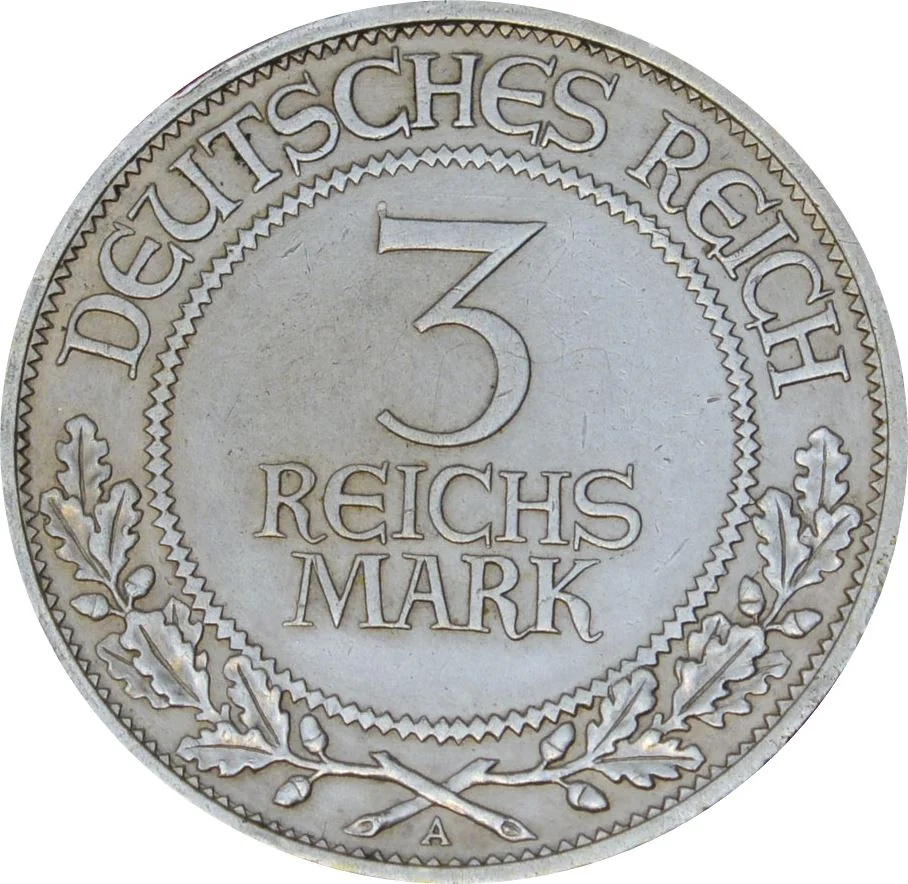
Obverse
Description:
Circle mark, leaf spray.
Inscription:
DEUTSCHES REICH
3 REICHS
MARK
A
3 REICHS
MARK
A
Translation:
GERMAN REICH
3 REICHS
MARK
A
3 REICHS
MARK
A
Language: German
Reverse
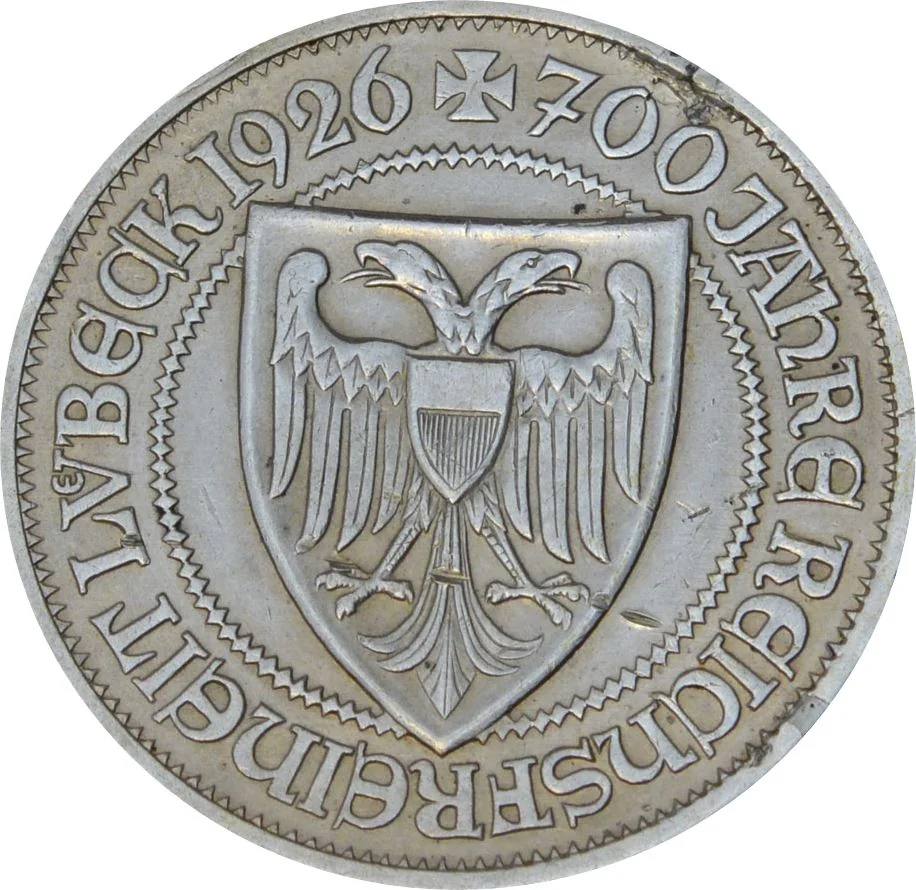
Description:
Double-headed eagle on a shield, dates above, within a circle.
Inscription:
700 JAHRE REICHSFREIHEIT LÜBECK 1926
Translation:
700 YEARS OF IMPERIAL FREEDOM LÜBECK 1926
Language: German
Edge
Lettering:EINIGKEIT UND RECHT UND FREIHEIT
Legend:
EINIGKEIT UND RECHT UND FREIHEIT
Translation:
Unity and Justice and Freedom
Language: German
Mintings
| Year | Mint Mark | Mintage | Quality | Collection |
|---|---|---|---|---|
| 1926 | A | 200,000 | ||
| 1926 | A | — | Proof |
Historical background
By 1926, Germany was in a period of fragile stabilization following the catastrophic hyperinflation of 1923. The old Reichsmark, rendered worthless, had been replaced in late 1924 by the new, mortgage-backed Rentenmark and then the fully gold-convertible Reichsmark, under the Dawes Plan. This plan, orchestrated by international (primarily American) financiers, restructured reparations payments and provided massive foreign loans. Consequently, the currency itself was stable, and the economy was experiencing a period of relative growth known as the "Golden Twenties."
However, this stability was superficial and built on precarious foundations. The German economy was fundamentally dependent on the continuous inflow of short-term American loans to service its reparations obligations and finance public works. This created a dangerous cycle of borrowing to pay debts, making the entire financial system vulnerable to any withdrawal of foreign capital. Furthermore, while price stability had returned, the social trauma of hyperinflation lingered deeply; it had wiped out the savings of the middle class and cemented a profound distrust of financial institutions and the Weimar Republic itself.
Therefore, the currency situation in 1926 was one of calm on the surface but underlying structural peril. The Reichsbank, under Hjalmar Schacht, maintained strict discipline to defend the new currency's value. Yet, the fundamental imbalances—reparations, dependency on foreign capital, and political fragility—remained unresolved. This apparent normality was a brief interlude, setting the stage for the severe financial crises that would follow the 1929 Wall Street Crash, when American loans were abruptly recalled.
However, this stability was superficial and built on precarious foundations. The German economy was fundamentally dependent on the continuous inflow of short-term American loans to service its reparations obligations and finance public works. This created a dangerous cycle of borrowing to pay debts, making the entire financial system vulnerable to any withdrawal of foreign capital. Furthermore, while price stability had returned, the social trauma of hyperinflation lingered deeply; it had wiped out the savings of the middle class and cemented a profound distrust of financial institutions and the Weimar Republic itself.
Therefore, the currency situation in 1926 was one of calm on the surface but underlying structural peril. The Reichsbank, under Hjalmar Schacht, maintained strict discipline to defend the new currency's value. Yet, the fundamental imbalances—reparations, dependency on foreign capital, and political fragility—remained unresolved. This apparent normality was a brief interlude, setting the stage for the severe financial crises that would follow the 1929 Wall Street Crash, when American loans were abruptly recalled.
⭐ Somewhat Rare