

20 dollars – Canada
Add to wishlist
Non-circulating coins
Commemoration: Diamond Jubilee
Canada
Context
Material
Diameter: 38 mm
Weight: 31.39 g
Silver Weight:: 31.39 g
Thickness: 3.1 mm
Shape: Round
Composition: 99.99% Silver
Standard: Silver ounce
Magnetic: No
Technique: Milled
Alignment: Medal alignment
flip
References
KM: #
Numista: #85863
Value
Exchange value: 20 CAD
Bullion value: $78.65
Inflation-adjusted value: 27.01 CAD
Obverse
Description:
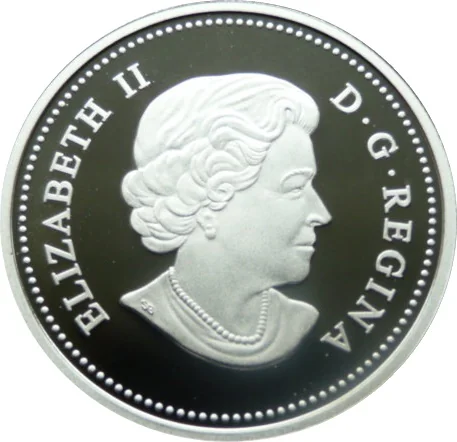
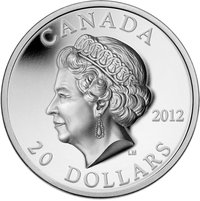
Queen Elizabeth II at 77, facing right, wearing a necklace and earrings.
Inscription:
ELIZABETH II D·G·REGINA
Translation:
Elizabeth II by the Grace of God Queen
Script: Latin
Engraver: Susan Taylor
Designer: Susanna Blunt
Reverse
Description:
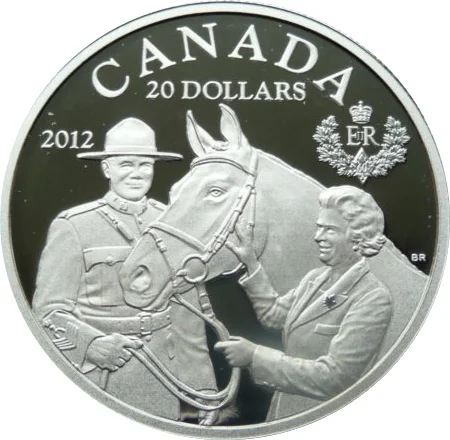
The Queen on Burmese, her horse gifted by the RCMP in 1969. An RCMP officer stands to the left, with the royal cypher above.
Inscription:
CANADA
20 DOLLARS 2012
BR
20 DOLLARS 2012
BR
Script: Latin
Engraver: Cecily Mok
Designer: Bonnie Ross
Edge
Reeded
Mints
| Name | Mark |
|---|---|
| Royal Canadian Mint of Ottawa | — |
Mintings
| Year | Mint Mark | Mintage | Quality | Collection |
|---|---|---|---|---|
| 2012 | — | 11,113 | Proof |
Historical background
In 2012, Canada's currency situation was characterized by a persistently strong Canadian dollar, often trading near or above parity with the US dollar. This "loonie," as it is colloquially known, had maintained this elevated level since late 2010, driven by a combination of high global commodity prices—particularly for oil, minerals, and grains—and relative economic stability that attracted foreign investment. While this strength was a testament to Canada's resilience following the 2008-09 financial crisis, it posed significant challenges for the country's export-oriented manufacturing sector, especially in Ontario and Quebec, which struggled with reduced competitiveness against US goods.
The Bank of Canada, under Governor Mark Carney, faced a delicate balancing act. With the domestic economy showing modest growth and household debt levels rising, there was pressure to keep interest rates low. However, the strong currency itself acted as a drag on economic activity and kept inflation subdued, allowing the Bank to maintain its benchmark interest rate at 1.00% throughout the year after a series of hikes in 2010-2011. This stance was explicitly cautious, with the Bank repeatedly warning that future rate increases would be "less imminent" due to global economic uncertainties, including the European sovereign debt crisis and a slowing US recovery.
Overall, the 2012 currency environment reflected Canada's commodity-linked economy in a period of global uncertainty. The high dollar benefited consumers through lower prices on imported goods and cross-border shopping, while simultaneously squeezing exporters and manufacturers. This dynamic contributed to a multi-speed national economy, where resource-rich western provinces like Alberta thrived, while central Canada's industrial heartland continued its difficult adjustment, setting the stage for ongoing debates about economic diversification and monetary policy.
The Bank of Canada, under Governor Mark Carney, faced a delicate balancing act. With the domestic economy showing modest growth and household debt levels rising, there was pressure to keep interest rates low. However, the strong currency itself acted as a drag on economic activity and kept inflation subdued, allowing the Bank to maintain its benchmark interest rate at 1.00% throughout the year after a series of hikes in 2010-2011. This stance was explicitly cautious, with the Bank repeatedly warning that future rate increases would be "less imminent" due to global economic uncertainties, including the European sovereign debt crisis and a slowing US recovery.
Overall, the 2012 currency environment reflected Canada's commodity-linked economy in a period of global uncertainty. The high dollar benefited consumers through lower prices on imported goods and cross-border shopping, while simultaneously squeezing exporters and manufacturers. This dynamic contributed to a multi-speed national economy, where resource-rich western provinces like Alberta thrived, while central Canada's industrial heartland continued its difficult adjustment, setting the stage for ongoing debates about economic diversification and monetary policy.
💎 Extremely Rare