

100 Kina (Independence) – Papua New Guinea
Non-circulating coins
Commemoration: 5th Anniversary of Independence
Papua New Guinea
Context

Material

References
KM: #Click to copy to clipboard17
Numista: #85721
Value
Exchange value: 100 PGK
Bullion value: $1438.68
Obverse
Description:
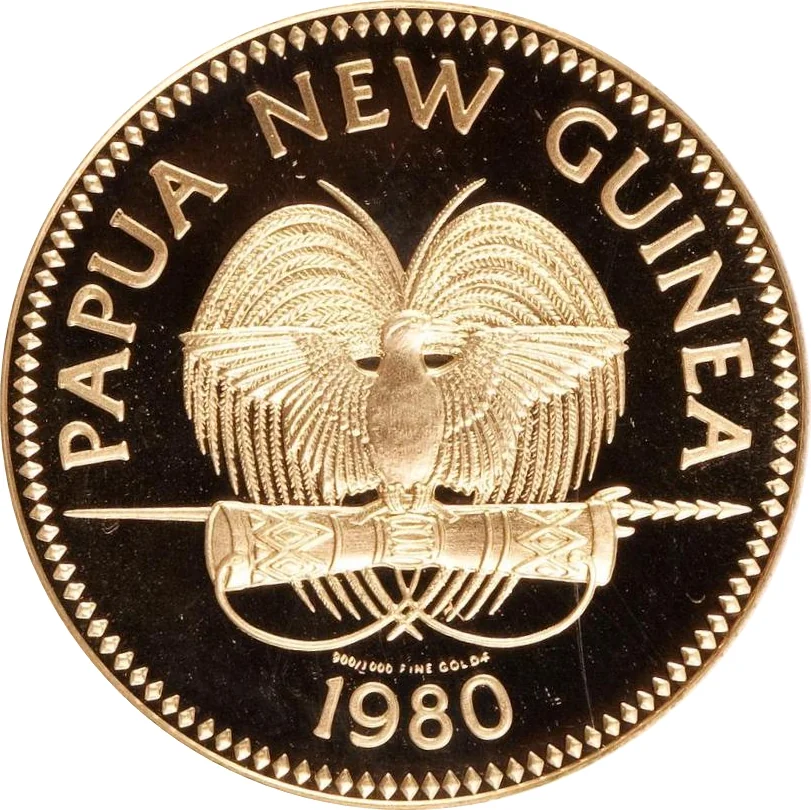
A bird-of-paradise above a spear and kundu drum.
Inscription:
PAPUA NEW GUINEA
900/1000 FINE GOLD FM
1980
900/1000 FINE GOLD FM
1980
Script: Latin
Reverse
Description:
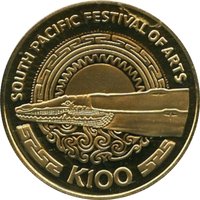
Value over map and flag.
Inscription:
5th ANNIVERSARY OF INDEPENDENCE
K100
K100
Script: Latin
Edge
Reeded
Mintings
| Year | Mint Mark | Mintage | Quality | Collection |
|---|---|---|---|---|
| 1980 | FM | 30 | Matte | |
| 1980 | FM | 1,118 | Proof |
Historical background
In 1980, Papua New Guinea (PNG) was a young nation navigating its economic sovereignty, having gained independence from Australia just five years earlier in 1975. Its currency, the kina (divided into 100 toea), was introduced in 1975 to replace the Australian dollar and symbolise this new autonomy. The initial exchange rate was set at par with the Australian dollar (1 kina = 1 AUD), and the currency was pegged to a basket of currencies, primarily weighted towards the Australian dollar. This arrangement aimed to provide stability for a developing economy heavily reliant on imports and foreign investment, while also managing the inflationary pressures common in a nation with a large, informal subsistence sector.
The economic backdrop of 1980 was one of cautious optimism tempered by structural challenges. The early post-independence years saw a boom in commodity exports, particularly copper from the massive Bougainville mine, which provided crucial government revenue and foreign exchange. However, this also created a vulnerability to global price swings and a "dual economy" where the modern mining sector existed alongside widespread rural subsistence. Inflation was a persistent concern, influenced by both domestic spending and imported price rises. The government and the Bank of Papua New Guinea, established in 1973, faced the delicate task of using monetary policy to foster growth while maintaining the kina's external value and controlling inflation.
Overall, the currency situation in 1980 was characterised by relative stability under its managed peg, but underlying pressures were evident. The kina's value was artificially supported, masking longer-term competitiveness issues. The economy's dependence on a narrow range of volatile commodity exports posed a risk to the balance of payments and, by extension, to the fixed exchange rate regime. Thus, while the kina successfully established itself as a national symbol, the year 1980 represented a period of calm before the more pronounced economic difficulties and eventual shift to a floating exchange rate that would emerge in the following decades.
The economic backdrop of 1980 was one of cautious optimism tempered by structural challenges. The early post-independence years saw a boom in commodity exports, particularly copper from the massive Bougainville mine, which provided crucial government revenue and foreign exchange. However, this also created a vulnerability to global price swings and a "dual economy" where the modern mining sector existed alongside widespread rural subsistence. Inflation was a persistent concern, influenced by both domestic spending and imported price rises. The government and the Bank of Papua New Guinea, established in 1973, faced the delicate task of using monetary policy to foster growth while maintaining the kina's external value and controlling inflation.
Overall, the currency situation in 1980 was characterised by relative stability under its managed peg, but underlying pressures were evident. The kina's value was artificially supported, masking longer-term competitiveness issues. The economy's dependence on a narrow range of volatile commodity exports posed a risk to the balance of payments and, by extension, to the fixed exchange rate regime. Thus, while the kina successfully established itself as a national symbol, the year 1980 represented a period of calm before the more pronounced economic difficulties and eventual shift to a floating exchange rate that would emerge in the following decades.
✨ Legendary