

2 marks (Martin Luther) – Germany
Add to wishlist
Circulating commemorative coins
Commemoration: 450th Anniversary of Birth of Martin Luther
Germany
Obverse
Description:
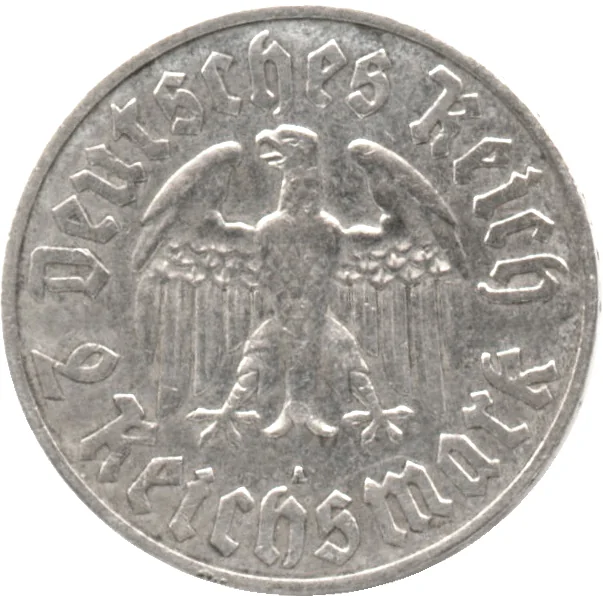
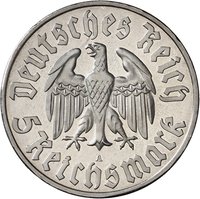
Eagle over value.
Inscription:
Deutsches Reich
2 Reichsmark
A
2 Reichsmark
A
Translation:
German Empire
2 Reichsmarks
2 Reichsmarks
Language: German
Reverse
Description:
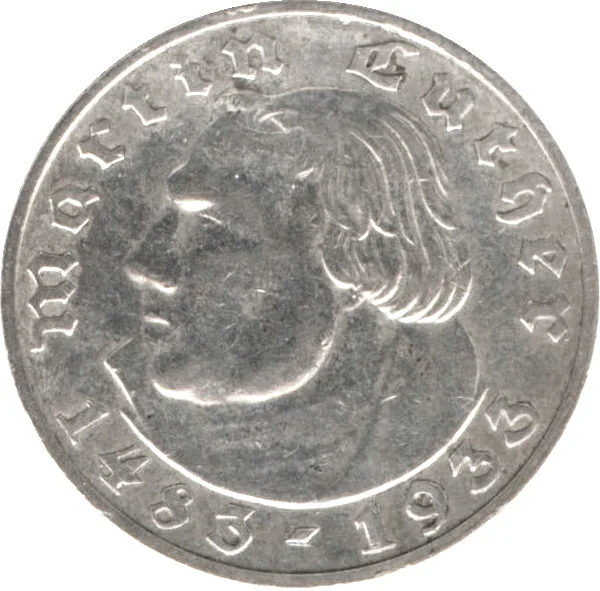
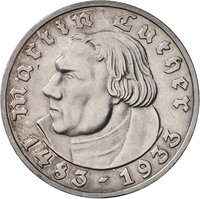
Left, dates down.
Inscription:
Martin Luther
1483 - 1933
1483 - 1933
Edge
Smooth with inscriptions
Legend:
EIN FESTE BURG IST UNSER GOTT
Translation:
A mighty fortress is our God
Language: German
Mintings
| Year | Mint Mark | Mintage | Quality | Collection |
|---|---|---|---|---|
| 1933 | G | — | Proof | |
| 1933 | A | 541,900 | ||
| 1933 | A | — | Proof | |
| 1933 | D | 140,600 | ||
| 1933 | D | — | Proof | |
| 1933 | E | 74,500 | ||
| 1933 | F | 100,300 | ||
| 1933 | F | — | Proof | |
| 1933 | G | 61,100 | ||
| 1933 | E | — | Proof | |
| 1933 | J | 81,700 | ||
| 1933 | J | — | Proof |
Historical background
In 1933, when Adolf Hitler and the Nazi Party came to power, Germany’s currency was superficially stable but fundamentally fragile and operating under severe constraints. The hyperinflation of 1923 had been ended by the introduction of the Rentenmark, later solidified as the Reichsmark, and backed by the Dawes and Young Plans which provided foreign loans. However, the Great Depression had triggered massive capital flight, a banking crisis in 1931, and soaring unemployment. While the immediate inflationary trauma was a decade past, the economy was depressed, and the currency’s stability was heavily dependent on strict capital controls and the management of foreign debt, leaving little room for domestic economic stimulus.
The Nazi regime’s immediate priority was to reduce unemployment and rearm, but it faced a critical shortage of foreign currency (Devisen) needed to import raw materials. To address this, the government implemented a system of strict autarky and complex currency controls under Hjalmar Schacht, President of the Reichsbank. The "New Plan" of 1934 instituted a system of bilateral trade agreements and used artificial accounting units like "aski marks" to trade with nations without spending scarce gold or convertible currency. This created a labyrinth of special marks with different values, effectively isolating the domestic Reichsmark from international markets to conserve resources for rearmament.
Consequently, by 1933-34, Germany had a dual currency system: a controlled and stable Reichsmark for domestic use, maintained through wage and price controls, and a separate, constrained system for foreign trade. This financial isolation allowed the regime to fund massive public works and rearmament without initially triggering hyperinflation, but it did so by accumulating hidden debt through instruments like the Mefo bills and sacrificing consumer goods production. The currency situation was thus a manipulated construct, designed to serve the regime’s political and military goals while masking underlying economic imbalances that would ultimately prove unsustainable.
The Nazi regime’s immediate priority was to reduce unemployment and rearm, but it faced a critical shortage of foreign currency (Devisen) needed to import raw materials. To address this, the government implemented a system of strict autarky and complex currency controls under Hjalmar Schacht, President of the Reichsbank. The "New Plan" of 1934 instituted a system of bilateral trade agreements and used artificial accounting units like "aski marks" to trade with nations without spending scarce gold or convertible currency. This created a labyrinth of special marks with different values, effectively isolating the domestic Reichsmark from international markets to conserve resources for rearmament.
Consequently, by 1933-34, Germany had a dual currency system: a controlled and stable Reichsmark for domestic use, maintained through wage and price controls, and a separate, constrained system for foreign trade. This financial isolation allowed the regime to fund massive public works and rearmament without initially triggering hyperinflation, but it did so by accumulating hidden debt through instruments like the Mefo bills and sacrificing consumer goods production. The currency situation was thus a manipulated construct, designed to serve the regime’s political and military goals while masking underlying economic imbalances that would ultimately prove unsustainable.
🌱 Common