

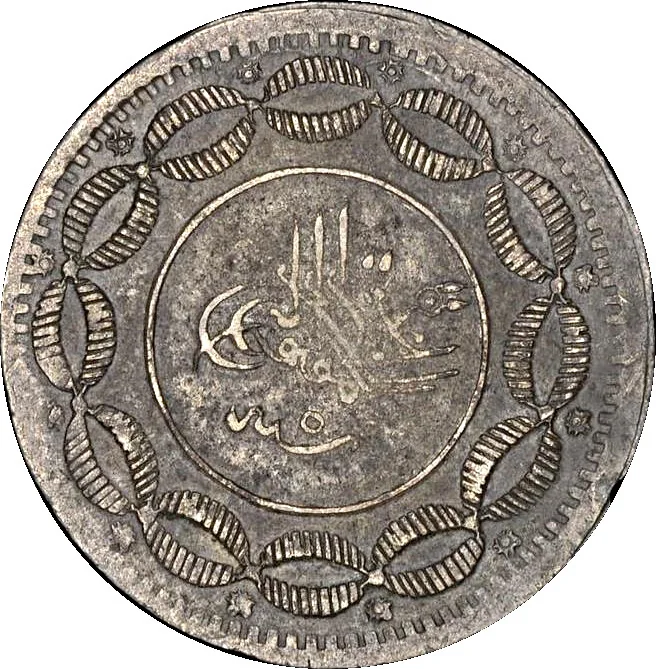
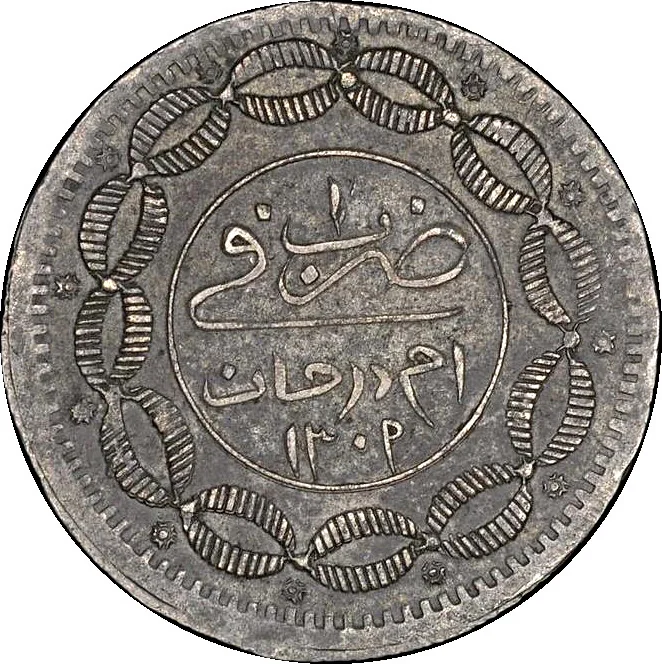
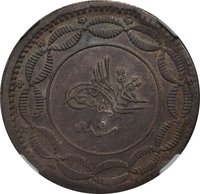
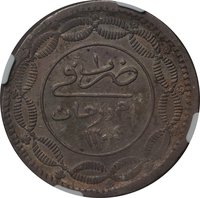
20 qirsh – Mahdist State
Add to wishlist
Sudan
Context
Year: 1892
Islamic (Hijri) Year:: 1309
Country: Sudan
Issuer: Mahdist State
Currency:
(1885—1898)
Demonetized: Yes
Material
References
KM: #
Numista: #114508
Mints
| Name | Mark |
|---|---|
| Omdurman | — |
Mintings
| Year | Mint Mark | Mintage | Quality | Collection |
|---|---|---|---|---|
| 1892 | — | — |
Historical background
By 1892, the Mahdist State (the Sudan) faced a severe and deteriorating currency crisis, a direct result of its economic isolation and the fiscal policies of the Khalifa Abdullahi. The state had cut itself off from the Ottoman-Egyptian financial system, rejecting Egyptian currency and failing to establish a trusted alternative. While the Mahdists minted their own gold and silver coins, notably the Riyal Mahdi, these were produced in insufficient quantities and with inconsistent purity, leading to widespread public distrust. Consequently, the economy regressed to a primitive system relying heavily on barter, Ottoman-Majidi coins (which retained value due to their reliable silver content), and even traditional commodity monies like cotton cloth (dammur) and slaves.
The crisis was exacerbated by the state’s relentless military demands and administrative failures. The treasury (Bayt al-Mal) was chronically depleted by the costs of maintaining large armies and feeding the population in the capital, Omdurman, especially after the famine of 1889-90. To raise revenue, the Khalifa imposed heavy taxes and confiscations, but this further drained the circulating currency from the general populace. Counterfeiting of the already dubious official coinage became rampant, further eroding confidence. The economy became increasingly localized and stagnant, with long-distance trade severely hampered by the lack of a reliable medium of exchange.
Ultimately, the currency situation reflected the broader collapse of the Mahdist administrative project. The state’s inability to provide a stable monetary system undermined its authority and crippled its capacity to govern effectively. By 1892, the financial disorder was a critical vulnerability, weakening the Mahdist State from within as it faced growing external threats, most notably from the reconquest forces of Anglo-Egyptian forces that would ultimately topple the regime six years later. The monetary chaos was both a symptom and a cause of the state’s progressive economic disintegration.
The crisis was exacerbated by the state’s relentless military demands and administrative failures. The treasury (Bayt al-Mal) was chronically depleted by the costs of maintaining large armies and feeding the population in the capital, Omdurman, especially after the famine of 1889-90. To raise revenue, the Khalifa imposed heavy taxes and confiscations, but this further drained the circulating currency from the general populace. Counterfeiting of the already dubious official coinage became rampant, further eroding confidence. The economy became increasingly localized and stagnant, with long-distance trade severely hampered by the lack of a reliable medium of exchange.
Ultimately, the currency situation reflected the broader collapse of the Mahdist administrative project. The state’s inability to provide a stable monetary system undermined its authority and crippled its capacity to govern effectively. By 1892, the financial disorder was a critical vulnerability, weakening the Mahdist State from within as it faced growing external threats, most notably from the reconquest forces of Anglo-Egyptian forces that would ultimately topple the regime six years later. The monetary chaos was both a symptom and a cause of the state’s progressive economic disintegration.
✨ Legendary