

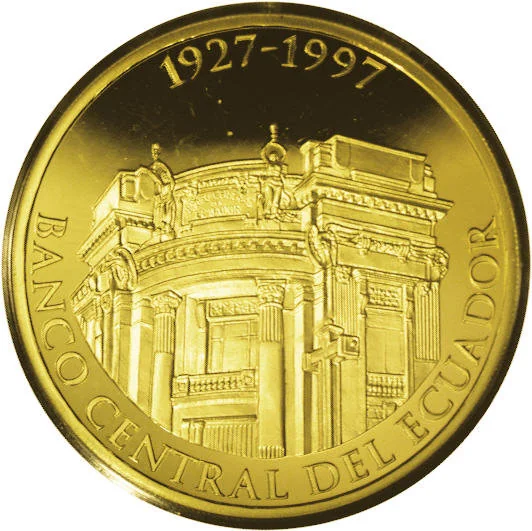
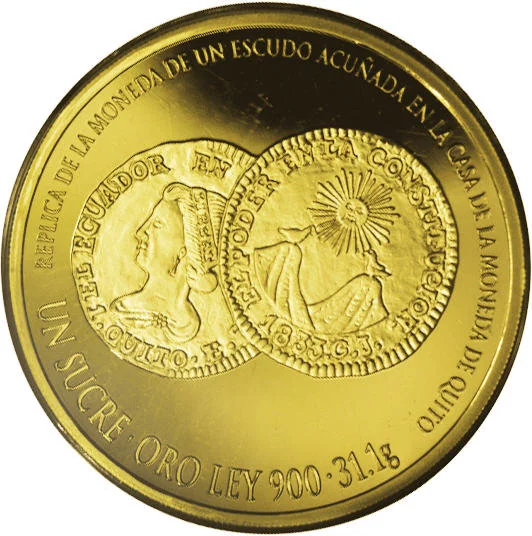
1 sucre (Central Bank) – Ecuador
Add to wishlist
Non-circulating coins
Commemoration: Central Bank's 70th Anniversary
Ecuador
Context
Material
Diameter: 40 mm
Weight: 31.1 g
Gold Weight:: 27.99 g
Shape: Round
Composition: 90% Gold
Standard: Silver ounce
Magnetic: No
Technique: Milled
Alignment: Coin alignment
flip
References
KM: #
Numista: #85082
Value
Exchange value: 1 ECS
Bullion value: $4294.14
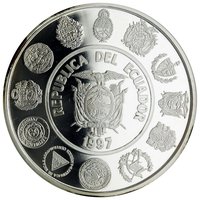
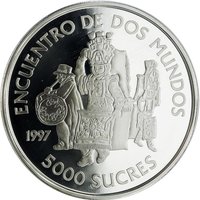
Obverse
Reverse
Description:
Overlapping obverse (Liberty Head) and reverse (sun over mountains with birds) designs of the 1833 Quito gold escudo (KM#15).
Inscription:
REPLICA DE LA MONEDA DE UN ESCUDO ACUÑADA EN LA CASA DE LA MONEDA DE QUITO
UN SUCRE * ORO LEY 900 * 31.1g
UN SUCRE * ORO LEY 900 * 31.1g
Translation:
REPLICA OF THE ONE SHIELD COIN STRUCK AT THE QUITO MINT
ONE SUCRE * GOLD FINENESS 900 * 31.1g
ONE SUCRE * GOLD FINENESS 900 * 31.1g
Script: Latin
Language: Spanish
Edge
Reeded
Mintings
| Year | Mint Mark | Mintage | Quality | Collection |
|---|---|---|---|---|
| 1997 | — | 2,000 | Proof |
Historical background
In 1997, Ecuador was in the late stages of a profound economic crisis that would culminate just two years later. The national currency, the sucre, was under severe and accelerating pressure, characterized by chronic devaluation and hyperinflation. This instability was rooted in a combination of external shocks, like the El Niño weather phenomenon and a drop in global oil prices, and deep-seated domestic issues including fiscal deficits, banking sector fragility, and political instability that prevented consistent economic policy. By the mid-1990s, the sucre's value was in freefall, eroding purchasing power and public confidence.
The government's response throughout 1997 was a desperate attempt to stabilize the currency through conventional measures, but these proved ineffective. Authorities implemented a crawling peg exchange rate regime, where the sucre was allowed to depreciate within a narrow, pre-announced band. However, defending this peg required high interest rates and the rapid depletion of already scarce foreign reserves. This period was also marked by significant dollarization of the economy de facto, as businesses and wealthy individuals increasingly conducted transactions and held savings in U.S. dollars to hedge against the sucre's collapse, further undermining the national currency.
Ultimately, the measures of 1997 were a holding action against an inevitable catastrophe. The banking system began to falter under the strain, leading to a major crisis in 1998-1999. With reserves exhausted and having lost all monetary policy credibility, the government abandoned the crawling peg in early 1999, leading to the sucre's final, dramatic collapse. This paved the way for the radical official adoption of the U.S. dollar as legal tender in January 2000, a move that ended the era of the sucre but was born from the failed stabilization efforts of the preceding years, including those of 1997.
The government's response throughout 1997 was a desperate attempt to stabilize the currency through conventional measures, but these proved ineffective. Authorities implemented a crawling peg exchange rate regime, where the sucre was allowed to depreciate within a narrow, pre-announced band. However, defending this peg required high interest rates and the rapid depletion of already scarce foreign reserves. This period was also marked by significant dollarization of the economy de facto, as businesses and wealthy individuals increasingly conducted transactions and held savings in U.S. dollars to hedge against the sucre's collapse, further undermining the national currency.
Ultimately, the measures of 1997 were a holding action against an inevitable catastrophe. The banking system began to falter under the strain, leading to a major crisis in 1998-1999. With reserves exhausted and having lost all monetary policy credibility, the government abandoned the crawling peg in early 1999, leading to the sucre's final, dramatic collapse. This paved the way for the radical official adoption of the U.S. dollar as legal tender in January 2000, a move that ended the era of the sucre but was born from the failed stabilization efforts of the preceding years, including those of 1997.
✨ Legendary