

2 Kroner – Denmark
Denmark
Context
Years: 1875–1899
Issuer: Denmark 
Ruler: Christian IX
Currency:
(since 1873)
Total mintage: 5,080,000
Material
References
KM: #Click to copy to clipboard798
Numista: #8493
Value
Exchange value: 2 DKK = $0.32
Bullion value: $34.34
Obverse
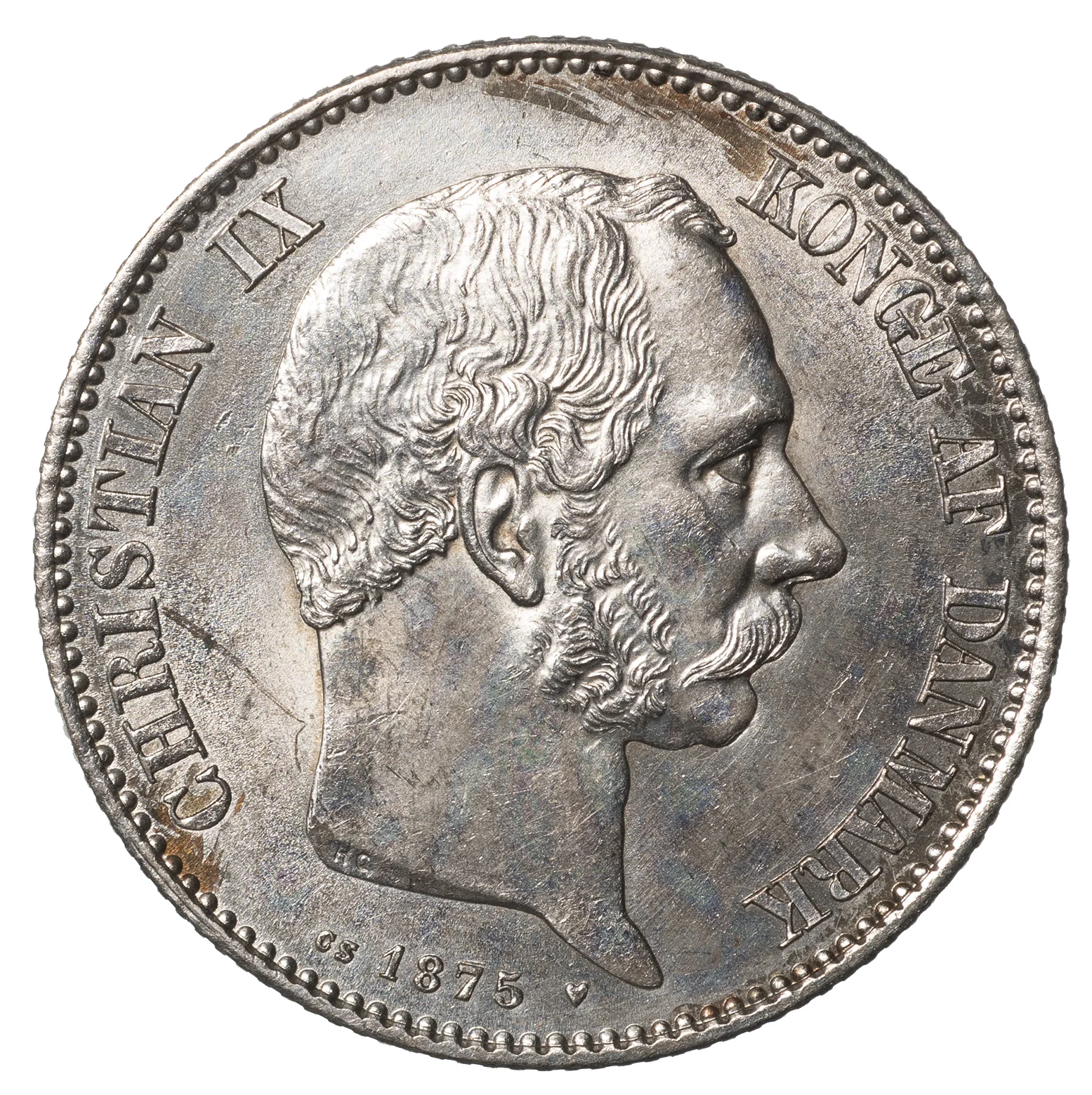
Description:
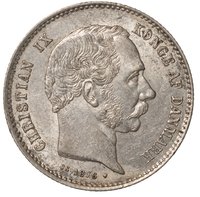
Christian IX, left-facing portrait.
Inscription:
CHRISTIAN IX
KONGE AF DANMARK
HG
CS 1876
KONGE AF DANMARK
HG
CS 1876
Translation:
Christian IX
King of Denmark
HG
CS 1876
King of Denmark
HG
CS 1876
Script: Latin
Engraver: Harald Conradsen (HC)
Reverse
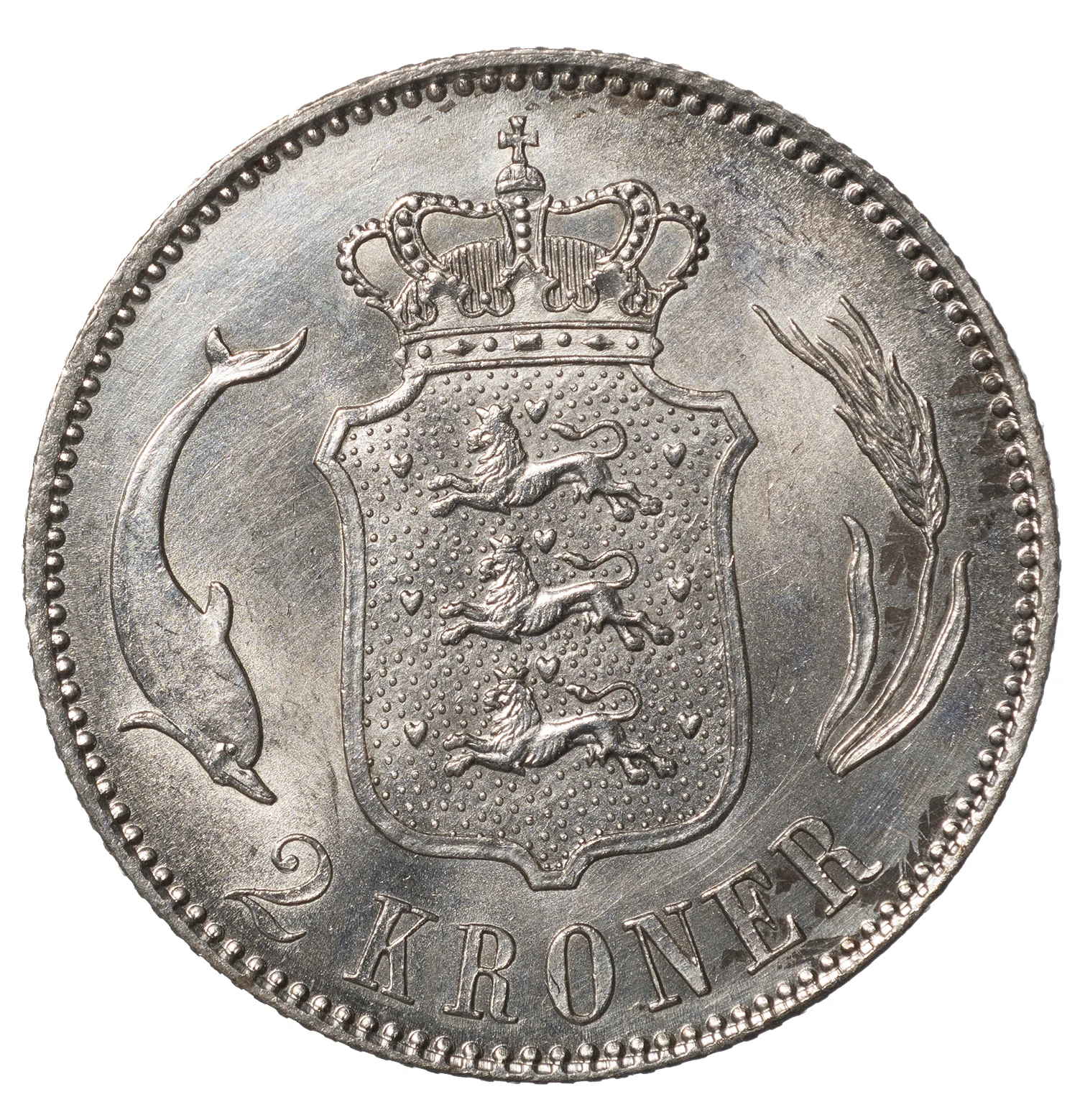
Description:
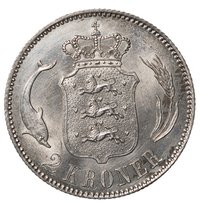
Danish coat of arms flanked by a porpoise and barley stalk, with denomination below.
Inscription:
2 KRONER
Script: Latin
Engraver: Harald Conradsen (HC)
Edge
Reeded
Mints
| Name | Mark |
|---|---|
| Royal Danish Mint | — |
Mintings
| Year | Mint Mark | Mintage | Quality | Collection |
|---|---|---|---|---|
| 1875 | HC/CS | 3,396,000 | ||
| 1876 | HC/CS | 1,381,000 | ||
| 1876 | HC/CS | — | Proof | |
| 1897 | HC/VBP | 151,000 | ||
| 1899 | HC/VBP | 152,000 |
Historical background
In 1875, Denmark undertook a decisive monetary reform that replaced its centuries-old and complex currency system with a single, modern national currency: the Danish krone. Prior to this, the country operated on the rigsdaler, a unit divided into 96 skilling, a system that was cumbersome for both domestic commerce and international trade. This fragmentation, alongside the broader Scandinavian movement towards economic integration and the global trend of adopting the gold standard, created strong impetus for change.
The reform, enacted by the Currency Act of 1873 (with implementation in 1875), established the krone as Denmark's official currency, subdivided into 100 øre. Crucially, Denmark joined Sweden and Norway in forming the Scandinavian Monetary Union (SMU), whereby all three nations adopted currencies with the same name (krone/krona) and an identical gold standard. This meant their currencies were fixed to a specific weight of gold and were intended to circulate freely across borders, facilitating trade and economic cooperation within the region.
Thus, the currency situation in Denmark in 1875 was one of transition and alignment. The old rigsdaler and skilling were being phased out in favor of the new, decimal-based krone. The reform was not merely a domestic change but a strategic integration into a wider Nordic economic bloc. While the political union of the SMU later dissolved in the early 20th century, the monetary framework proved enduring, leaving Denmark with the stable and familiar krone that remains its currency today.
The reform, enacted by the Currency Act of 1873 (with implementation in 1875), established the krone as Denmark's official currency, subdivided into 100 øre. Crucially, Denmark joined Sweden and Norway in forming the Scandinavian Monetary Union (SMU), whereby all three nations adopted currencies with the same name (krone/krona) and an identical gold standard. This meant their currencies were fixed to a specific weight of gold and were intended to circulate freely across borders, facilitating trade and economic cooperation within the region.
Thus, the currency situation in Denmark in 1875 was one of transition and alignment. The old rigsdaler and skilling were being phased out in favor of the new, decimal-based krone. The reform was not merely a domestic change but a strategic integration into a wider Nordic economic bloc. While the political union of the SMU later dissolved in the early 20th century, the monetary framework proved enduring, leaving Denmark with the stable and familiar krone that remains its currency today.
🌱 Common