

4 Pfennigs – Germany
Germany
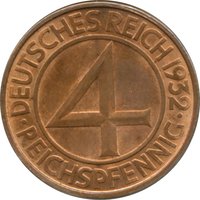
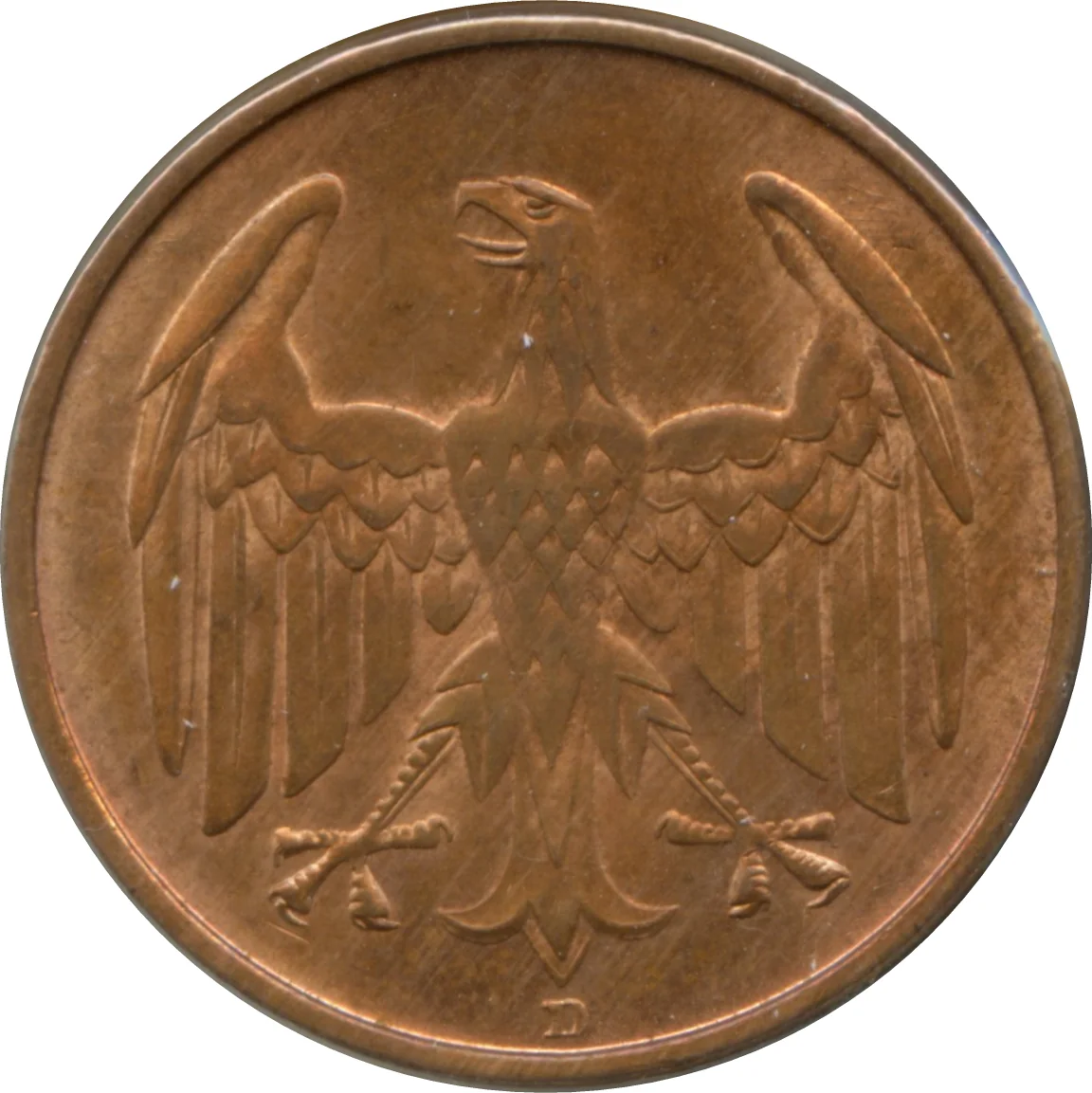
Obverse
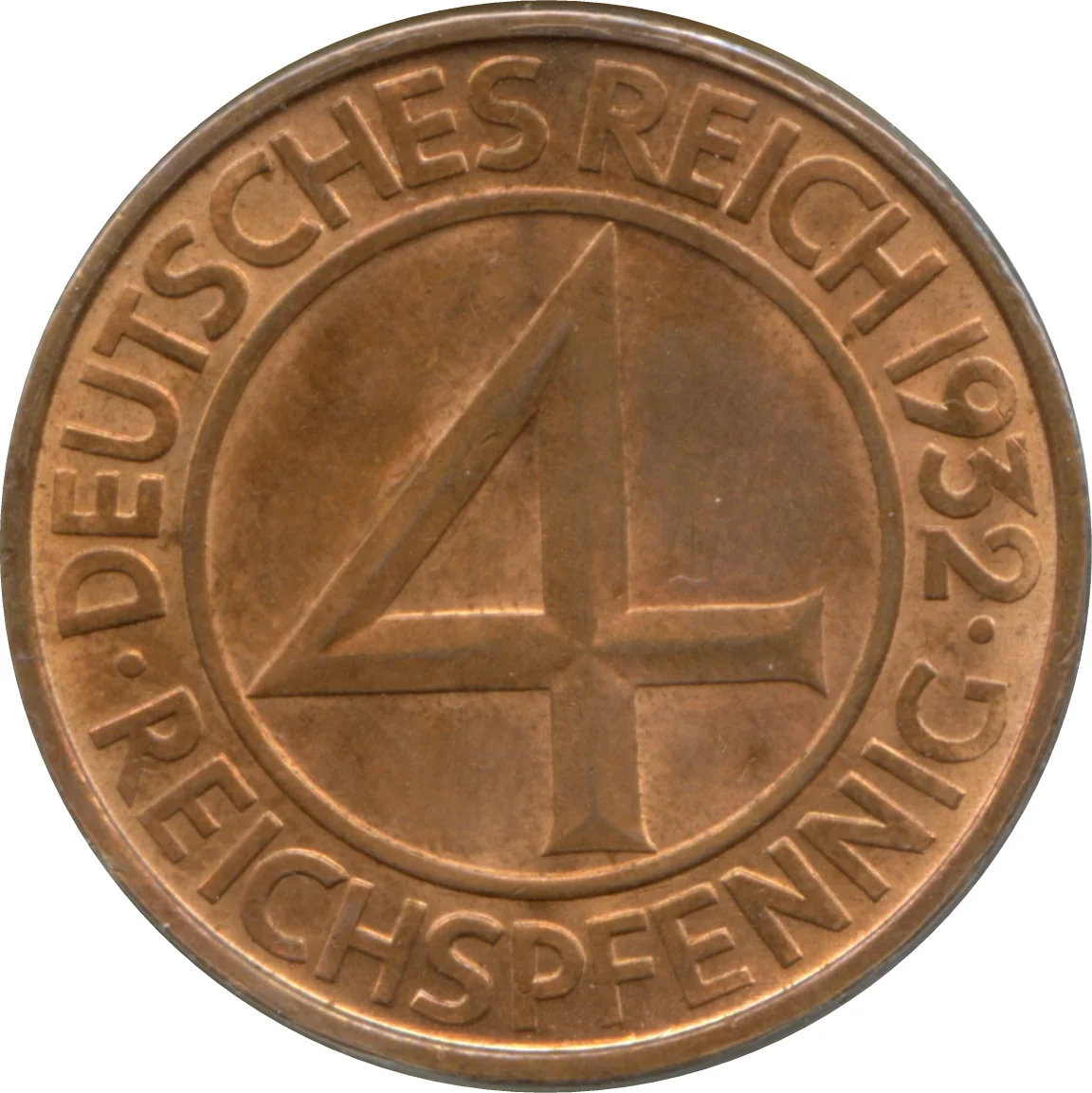
Reverse
Description:
Central numerical value.
Inscription:
DEUTSCHES REICH 1932
4
REICHSPFENNIG
4
REICHSPFENNIG
Translation:
German Reich 1932
4
Reichspfennig
4
Reichspfennig
Script: Latin
Language: German
Engraver: Reinhard Kullrich
Edge
Plain
Mints
| Name | Mark |
|---|---|
| Berlin | A |
| Munich | D |
| Muldenhütten | E |
| Staatliche Münze Baden-Württemberg | F |
| Staatliche Münze Baden-Württemberg | G |
| Hamburgische Münze | J |
Mintings
Historical background
By 1932, Germany’s currency situation was defined not by hyperinflation—that had ended in 1924—but by the catastrophic deflation and banking crisis of the Great Depression. The Reichsmark, stabilized after the 1923 disaster, was now shackled by the gold standard and the punishing reparations schedule from the Young Plan. As foreign loans were abruptly withdrawn following the 1929 Wall Street Crash, the German economy contracted violently. Businesses failed, tax revenues collapsed, and unemployment soared to over six million, creating a desperate cycle of falling prices, wages, and demand.
The government of Chancellor Heinrich Brüning, determined to avoid inflation at all costs and to prove Germany could not pay reparations, enforced a brutal policy of austerity. He raised taxes, slashed public spending and welfare benefits, and defended the Reichsmark’s parity through deflationary pressure. This "hunger policy" deliberately deepened the depression, wiping out savings and pushing the middle and working classes into poverty. The banking system began to buckle under the strain of failing loans and a loss of confidence, culminating in the collapse of major banks in the summer of 1931.
Consequently, strict capital controls were imposed, and the Reichsmark was effectively split into different types with varying values for different purposes, creating a complex system of blocked accounts. While the physical currency remained stable, its economic foundation was crumbling. This environment of mass unemployment, social despair, and perceived betrayal by the Weimar Republic created the fertile ground for political extremism, paving the way for the Nazi Party’s electoral breakthroughs and the eventual end of democratic government.
The government of Chancellor Heinrich Brüning, determined to avoid inflation at all costs and to prove Germany could not pay reparations, enforced a brutal policy of austerity. He raised taxes, slashed public spending and welfare benefits, and defended the Reichsmark’s parity through deflationary pressure. This "hunger policy" deliberately deepened the depression, wiping out savings and pushing the middle and working classes into poverty. The banking system began to buckle under the strain of failing loans and a loss of confidence, culminating in the collapse of major banks in the summer of 1931.
Consequently, strict capital controls were imposed, and the Reichsmark was effectively split into different types with varying values for different purposes, creating a complex system of blocked accounts. While the physical currency remained stable, its economic foundation was crumbling. This environment of mass unemployment, social despair, and perceived betrayal by the Weimar Republic created the fertile ground for political extremism, paving the way for the Nazi Party’s electoral breakthroughs and the eventual end of democratic government.
🌱 Common