

20 Euro (Michael Collins) – Ireland
Non-circulating coins
Commemoration: 90th anniversary of the death of Michael Collins.
Ireland
Context
Year: 2012
Issuer: Ireland 
Issuing organization: Central bank of Ireland
Period:
(since 1937)
Currency:
(since 2002)
Total mintage: 12,000
Material
References
KM: #Click to copy to clipboard74
Numista: #84546
Value
Exchange value: 20 EUR = $23.63
Bullion value: $83.45
Inflation-adjusted value: 25.63 EUR
Obverse
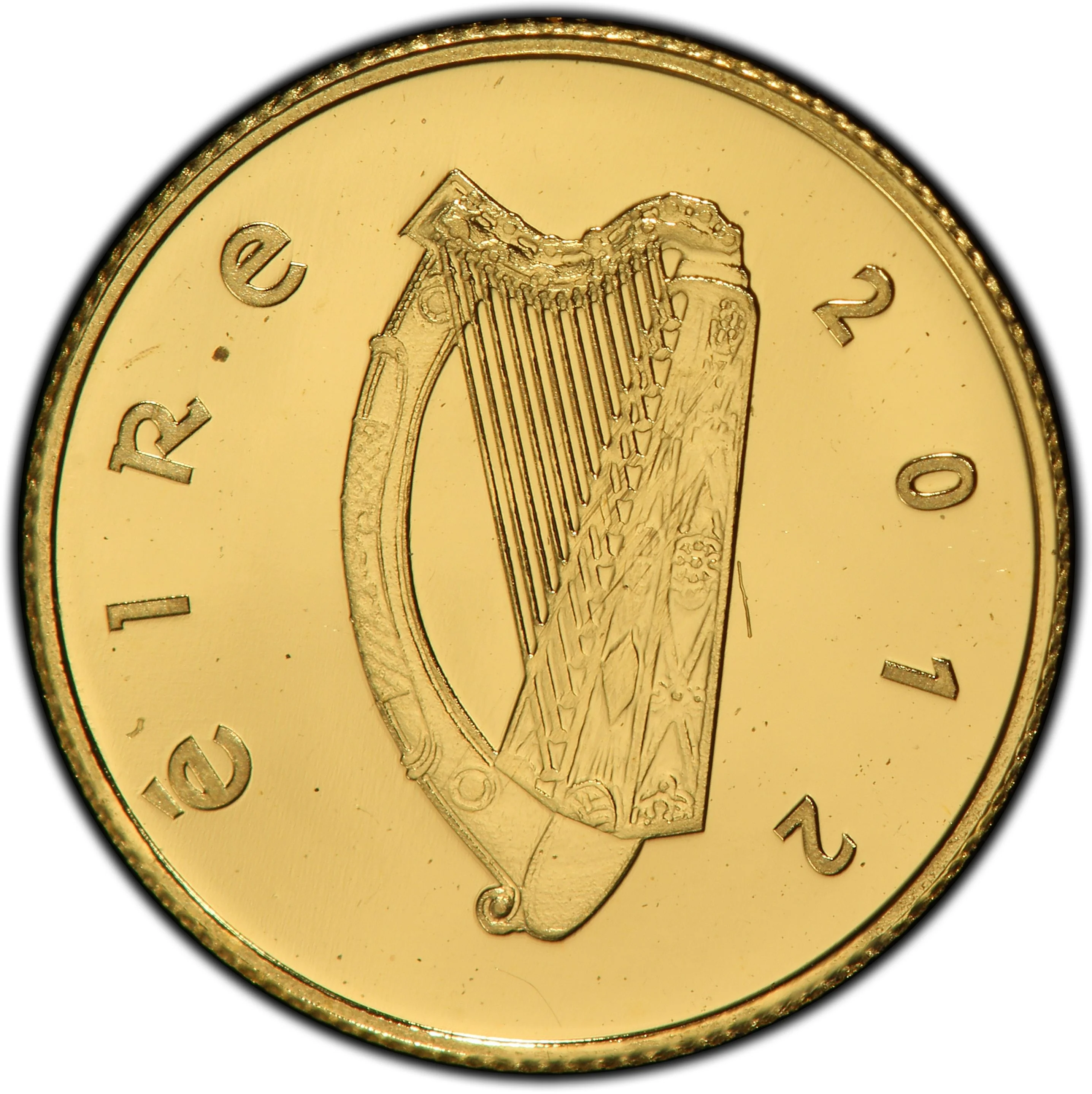
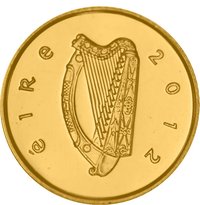
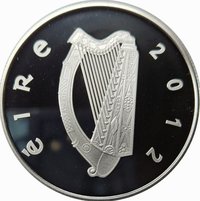
Description:
Harpist
Inscription:
éire 2012
Translation:
Ireland 2012
Script: Latin (Gaelic)
Language: Irish
Reverse
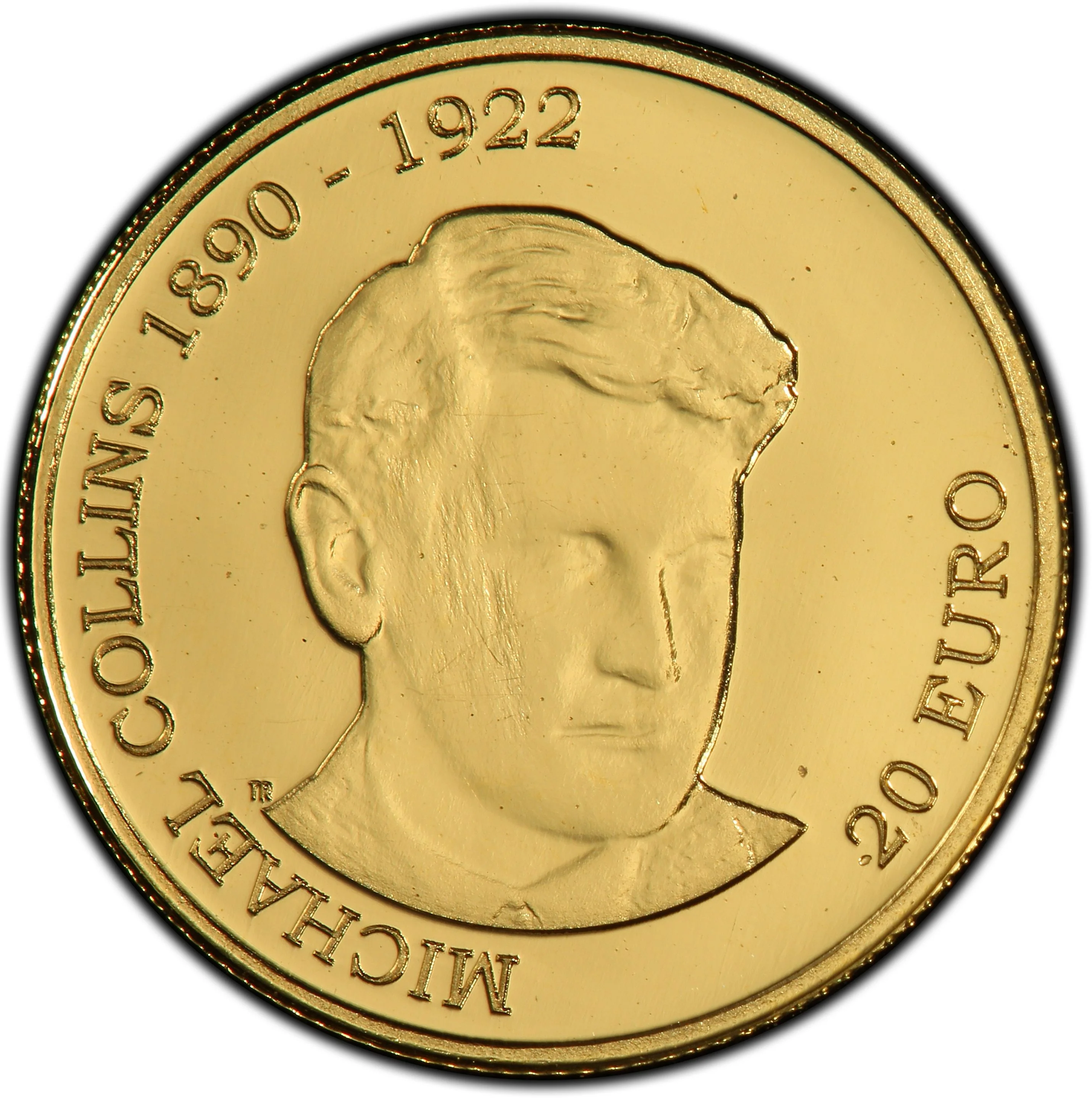
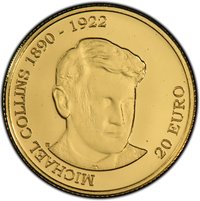
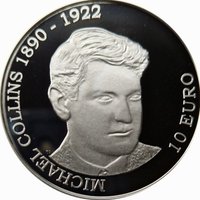
Description:
Apollo 11 Command Module pilot.
Inscription:
MICHAEL COLLINS 1890-1922
TR
TR
Script: Latin
Designer: Thomas Ryan
Edge
Categories
| Event> Death anniversary |
| Event> Independence |
| Person> Military leader |
| Person> Politician |
Mintings
| Year | Mint Mark | Mintage | Quality | Collection |
|---|---|---|---|---|
| 2012 | — | 12,000 | Proof |
Historical background
In 2012, Ireland was in its fifth year of a profound economic and banking crisis, but its currency situation was uniquely stable compared to the turmoil in other Eurozone periphery nations. As a founding member of the Euro, Ireland had used the euro since 1999, meaning it did not face the speculative currency attacks or devaluation fears that plagued countries like the UK. However, the fixed exchange rate within the Eurozone removed a key tool for economic adjustment, forcing all necessary correction onto domestic wages, prices, and severe fiscal austerity, a process known as "internal devaluation."
The core financial context was the aftermath of the EU-IMF bailout programme agreed in late 2010. By 2012, Ireland was midway through implementing this €85 billion rescue package, which was necessitated by the state's catastrophic guarantee of its insolvent banking sector. The currency stability provided by the euro was a double-edged sword: it prevented a bank run and a currency collapse, but it also locked Ireland into a high-interest-rate environment set by the ECB for the entire zone, which was inappropriate for a contracting economy. This exacerbated the deflationary pressure and deep recession.
Consequently, the national debate in 2012 was not about leaving the euro – "Grexit" fears were centred on Greece – but about the harsh social costs of regaining competitiveness within it. The government was focused on meeting stringent bailout targets to return to bond markets, a goal achieved with the successful issuance of a long-term bond in mid-2012. Thus, Ireland's currency situation was one of paradoxical stability within a storm, as the unshakeable peg to the euro provided a framework for a brutal but structured economic adjustment.
The core financial context was the aftermath of the EU-IMF bailout programme agreed in late 2010. By 2012, Ireland was midway through implementing this €85 billion rescue package, which was necessitated by the state's catastrophic guarantee of its insolvent banking sector. The currency stability provided by the euro was a double-edged sword: it prevented a bank run and a currency collapse, but it also locked Ireland into a high-interest-rate environment set by the ECB for the entire zone, which was inappropriate for a contracting economy. This exacerbated the deflationary pressure and deep recession.
Consequently, the national debate in 2012 was not about leaving the euro – "Grexit" fears were centred on Greece – but about the harsh social costs of regaining competitiveness within it. The government was focused on meeting stringent bailout targets to return to bond markets, a goal achieved with the successful issuance of a long-term bond in mid-2012. Thus, Ireland's currency situation was one of paradoxical stability within a storm, as the unshakeable peg to the euro provided a framework for a brutal but structured economic adjustment.
💎 Extremely Rare