

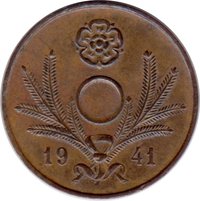
Obverse
Inscription:
1943
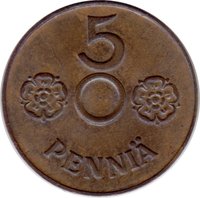
Reverse
Edge
Plain
Mintings
| Year | Mint Mark | Mintage | Quality | Collection |
|---|---|---|---|---|
| 1943 | — | — | ||
| 1944 | — | — | ||
| 1945 | — | — |
Historical background
In 1943, Finland's currency situation was defined by the pressures of the Continuation War (1941-1944) against the Soviet Union, fought alongside Nazi Germany. The Finnish markka (markkaa) was under severe strain due to the enormous costs of warfare, which consumed over half of the state budget. To finance the conflict, the government relied heavily on borrowing from the central bank, the Bank of Finland, effectively printing money. This led to a significant expansion of the money supply, creating powerful inflationary pressures within a tightly controlled wartime economy.
The government attempted to manage this inflation through a comprehensive system of price controls, rationing, and subsidies for essential goods. While these measures prevented the hyperinflation seen in some other warring nations, they created a distorted economy. A thriving black market emerged where goods, especially scarce items like coffee, tobacco, and quality textiles, could be obtained at prices far above official rates. This meant that while the official value of the markka was maintained, its real purchasing power eroded significantly for citizens outside the rationing system or those seeking additional goods.
Furthermore, Finland's international trade was heavily constrained and redirected. Traditional trade routes were severed, and the country became economically dependent on Germany, which provided crucial loans, military supplies, and became the primary market for Finnish exports like timber and nickel. This dependency meant the markka's stability was indirectly linked to the German Reichsmark and the fortunes of the German war effort. Overall, the currency situation in 1943 was one of fragile, state-enforced stability masking underlying monetary expansion and economic distortion, entirely subordinated to the demands of a costly and precarious war.
The government attempted to manage this inflation through a comprehensive system of price controls, rationing, and subsidies for essential goods. While these measures prevented the hyperinflation seen in some other warring nations, they created a distorted economy. A thriving black market emerged where goods, especially scarce items like coffee, tobacco, and quality textiles, could be obtained at prices far above official rates. This meant that while the official value of the markka was maintained, its real purchasing power eroded significantly for citizens outside the rationing system or those seeking additional goods.
Furthermore, Finland's international trade was heavily constrained and redirected. Traditional trade routes were severed, and the country became economically dependent on Germany, which provided crucial loans, military supplies, and became the primary market for Finnish exports like timber and nickel. This dependency meant the markka's stability was indirectly linked to the German Reichsmark and the fortunes of the German war effort. Overall, the currency situation in 1943 was one of fragile, state-enforced stability masking underlying monetary expansion and economic distortion, entirely subordinated to the demands of a costly and precarious war.
✨ Legendary