

5 Won – North Korea
Non-circulating coins
Commemoration: STS Sedov
North Korea
Context
Year: 2005
Issuer: North Korea 
Period:
(since 1948)
Currency:
(1959—2009)
Demonetized: Yes
Total mintage: 5,000
Material
References
KM: #Click to copy to clipboard1085
Numista: #84414
Value
Exchange value: 5 KPW
Bullion value: $57.15
Obverse
Description:
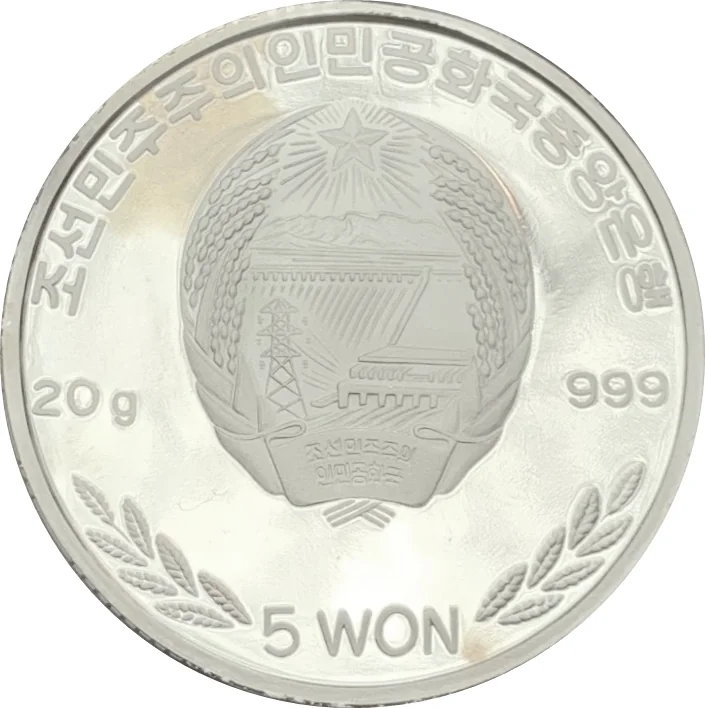
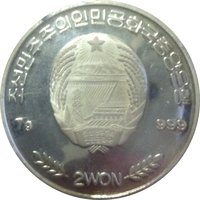
National Coat of Arms with denomination.
Inscription:
조선민주주의인민공화국중앙은행
20g 999
5 WON
20g 999
5 WON
Translation:
DEMOCRATIC PEOPLE'S REPUBLIC OF KOREA CENTRAL BANK
20g 999
5 WON
20g 999
5 WON
Language: Korean
Reverse
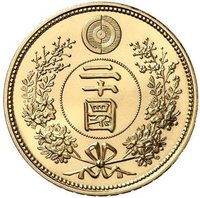
Description:
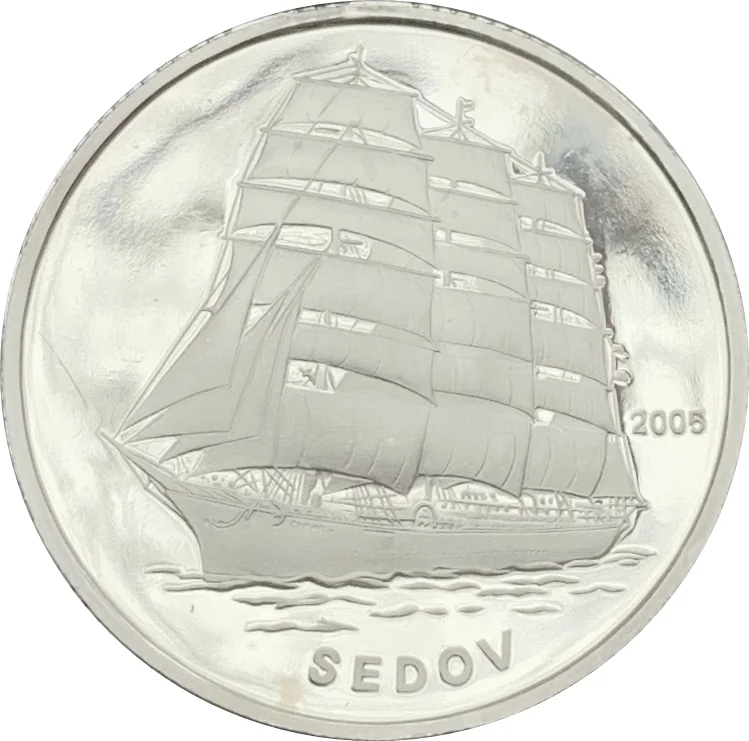
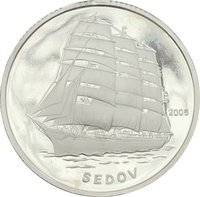
STS Sedov, sailing ship.
Inscription:
2005
SEDOV
SEDOV
Edge
Reeded
Categories
| Transportation> Watercraft |
Mintings
| Year | Mint Mark | Mintage | Quality | Collection |
|---|---|---|---|---|
| 2005 | — | 5,000 | Proof |
Historical background
In 2005, North Korea's currency situation was characterized by extreme state control, severe inflation, and the emergence of a complex dual economy. The official currency, the North Korean won (KPW), was used within the state-planned economy, but its value was artificially set by the government and bore little relation to reality. Hyperinflation had rendered salaries paid in won nearly meaningless for purchasing goods, as the state distribution system (the Public Distribution System) had largely broken down following the famine of the 1990s. This collapse forced the population to rely on informal markets, known as jangmadang, for survival.
Alongside the devalued won, a multi-currency system dominated daily life, with foreign currencies acting as the primary medium for meaningful exchange. The US dollar was the most trusted, but the Chinese yuan and, to a lesser extent, the euro and Japanese yen, were also widely circulated, especially in border regions and markets. This dollarization was tacitly accepted by the state as it facilitated trade and helped stabilize the informal economy. The government even operated official foreign currency stores, selling imported and luxury goods for hard cash, creating a stark divide between those with access to foreign currency and those reliant solely on the worthless won.
The underlying tension of this dual system set the stage for a major economic shock. The regime, viewing the growing private market activity and the erosion of its monetary control as a threat to its authority, was preparing a drastic measure. While the infamous currency redenomination of 2009 was still four years away, the economic conditions of 2005—the worthless official currency, the reliance on foreign money, and the thriving informal markets—were the direct precursors that would eventually lead the government to attempt a radical and disastrous reassertion of control over the economy.
Alongside the devalued won, a multi-currency system dominated daily life, with foreign currencies acting as the primary medium for meaningful exchange. The US dollar was the most trusted, but the Chinese yuan and, to a lesser extent, the euro and Japanese yen, were also widely circulated, especially in border regions and markets. This dollarization was tacitly accepted by the state as it facilitated trade and helped stabilize the informal economy. The government even operated official foreign currency stores, selling imported and luxury goods for hard cash, creating a stark divide between those with access to foreign currency and those reliant solely on the worthless won.
The underlying tension of this dual system set the stage for a major economic shock. The regime, viewing the growing private market activity and the erosion of its monetary control as a threat to its authority, was preparing a drastic measure. While the infamous currency redenomination of 2009 was still four years away, the economic conditions of 2005—the worthless official currency, the reliance on foreign money, and the thriving informal markets—were the direct precursors that would eventually lead the government to attempt a radical and disastrous reassertion of control over the economy.
✨ Legendary