

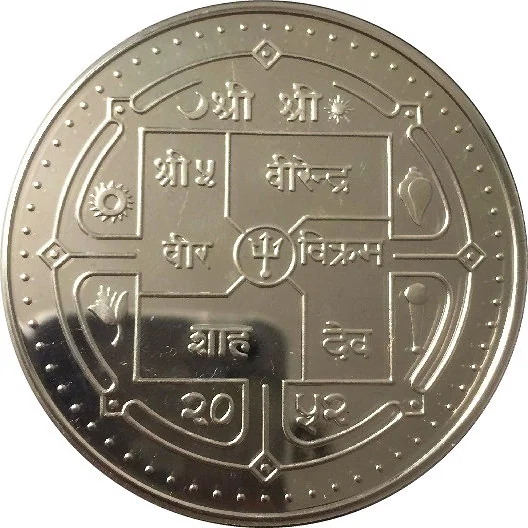
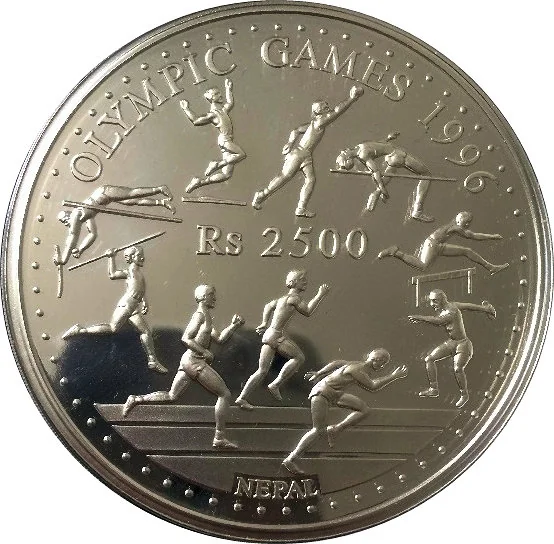
2500 Rupees – Nepal
Non-circulating coins
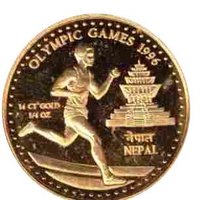
Commemoration: Olympic Games 1996 Atlanta
Nepal
Context
Year: 1995
Vikram Samvat Year: 2052
Issuer: Nepal 
Ruler: Birendra Bir Bikram Shah
Currency:
(since 1932)
Total mintage: 5,000
Material
Diameter: 65 mm
Weight: 155.5 g
Silver weight: 155.34 g
Shape: Round
Composition: 99.9% Silver
Standard: Silver 5 ounces
Magnetic: No
Technique: Milled
Alignment: Medal alignment
flip
References
Numista: #84405
Value
Exchange value: 2500 NPR
Bullion value: $449.97
Categories
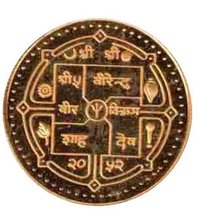
| Symbols> Coat of Arms |
| Sport> Summer Olympic Games |
Mintings
| Year | Mint Mark | Mintage | Quality | Collection |
|---|---|---|---|---|
| 1995 | — | 5,000 | Proof |
Historical background
In 1995, Nepal's currency situation was characterized by a dual exchange rate system and significant economic pressures following a period of political transition. The country operated a fixed official exchange rate for the Nepalese rupee (NPR), pegged to the Indian rupee (INR) at a rate of 1.6 NPR to 1 INR, a cornerstone of the 1960 Treaty of Trade and Transit. However, alongside this official rate existed a thriving black market for foreign exchange, particularly for hard currencies like the US dollar, due to strict capital controls and a growing trade deficit. This disparity reflected underlying economic strains and inefficiencies.
The economy was grappling with the consequences of the early-1990s shift to a multiparty democracy and economic liberalization, which had increased imports but not sufficiently boosted exports. A large trade deficit with India, which accounted for the majority of Nepal's trade, was a primary concern. While the peg to the Indian rupee provided stability for cross-border transactions, it also meant Nepal imported inflation from India and had limited independent monetary policy tools. Remittances, not yet the colossal inflow they would become, were growing but insufficient to offset the balance of payments pressures.
Overall, the currency situation in 1995 was one of managed stability on the surface, underpinned by the Indian rupee peg, but with mounting internal and external imbalances. The black market premium signaled market distortions and pent-up demand for foreign currency. This period set the stage for subsequent financial reforms, including the introduction of a unified, market-determined exchange rate system in the early 2000s, which would dismantle the dual-rate structure and liberalize the foreign exchange regime.
The economy was grappling with the consequences of the early-1990s shift to a multiparty democracy and economic liberalization, which had increased imports but not sufficiently boosted exports. A large trade deficit with India, which accounted for the majority of Nepal's trade, was a primary concern. While the peg to the Indian rupee provided stability for cross-border transactions, it also meant Nepal imported inflation from India and had limited independent monetary policy tools. Remittances, not yet the colossal inflow they would become, were growing but insufficient to offset the balance of payments pressures.
Overall, the currency situation in 1995 was one of managed stability on the surface, underpinned by the Indian rupee peg, but with mounting internal and external imbalances. The black market premium signaled market distortions and pent-up demand for foreign currency. This period set the stage for subsequent financial reforms, including the introduction of a unified, market-determined exchange rate system in the early 2000s, which would dismantle the dual-rate structure and liberalize the foreign exchange regime.
✨ Legendary