

5000 Lira – Turkey
Non-circulating coins
Commemoration: Yunus Emre
Turkey
Context

Material
Diameter: 29.7 mm
Weight: 12 g
Shape: Round
Composition: Copper-nickel
Technique: Milled
Alignment: Coin alignment
flip
References
KM: #Click to copy to clipboard1005
Numista: #84318
Value
Exchange value: 5000 TRL
Inflation-adjusted value: 101092166.80 TRL
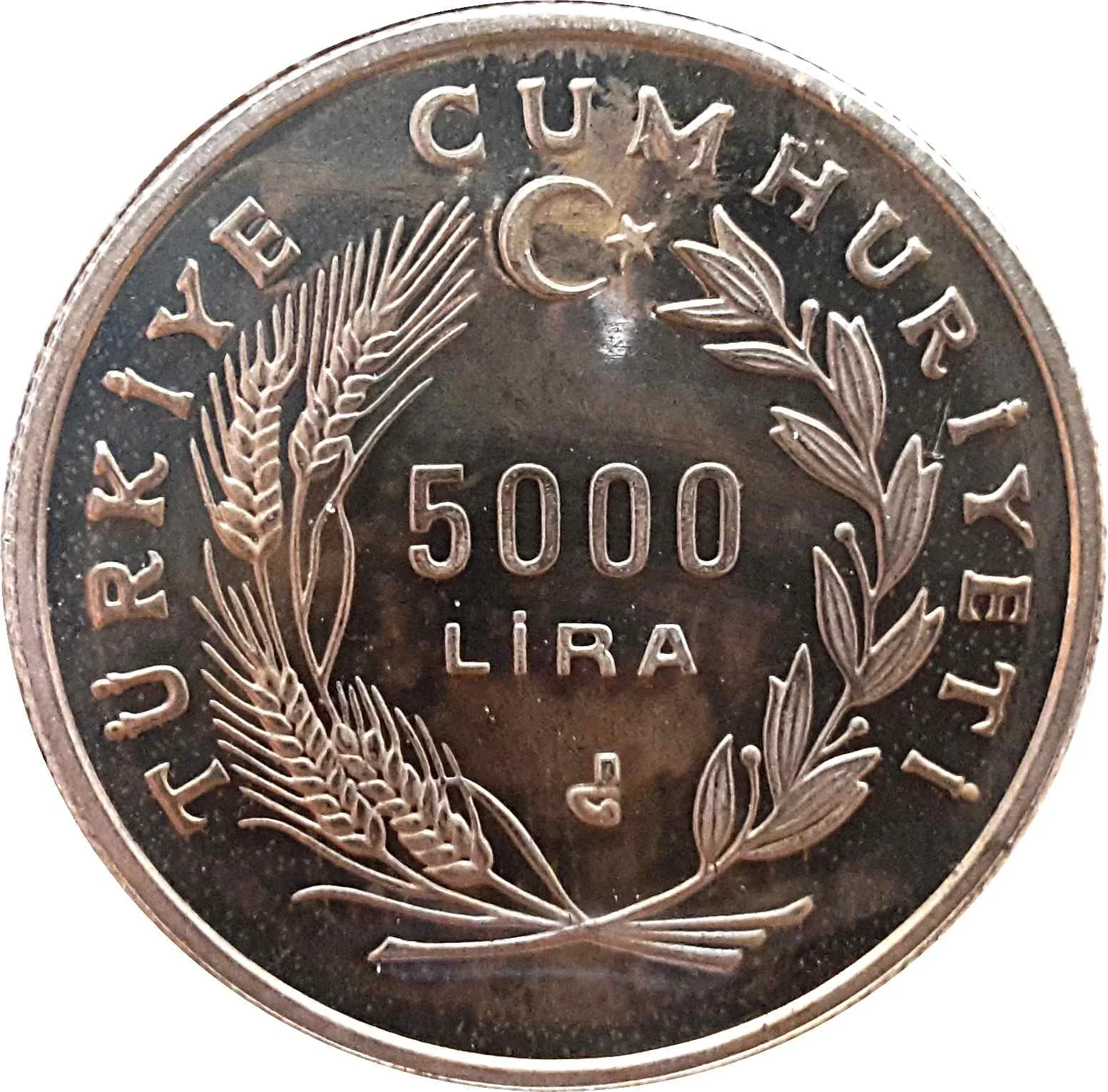
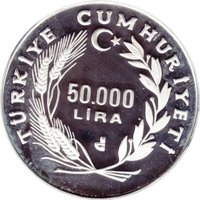
Obverse
Description:
Wreath's worth
Inscription:
TÜRKİYE CUMHURİYETİ
5000
LİRA
5000
LİRA
Translation:
REPUBLIC OF TURKEY
5000
LIRA
5000
LIRA
Script: Latin
Language: Turkish
Engraver: Suat Özyönüm
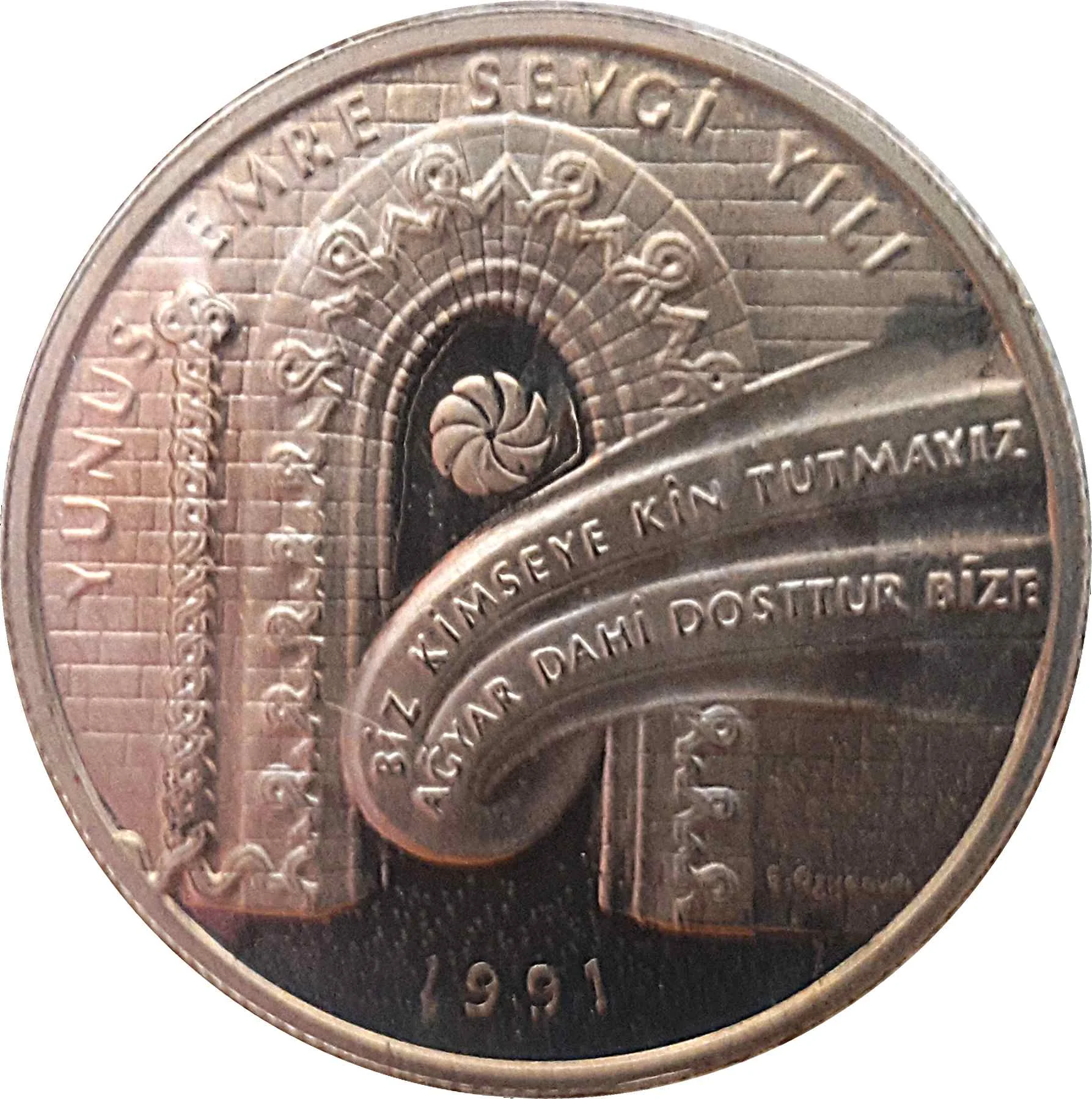
Reverse
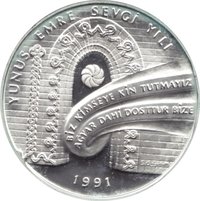
Description:
Carved inscription with arch
Inscription:
YUNUS EMRE SEVGİ YILI
BİZ KİMSEYE KİN TUTMAYIZ
AĞYAR DAHİ DOSTTUR BİZE
1991
BİZ KİMSEYE KİN TUTMAYIZ
AĞYAR DAHİ DOSTTUR BİZE
1991
Translation:
YUNUS EMRE YEAR OF LOVE
WE HOLD A GRUDGE AGAINST NO ONE
EVEN THE STRANGER IS A FRIEND TO US
1991
WE HOLD A GRUDGE AGAINST NO ONE
EVEN THE STRANGER IS A FRIEND TO US
1991
Script: Latin
Language: Turkish
Designer and engraver: Suat Özyönüm
Edge
Categories
| Art> Literature |
Mints
| Name | Mark |
|---|---|
| Turkish State Mint | — |
Mintings
| Year | Mint Mark | Mintage | Quality | Collection |
|---|---|---|---|---|
| 1991 | — | 7,490 | Proof |
Historical background
In 1991, Turkey’s currency situation was characterized by chronic high inflation and a heavily managed, yet deteriorating, lira. The economy was emerging from the financial liberalization reforms of the 1980s, which had ended strict capital controls but failed to instill fiscal discipline. The government continued to run large budget deficits, primarily financed by the Central Bank of the Republic of Turkey (CBRT), leading to persistent monetization of debt. This practice directly fueled an annual inflation rate that remained stubbornly high, hovering around 60-70%, eroding purchasing power and creating deep uncertainty for both businesses and savers.
The exchange rate regime was a crawling peg, where the Turkish lira was devalued daily against a basket of currencies, primarily the US dollar, in a pre-announced manner intended to outpace inflation and maintain export competitiveness. However, this system was under constant pressure. Political instability—with a fragile coalition government following the 1991 elections—and rising public spending, including costly involvement in the Gulf War, undermined confidence. Consequently, the gap between the official exchange rate and the black-market rate widened significantly, indicating a loss of faith in the government's ability to manage the currency.
Overall, 1991 represented a continuation of Turkey's "lost decade" of high inflation, rather than a crisis point itself. The structural weaknesses of fiscal profligacy, reliance on seigniorage, and political fragmentation created an environment where the lira was in a steady state of controlled decline. This unsustainable trajectory set the stage for the more severe financial crises that would erupt later in the 1990s, as the crawling peg system ultimately proved incapable of containing the pressures from chronic macroeconomic imbalances.
The exchange rate regime was a crawling peg, where the Turkish lira was devalued daily against a basket of currencies, primarily the US dollar, in a pre-announced manner intended to outpace inflation and maintain export competitiveness. However, this system was under constant pressure. Political instability—with a fragile coalition government following the 1991 elections—and rising public spending, including costly involvement in the Gulf War, undermined confidence. Consequently, the gap between the official exchange rate and the black-market rate widened significantly, indicating a loss of faith in the government's ability to manage the currency.
Overall, 1991 represented a continuation of Turkey's "lost decade" of high inflation, rather than a crisis point itself. The structural weaknesses of fiscal profligacy, reliance on seigniorage, and political fragmentation created an environment where the lira was in a steady state of controlled decline. This unsustainable trajectory set the stage for the more severe financial crises that would erupt later in the 1990s, as the crawling peg system ultimately proved incapable of containing the pressures from chronic macroeconomic imbalances.
💎 Very Rare