

100 Zlotys – Poland
Circulating commemorative coins
Commemoration: Polish Women's Memorial Hospital Center
Poland

Obverse
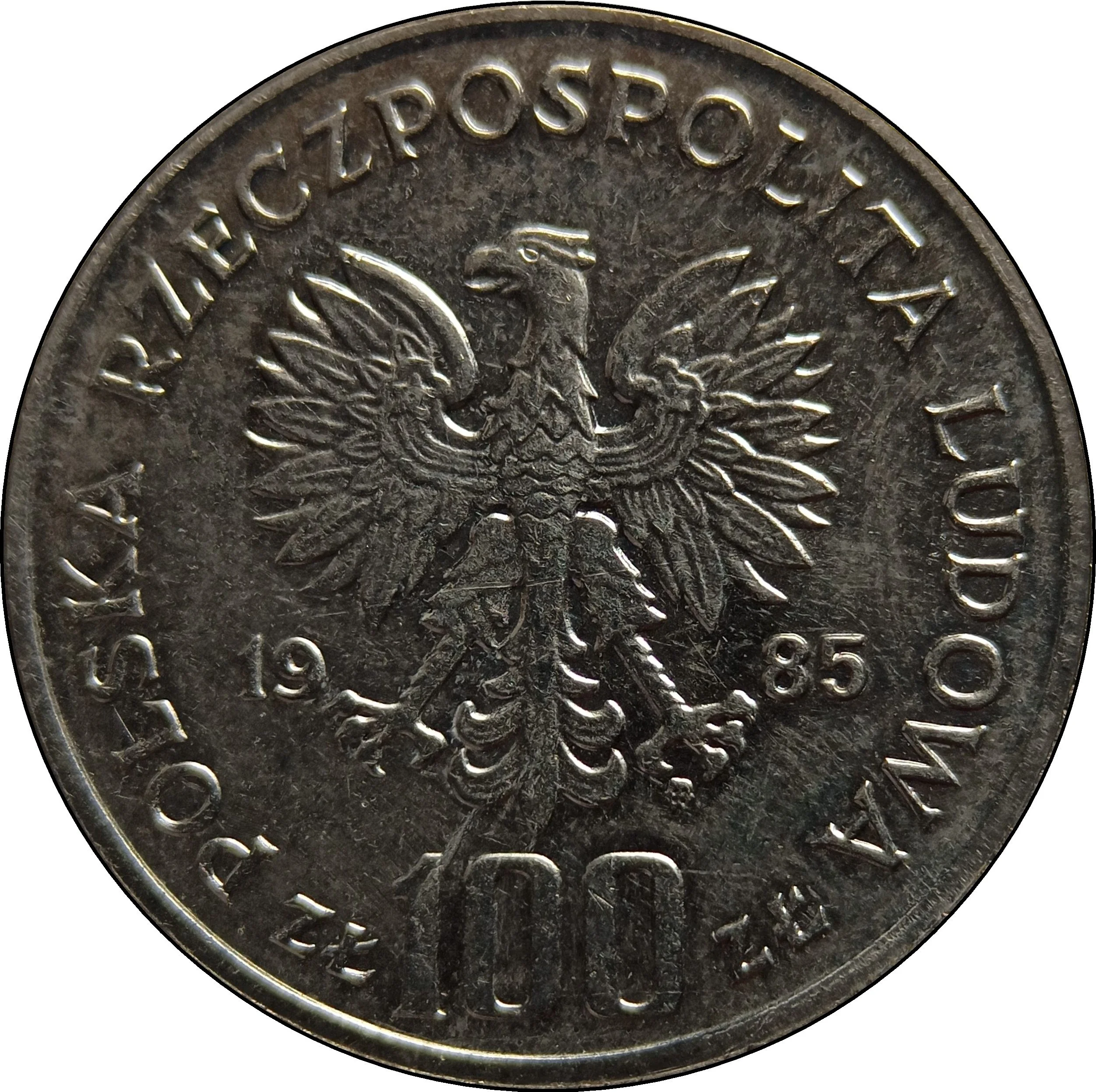
Description:
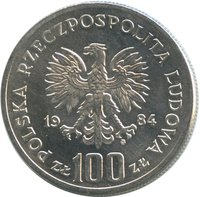
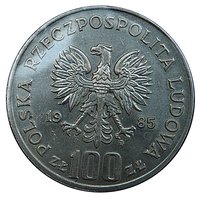
The Polish national coat of arms.
Inscription:
POLSKA RZECZPOSPOLITA LUDOWA
1985
mw
ZŁ 100 ZŁ
1985
mw
ZŁ 100 ZŁ
Translation:
PEOPLE'S REPUBLIC OF POLAND
1985
mw
100 ZŁ ZŁ
1985
mw
100 ZŁ ZŁ
Script: Latin
Language: Polish
Engraver: Stanisława Wątróbska-Frindt
Reverse
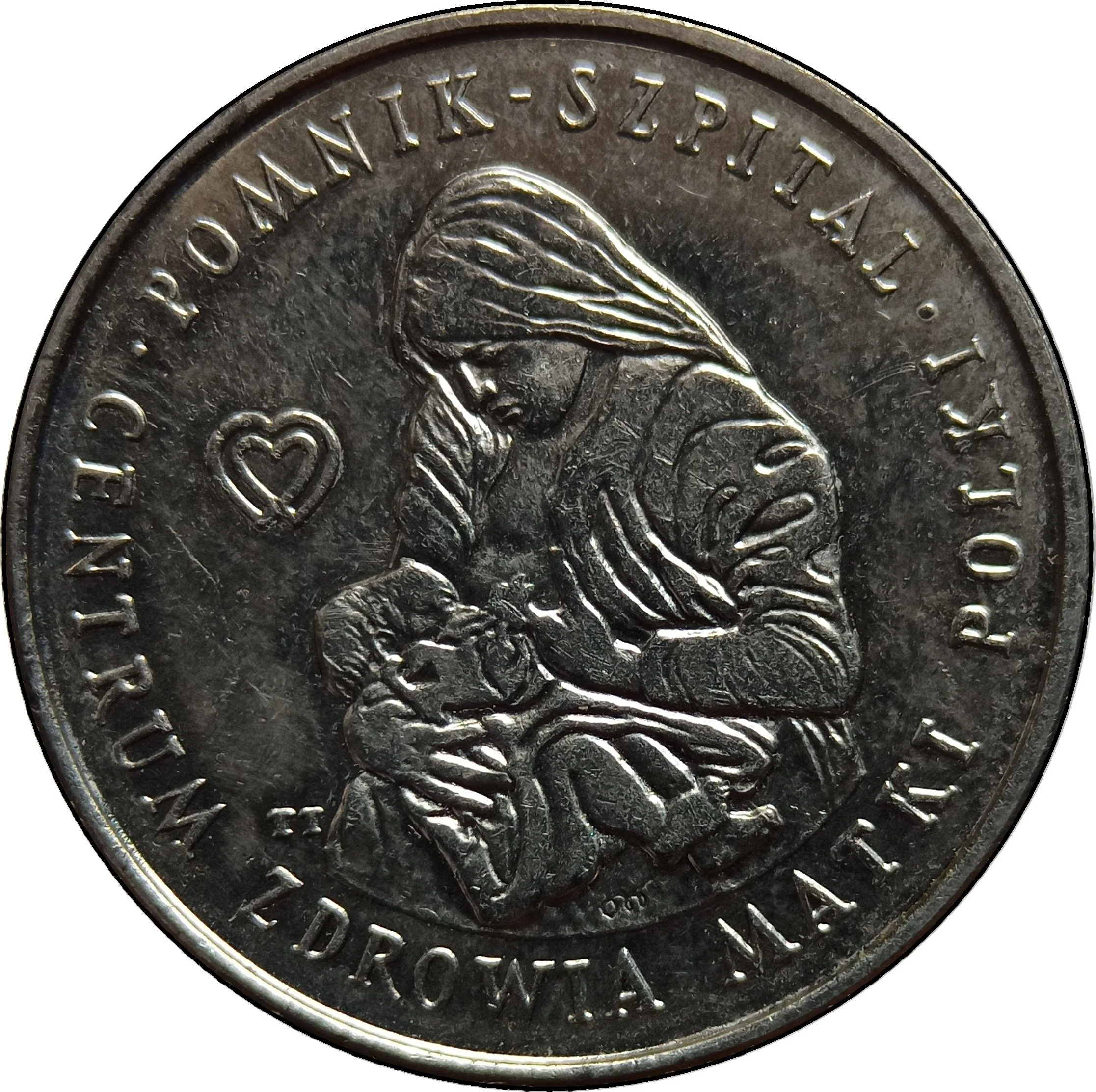
Description:
Mother nursing baby.
Inscription:
· POMNIK - SZPITAL ·
CENTRUM ZDROWIA MATKI POLKI
TT
CENTRUM ZDROWIA MATKI POLKI
TT
Script: Latin
Engraver: Tadeusz Tchórzewski
Edge
Milled
Mints
| Name | Mark |
|---|---|
| Mint of Poland | (MW) |
Mintings
| Year | Mint Mark | Mintage | Quality | Collection |
|---|---|---|---|---|
| 1985 | MW | 1,927,000 |
Historical background
In 1985, Poland's currency situation was a direct reflection of the deep crisis of the centrally planned economy under the communist regime. The official currency, the złoty, was non-convertible and its exchange rate was set arbitrarily by the state at an artificially high level (approximately 150 złoty to 1 US dollar). This official rate, however, was largely symbolic, used only for limited state accounting and a handful of government transactions. The real value of the złoty was determined on a thriving black market, where the dollar traded for between 500 to 800 złoty, exposing the vast gulf between the state's fiction and economic reality.
The economy was characterized by severe shortages of basic goods, rampant inflation, and a crushing foreign debt burden exceeding $30 billion. To access hard currency, the government operated a network of state-run Pewex and Baltona shops, where Poles could purchase Western goods—from food to electronics—exclusively for US dollars or other hard currencies. This created a two-tiered economic society: those with access to dollars (often through remittances from family abroad or black-market dealings) lived in relative privilege, while those reliant solely on złoty wages faced empty shelves and long queues for substandard products.
The government of General Wojciech Jaruzelski, having imposed martial law in 1981, maintained strict currency controls to stem the outflow of hard currency. However, its attempts at partial reform were ineffective. Price increases on basic necessities, meant to reduce subsidies, only fuelled social discontent without solving underlying inefficiencies. The currency situation in 1985 was thus a potent symbol of systemic failure, demonstrating the collapse of the command economy and foreshadowing the radical transformations that would culminate in the shock therapy and złoty redenomination of the post-communist 1990s.
The economy was characterized by severe shortages of basic goods, rampant inflation, and a crushing foreign debt burden exceeding $30 billion. To access hard currency, the government operated a network of state-run Pewex and Baltona shops, where Poles could purchase Western goods—from food to electronics—exclusively for US dollars or other hard currencies. This created a two-tiered economic society: those with access to dollars (often through remittances from family abroad or black-market dealings) lived in relative privilege, while those reliant solely on złoty wages faced empty shelves and long queues for substandard products.
The government of General Wojciech Jaruzelski, having imposed martial law in 1981, maintained strict currency controls to stem the outflow of hard currency. However, its attempts at partial reform were ineffective. Price increases on basic necessities, meant to reduce subsidies, only fuelled social discontent without solving underlying inefficiencies. The currency situation in 1985 was thus a potent symbol of systemic failure, demonstrating the collapse of the command economy and foreshadowing the radical transformations that would culminate in the shock therapy and złoty redenomination of the post-communist 1990s.
🌱 Common