

5 Euro – Portugal
Circulating commemorative coins
Commemoration: World Scouting Centennial
Portugal
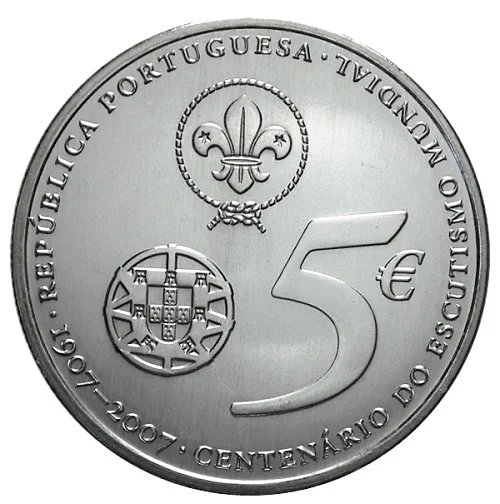
Obverse
Description:
Portuguese Scouting emblem
Inscription:
REPÚBLICA PORTUGUESA
5 €
·1907-2007·CENTENÁRIO DO ESCUTISMO MUNDIAL·
5 €
·1907-2007·CENTENÁRIO DO ESCUTISMO MUNDIAL·
Translation:
PORTUGUESE REPUBLIC
5 €
·1907-2007·CENTENARY OF WORLD SCOUTING·
5 €
·1907-2007·CENTENARY OF WORLD SCOUTING·
Script: Latin
Language: Portuguese
Engraver: João Calviño
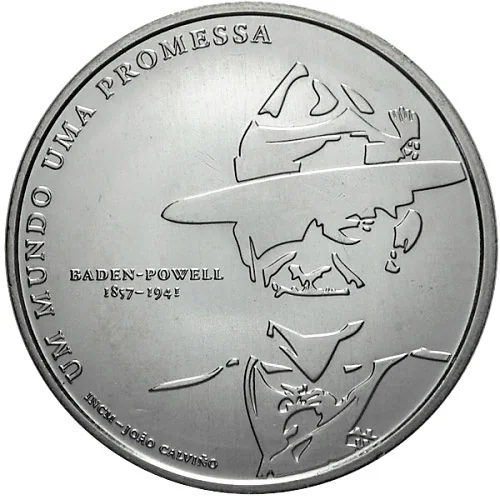
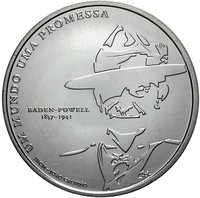
Reverse
Description:
Lord Baden-Powell, linear portrait.
Inscription:
UM MUNDO UMA PROMESA
BADEN-POWELL
1857-1941
INCM-JOÃO CALVIÑO
BADEN-POWELL
1857-1941
INCM-JOÃO CALVIÑO
Translation:
ONE WORLD ONE PROMISE
BADEN-POWELL
1857-1941
INCM-JOÃO CALVIÑO
BADEN-POWELL
1857-1941
INCM-JOÃO CALVIÑO
Script: Latin
Languages: English, Portuguese
Engraver: João Calviño
Edge
Reeded
Mintings
| Year | Mint Mark | Mintage | Quality | Collection |
|---|---|---|---|---|
| 2007 | INCM | 79,801 |
Historical background
In 2007, Portugal was a member of the Eurozone, having adopted the euro as its official currency in 1999 (with notes and coins introduced in 2002). This meant it had fully ceded control of its monetary policy to the European Central Bank (ECB), which set interest rates for the entire currency bloc. While the euro brought macroeconomic stability, lower transaction costs, and easier access to capital markets, it also removed key adjustment tools like currency devaluation, which Portugal had historically used to regain competitiveness against its European partners.
The country entered 2007 in a state of economic fragility, marked by a decade of low growth and rising public and private debt. A key issue was a pronounced loss of competitiveness within the Eurozone, as unit labor costs had risen faster than in Germany and other core economies. This resulted in persistent current account deficits, as Portugal imported more than it exported. The economy was propped up by relatively low ECB interest rates, which fueled a credit boom and a housing market bubble, masking underlying structural problems in productivity and the export sector.
By the end of 2007, the global financial crisis was beginning to unfold, but its full impact on Portugal was not yet fully felt. The underlying weaknesses—stagnant growth, high debt levels, and a lack of competitiveness—had made the Portuguese economy particularly vulnerable. The fixed exchange rate of the euro meant Portugal could not devalue its currency to stimulate exports, trapping it in what some economists termed a "straitjacket." This precarious situation set the stage for the severe sovereign debt crisis that would fully erupt in 2010-2011, ultimately leading Portugal to request an international financial bailout in April 2011.
The country entered 2007 in a state of economic fragility, marked by a decade of low growth and rising public and private debt. A key issue was a pronounced loss of competitiveness within the Eurozone, as unit labor costs had risen faster than in Germany and other core economies. This resulted in persistent current account deficits, as Portugal imported more than it exported. The economy was propped up by relatively low ECB interest rates, which fueled a credit boom and a housing market bubble, masking underlying structural problems in productivity and the export sector.
By the end of 2007, the global financial crisis was beginning to unfold, but its full impact on Portugal was not yet fully felt. The underlying weaknesses—stagnant growth, high debt levels, and a lack of competitiveness—had made the Portuguese economy particularly vulnerable. The fixed exchange rate of the euro meant Portugal could not devalue its currency to stimulate exports, trapping it in what some economists termed a "straitjacket." This precarious situation set the stage for the severe sovereign debt crisis that would fully erupt in 2010-2011, ultimately leading Portugal to request an international financial bailout in April 2011.
🌱 Fairly Common