

300 new dinars (Nikola Tesla) – Yugoslavia
Add to wishlist
Non-circulating coins
Commemoration: 140th Anniversary of the birth of the brilliant Serbian scientist Nikola Tesla
Context
Year: 1996
Issuer: Yugoslavia
Period:
(1992—2003)
Currency:
(1994—2003)
Demonetized: Yes
Total mintage: 10,000
Material
References
KM: #
Numista: #84144
Value
Exchange value: 300 YUM
Bullion value: $61.25
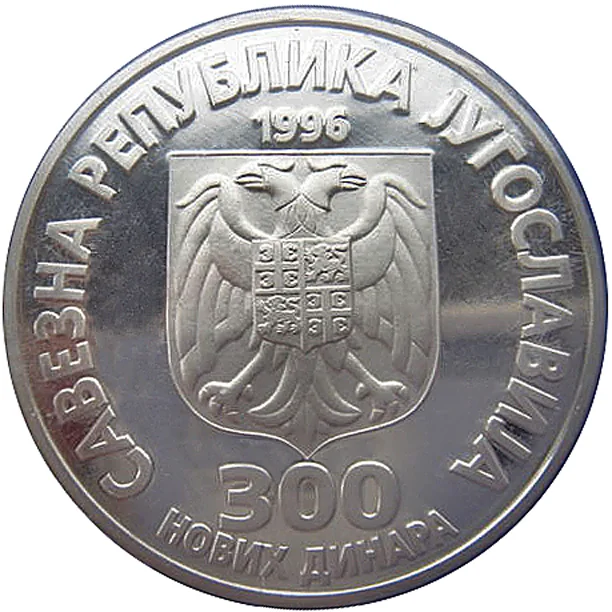
Obverse
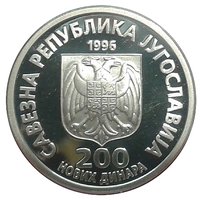
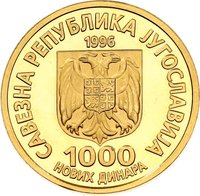
Description:
Грб Савезне Републике Југославије
Inscription:
САВЕЗНА РЕПУБЛИКА ЈУГОСЛАВИЈА
1996
300
НОВИХ ДИНАРА
1996
300
НОВИХ ДИНАРА
Translation:
FEDERAL REPUBLIC OF YUGOSLAVIA
1996
300
NEW DINARS
1996
300
NEW DINARS
Language: Serbian
Engraver: Dragomir Mileusnić
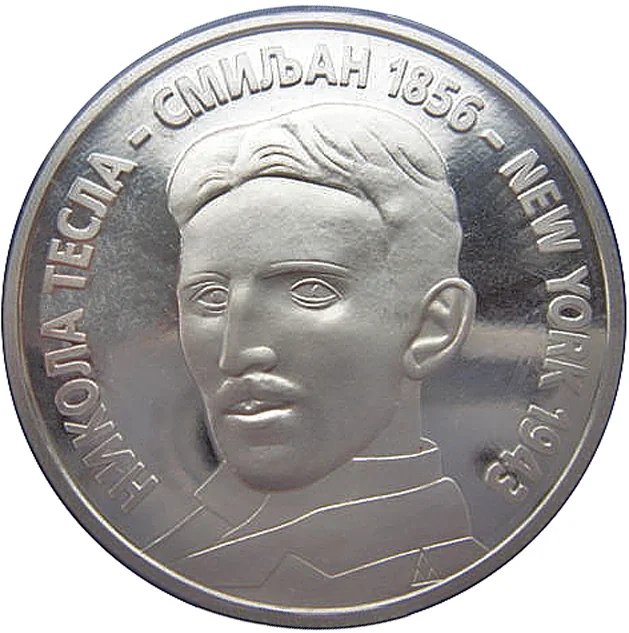
Reverse
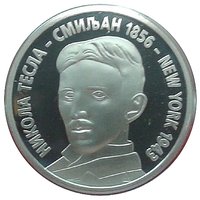
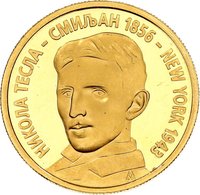
Description:
Nikola Tesla portrait
Inscription:
НИКОЛА ТЕСЛА - СМИЉАН 1856 - NEW YORK 1943
Translation:
NIKOLA TESLA - SMILJAN 1856 - NEW YORK 1943
Engraver: Dragomir Mileusnić
Edge
Categories
| Event> Birth anniversary |
| Person> Scientist |
| Symbols> Coat of Arms |
Mintings
| Year | Mint Mark | Mintage | Quality | Collection |
|---|---|---|---|---|
| 1996 | — | 10,000 | Proof |
Historical background
By 1996, the Federal Republic of Yugoslavia (consisting of Serbia and Montenegro) was in the late stages of a profound monetary crisis, characterized by one of history's most severe hyperinflations, which had officially peaked in January 1994. The government of Slobodan Milošević had ended that episode by introducing a new "super dinar" in January 1994, pegged one-to-one to the Deutsche Mark and backed by hard currency reserves. This radical stabilization, engineered by then-National Bank Governor Dragoslav Avramović, initially succeeded in halting inflation and restoring a degree of monetary normalcy.
However, by 1996, the underlying structural problems that caused the original hyperinflation—primarily the government financing massive public spending and loss-making state enterprises by printing money—had not been resolved. The regime resumed expansive fiscal and monetary policies, placing renewed pressure on the currency peg. Confidence in the super dinar began to erode as the money supply expanded, leading to a growing black-market exchange rate premium over the official Deutsche Mark peg. This period represented a slow-burn relapse, where the currency was stable on the surface but fundamentally weakening due to a lack of fiscal discipline and the ongoing impacts of international sanctions, which were only partially eased following the Dayton Agreement in late 1995.
Consequently, 1996 was a year of fragile and deteriorating stability. The Avramović dinar remained in circulation, but its hard-currency backing was being depleted to maintain the peg, a unsustainable strategy. The economic situation fueled social discontent, which manifested in large-scale protests in Belgrade against the Milošević government during the winter of 1996-97. The currency's vulnerability foreshadowed the further devaluations and monetary instability that would follow in the final years of the decade, ultimately leading to the adoption of the Deutsche Mark (and later the Euro) as de facto currencies before the state's dissolution in 2003.
However, by 1996, the underlying structural problems that caused the original hyperinflation—primarily the government financing massive public spending and loss-making state enterprises by printing money—had not been resolved. The regime resumed expansive fiscal and monetary policies, placing renewed pressure on the currency peg. Confidence in the super dinar began to erode as the money supply expanded, leading to a growing black-market exchange rate premium over the official Deutsche Mark peg. This period represented a slow-burn relapse, where the currency was stable on the surface but fundamentally weakening due to a lack of fiscal discipline and the ongoing impacts of international sanctions, which were only partially eased following the Dayton Agreement in late 1995.
Consequently, 1996 was a year of fragile and deteriorating stability. The Avramović dinar remained in circulation, but its hard-currency backing was being depleted to maintain the peg, a unsustainable strategy. The economic situation fueled social discontent, which manifested in large-scale protests in Belgrade against the Milošević government during the winter of 1996-97. The currency's vulnerability foreshadowed the further devaluations and monetary instability that would follow in the final years of the decade, ultimately leading to the adoption of the Deutsche Mark (and later the Euro) as de facto currencies before the state's dissolution in 2003.
💎 Extremely Rare