

20 zlotys – Poland
Add to wishlist
Circulating commemorative coins
Commemoration: Maria Konopnicka
Poland
Context
Year: 1978
Issuer: Poland
Period:
(1952—1989)
Currency:
(1949—1994)
Demonetization: 1 January 1995
Total mintage: 2,009,800
Material
Diameter: 29 mm
Weight: 10.15 g
Thickness: 2.1 mm
Shape: Round
Composition: Copper-nickel
Technique: Milled
Alignment: Medal alignment
flip
References
Y: #
Numista: #8410
Value
Exchange value: 20 PLZ
Inflation-adjusted value: 128842.59 PLZ
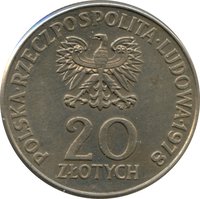
Obverse
Description:
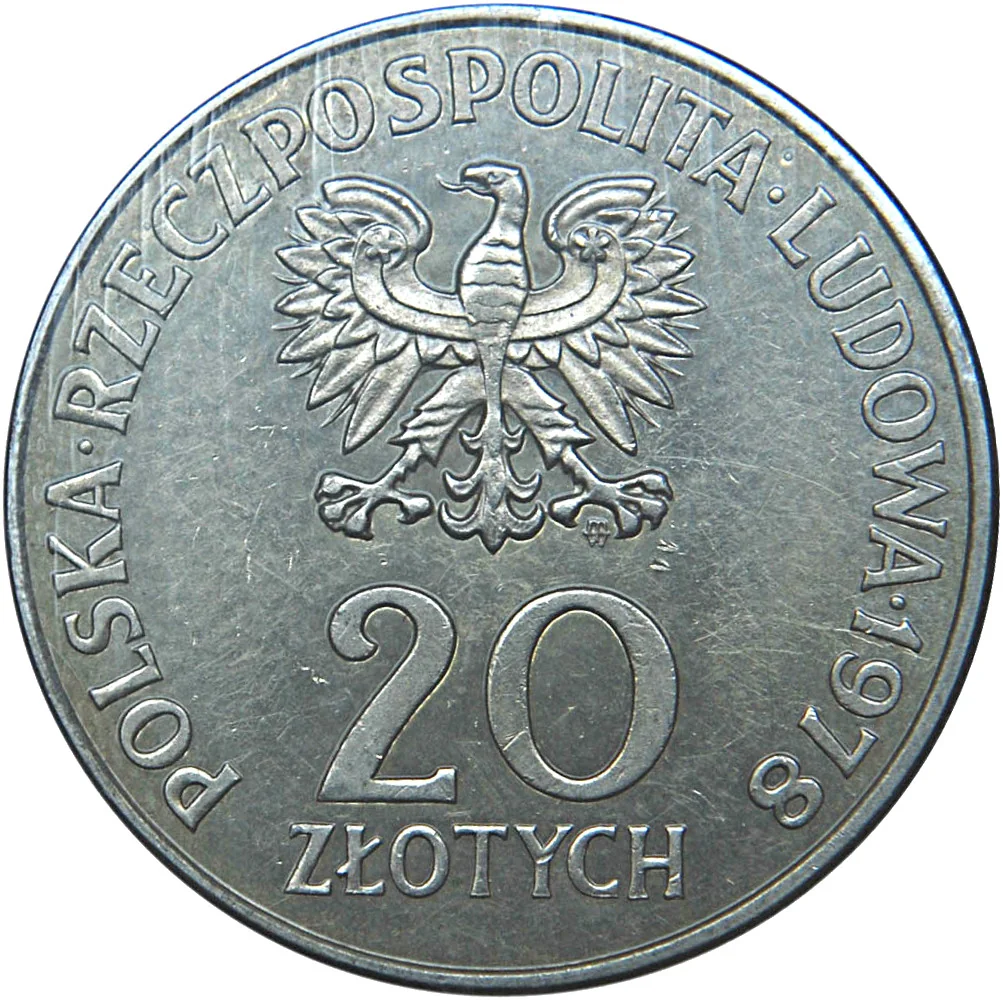
The Polish national coat of arms.
Inscription:
POLSKA∙RZECZPOSPOLITA∙LUDOWA∙1978
mw
20
ZŁOTYCH
mw
20
ZŁOTYCH
Translation:
Polish People's Republic 1978
20 Złotych
20 Złotych
Script: Latin
Language: Polish
Engraver: Józef Markiewicz-Nieszcz
Reverse
Description:
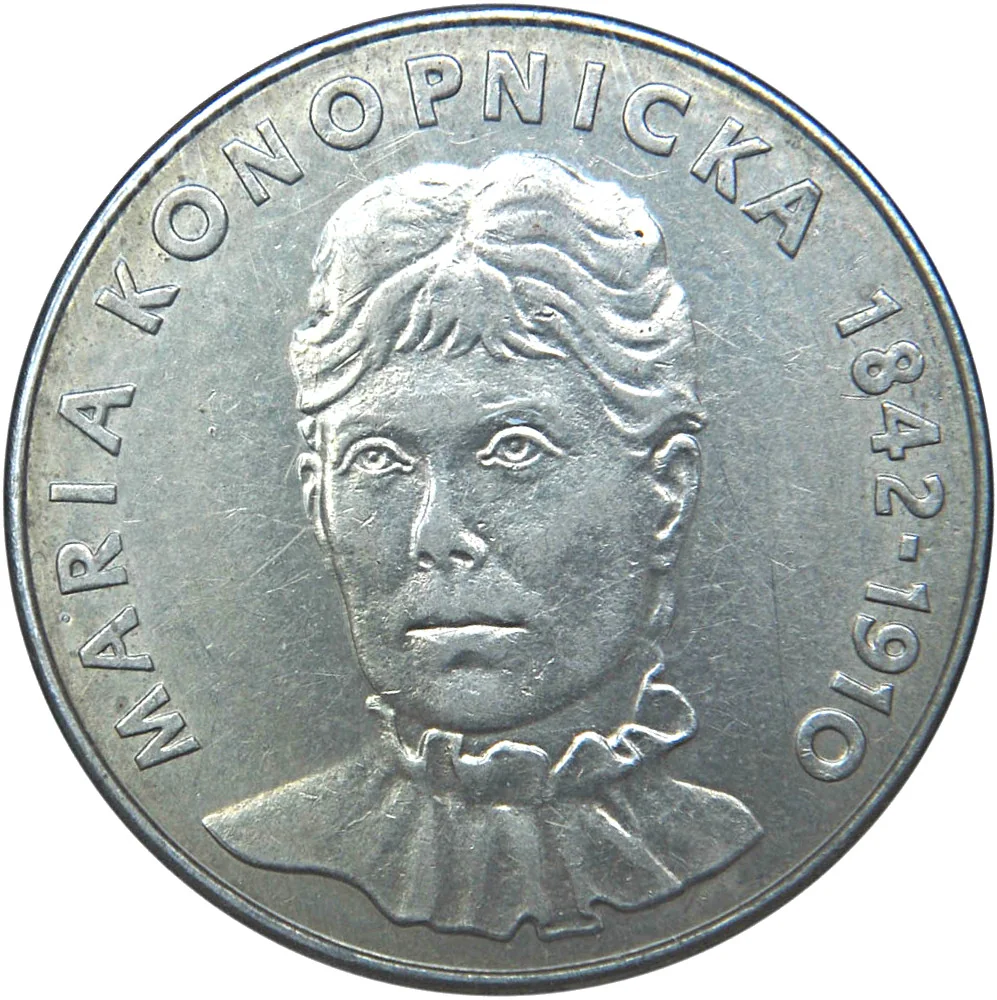
Portrait of Maria Konopnicka
Inscription:
MARIA KONOPNICKA 1842-1910
Script: Latin
Engraver: Ewa Olszewska-Borys
Edge
Reeded
Categories
| Art> Literature |
Mints
| Name | Mark |
|---|---|
| Mint of Poland | (MW) |
Mintings
| Year | Mint Mark | Mintage | Quality | Collection |
|---|---|---|---|---|
| 1978 | MW | 2,009,800 |
Historical background
In 1978, Poland's currency situation was characterized by the rigidities and growing distortions of a centrally planned economy under the communist regime. Officially, the Polish złoty (PLN) was a non-convertible currency with an exchange rate fixed by the state against a basket of hard currencies, primarily the US dollar. This official rate, however, was largely symbolic for the average citizen, as it applied only to limited state transactions and bore no relation to the currency's real purchasing power or the thriving black market. The economy was plagued by chronic shortages of consumer goods, leading to suppressed inflation where money in hand often could not buy available goods, creating a profound disconnect between the złoty's nominal value and its real worth.
A critical feature of the monetary landscape was the existence of a dual-currency system, centered on the possession of hard currencies like US dollars. For ordinary Poles, access to Western goods was primarily through Pewex and Baltona shops, a state-run chain of stores where luxury items, quality food, and scarce goods could only be purchased with hard currency. This created a privileged parallel economy, deepening social inequalities and undermining the złoty. Furthermore, a vast black market for foreign exchange operated openly, where the dollar traded at a rate several times higher than the official one, reflecting the true lack of confidence in the national currency.
Beneath this unstable facade, the foundations for a severe economic crisis were solidifying. The decade of heavy borrowing from Western banks during the 1970s, intended to modernize industry, had resulted in a massive hard currency debt. By 1978, debt servicing was consuming a crippling portion of Poland's export earnings. The government, committed to maintaining subsidies and fixed prices for basic goods, was increasingly financing itself by printing money, embedding latent inflationary pressures. Thus, while 1978 did not yet see hyperinflation, the currency system was under severe strain, setting the stage for the economic collapse, social unrest, and the eventual devaluation and monetary reforms of the following decade.
A critical feature of the monetary landscape was the existence of a dual-currency system, centered on the possession of hard currencies like US dollars. For ordinary Poles, access to Western goods was primarily through Pewex and Baltona shops, a state-run chain of stores where luxury items, quality food, and scarce goods could only be purchased with hard currency. This created a privileged parallel economy, deepening social inequalities and undermining the złoty. Furthermore, a vast black market for foreign exchange operated openly, where the dollar traded at a rate several times higher than the official one, reflecting the true lack of confidence in the national currency.
Beneath this unstable facade, the foundations for a severe economic crisis were solidifying. The decade of heavy borrowing from Western banks during the 1970s, intended to modernize industry, had resulted in a massive hard currency debt. By 1978, debt servicing was consuming a crippling portion of Poland's export earnings. The government, committed to maintaining subsidies and fixed prices for basic goods, was increasingly financing itself by printing money, embedding latent inflationary pressures. Thus, while 1978 did not yet see hyperinflation, the currency system was under severe strain, setting the stage for the economic collapse, social unrest, and the eventual devaluation and monetary reforms of the following decade.
🌱 Common