

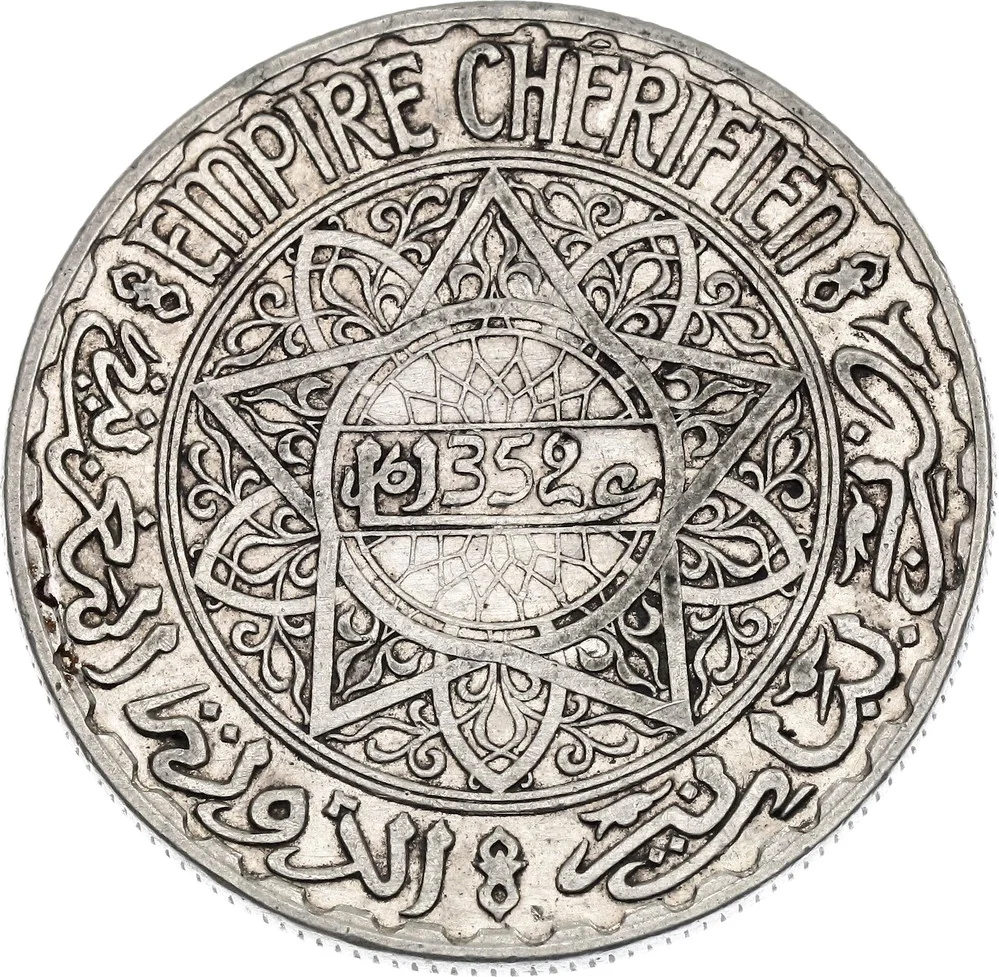
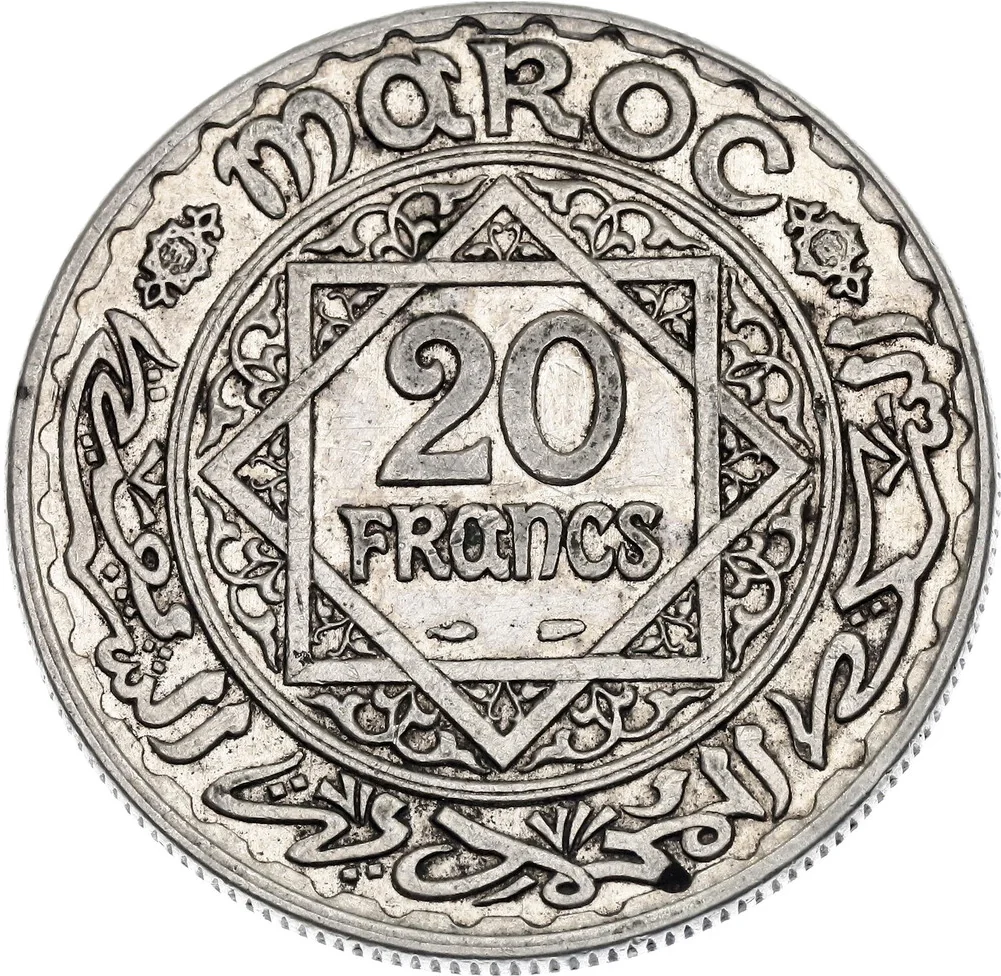
20 francs – Morocco
Add to wishlist
Morocco
Context
Years: 1928–1933
Issuer: Morocco
Ruler: Mohammed V
Currency:
(1910—1959)
Demonetized: Yes
Total mintage: 2,177,000
Material
References
Y: #
Numista: #8404
Value
Bullion value: $34.08
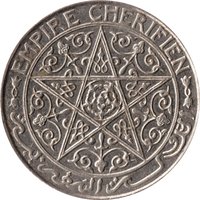
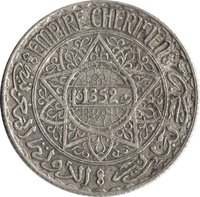
Obverse
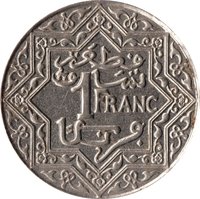
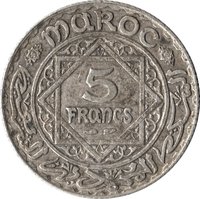
Reverse
Edge
Reeded
Mintings
| Year | Mint Mark | Mintage | Quality | Collection |
|---|---|---|---|---|
| 1928 | — | 177,000 | ||
| 1933 | — | 2,000,000 |
Historical background
In 1928, Morocco's currency situation was a complex reflection of its political status as a protectorate jointly administered by France and Spain. The country did not possess a single, unified national currency. Instead, monetary circulation was fragmented and dominated by the colonial powers. The French zone primarily used the Moroccan franc, which was pegged at par to the French franc and issued by the State Bank of Morocco (Banque d'État du Maroc), an institution under French control. In the Spanish northern zone and southern enclaves, the Spanish peseta was the official currency.
This system created significant practical challenges for internal trade and economic cohesion. Alongside these colonial currencies, the traditional Moroccan silver dirham and, most notably, the Hassani rial (a silver coin) continued to circulate, particularly in rural and remote areas, maintaining a tangible link to the pre-protectorate monetary tradition. Furthermore, a multitude of foreign coins, including Spanish and French gold coins and even the British sovereign, were used for large transactions and savings, leading to a complicated and often inefficient multi-currency environment.
The year 1928 itself was not marked by a major monetary reform but represented a period of consolidation within this dual framework. The French authorities continued to promote the use of the Moroccan franc to deepen economic integration with France and streamline administration. However, the persistent circulation of traditional and foreign specie underscored the incomplete nature of this monetary unification and highlighted the tension between colonial economic designs and enduring local financial practices. This fragmented system would remain largely in place until after Morocco regained independence in 1956.
This system created significant practical challenges for internal trade and economic cohesion. Alongside these colonial currencies, the traditional Moroccan silver dirham and, most notably, the Hassani rial (a silver coin) continued to circulate, particularly in rural and remote areas, maintaining a tangible link to the pre-protectorate monetary tradition. Furthermore, a multitude of foreign coins, including Spanish and French gold coins and even the British sovereign, were used for large transactions and savings, leading to a complicated and often inefficient multi-currency environment.
The year 1928 itself was not marked by a major monetary reform but represented a period of consolidation within this dual framework. The French authorities continued to promote the use of the Moroccan franc to deepen economic integration with France and streamline administration. However, the persistent circulation of traditional and foreign specie underscored the incomplete nature of this monetary unification and highlighted the tension between colonial economic designs and enduring local financial practices. This fragmented system would remain largely in place until after Morocco regained independence in 1956.
🌱 Fairly Common