

5 reais – Brazil
Add to wishlist
Non-circulating coins
Commemoration: Olympic Games Rio 2016
Brazil
Obverse
Description:
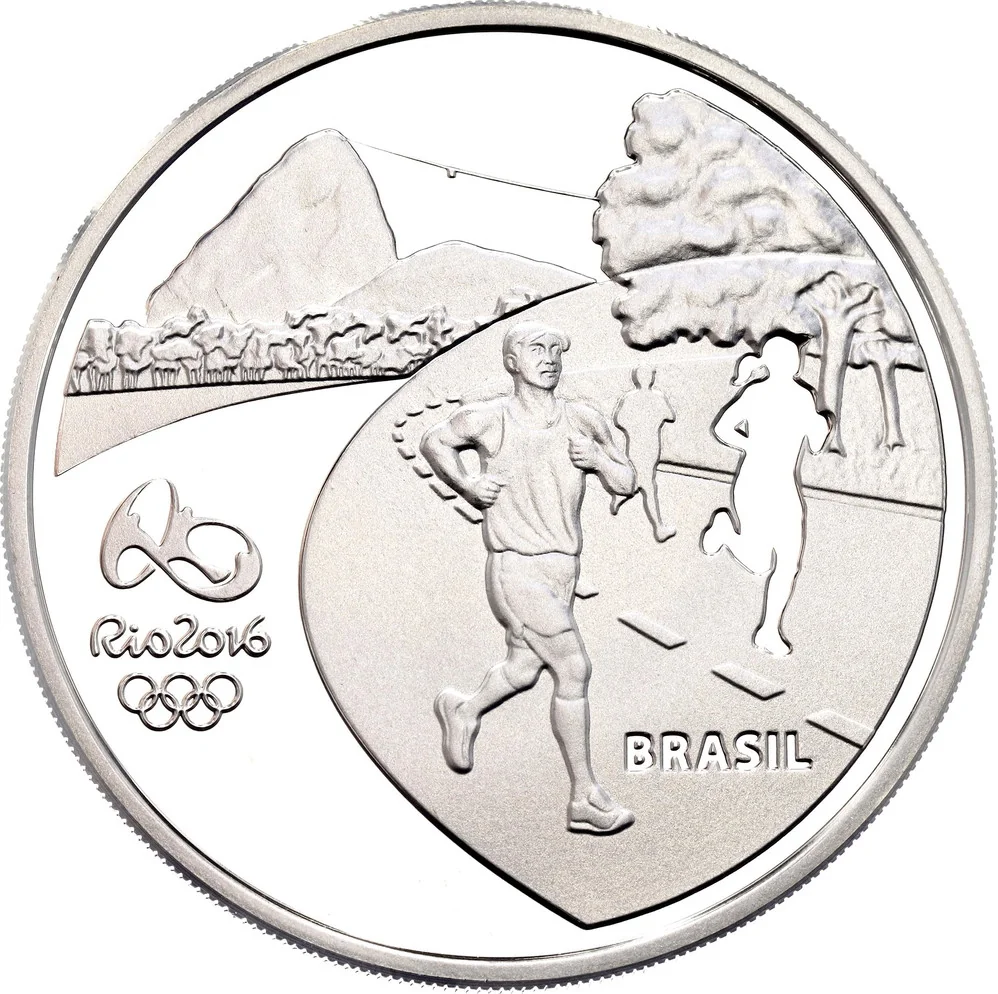
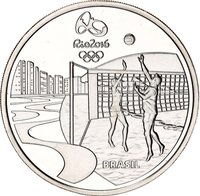
Running at Aterro do Flamengo with Sugar Loaf in the background, alongside the Rio 2016 logo and "Brazil."
Inscription:
Rio 2016
BRASIL
BRASIL
Translation:
Rio 2016
Brazil
Brazil
Script: Latin
Language: Portuguese
Reverse
Description:
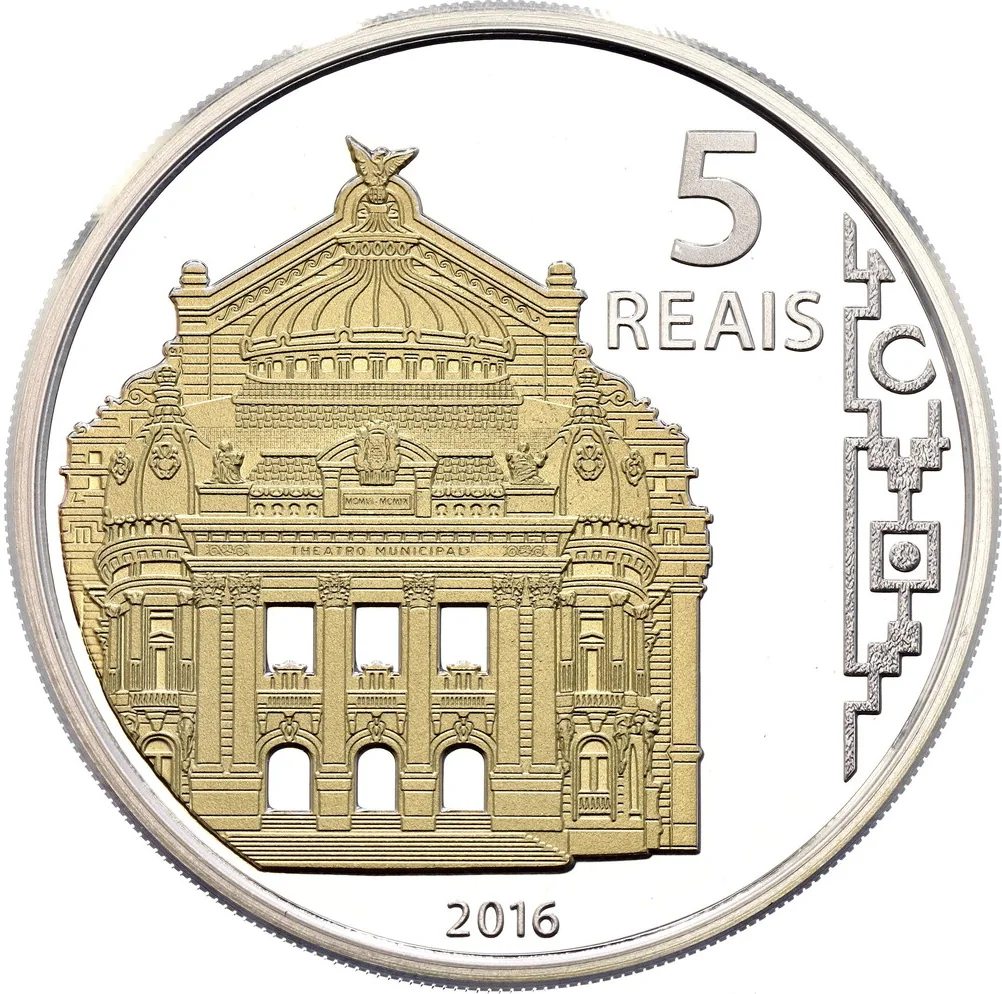
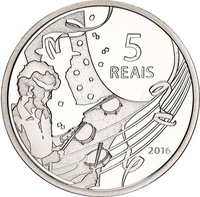
The Municipal Theater is highlighted, with its 2016 face value of five reais.
Inscription:
5 REAIS
2016
2016
Script: Latin
Edge
Reeded
Mints
| Name | Mark |
|---|---|
| Casa da Moeda do Brasil | — |
Mintings
| Year | Mint Mark | Mintage | Quality | Collection |
|---|---|---|---|---|
| 2016 | — | 13,300 | Proof |
Historical background
In 2016, Brazil was in the throes of a severe economic and political crisis, which directly shaped its currency situation. The Brazilian real (BRL) had already experienced significant depreciation in the preceding years, but 2016 proved to be a year of extreme volatility and weakness. The currency began the year near R$4.00 to the US dollar, a historic low, reflecting a "perfect storm" of collapsing commodity prices, a deep recession, and a sprawling corruption scandal (Operation Car Wash) that paralyzed political function and business confidence.
The primary drivers of the real's weakness were twofold: deep economic fundamentals and intense political instability. Brazil was experiencing its worst recession in a century, with GDP contracting sharply and inflation running in double digits. Simultaneously, the impeachment process against President Dilma Rousseff created profound uncertainty, freezing investment and policymaking. This toxic mix led to a loss of investor confidence, capital flight, and relentless downward pressure on the currency. The Central Bank of Brazil intervened periodically in the foreign exchange market, but its efforts were largely aimed at smoothing volatility rather than defending a specific level, as the fundamental drivers were beyond mere market operations.
By the latter half of 2016, the currency situation began to stabilize, albeit at a severely depreciated level. The real strengthened to around R$3.20/USD by year's end, a recovery fueled by several factors: the conclusion of the impeachment process and the installation of a new market-friendly government under Michel Temer, which promised fiscal reforms; a gradual easing of the brutal recession; and a more cautious approach by the U.S. Federal Reserve on interest rate hikes. However, the legacy of 2016 was a permanently weakened currency, reflecting a diminished economic outlook and underscoring how deeply political turmoil can destabilize a nation's financial foundations.
The primary drivers of the real's weakness were twofold: deep economic fundamentals and intense political instability. Brazil was experiencing its worst recession in a century, with GDP contracting sharply and inflation running in double digits. Simultaneously, the impeachment process against President Dilma Rousseff created profound uncertainty, freezing investment and policymaking. This toxic mix led to a loss of investor confidence, capital flight, and relentless downward pressure on the currency. The Central Bank of Brazil intervened periodically in the foreign exchange market, but its efforts were largely aimed at smoothing volatility rather than defending a specific level, as the fundamental drivers were beyond mere market operations.
By the latter half of 2016, the currency situation began to stabilize, albeit at a severely depreciated level. The real strengthened to around R$3.20/USD by year's end, a recovery fueled by several factors: the conclusion of the impeachment process and the installation of a new market-friendly government under Michel Temer, which promised fiscal reforms; a gradual easing of the brutal recession; and a more cautious approach by the U.S. Federal Reserve on interest rate hikes. However, the legacy of 2016 was a permanently weakened currency, reflecting a diminished economic outlook and underscoring how deeply political turmoil can destabilize a nation's financial foundations.


💎 Extremely Rare