

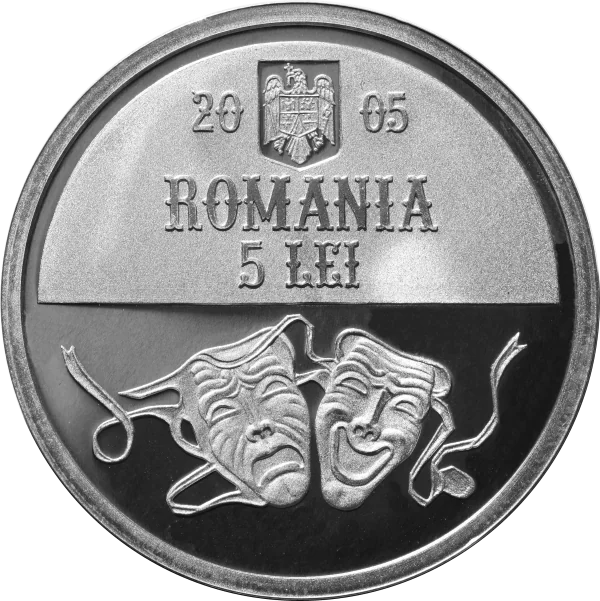
5 Lei (Grigore Vasiliu-Birlic) – Romania
Non-circulating coins
Commemoration: 100 Years from the Birth of Grigore Vasiliu-Birlic
Romania
Context

Material
Diameter: 37 mm
Weight: 31.1 g
Silver weight: 31.07 g
Shape: Round
Composition: 99.9% Silver
Standard: Silver ounce
Magnetic: No
Technique: Milled
References
KM: #Click to copy to clipboard208
Numista: #83518
Value
Exchange value: 5 RON = $1.16
Bullion value: $88.32
Inflation-adjusted value: 12.97 RON
Obverse
Reverse
Description:
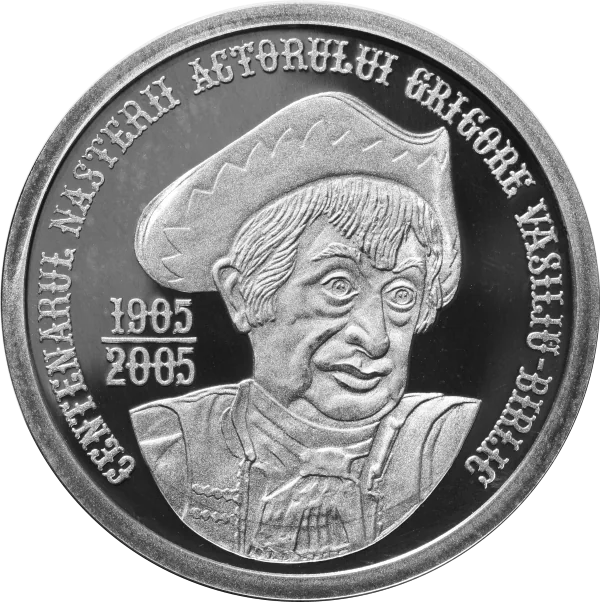
A bust of actor Grigore Vasiliu-Birlic in a comedic role, encircled by the inscription "CENTENARUL NAȘTERII ACTORULUI GRIGORE VASILIU-BIRLIC". The years 1905 and 2005 are stacked to the left of the bust.
Inscription:
CENTENARUL NASTERII ACTORULUI GRIGORE VASILIU-BIRLIC
1905
2005
1905
2005
Edge
Milled
Mintings
| Year | Mint Mark | Mintage | Quality | Collection |
|---|---|---|---|---|
| 2005 | — | 150 | Proof |
Historical background
In 2005, Romania was in a period of economic transition and convergence, actively preparing for its eventual accession to the European Union in 2007. The national currency, the Romanian leu (RON), had undergone a significant redenomination just two years prior in July 2003, where 10,000 old lei were replaced by one new leu. This move was a crucial step in stabilizing the currency, simplifying transactions, and curbing the psychological impact of high nominal values, thereby boosting public confidence in the monetary system after years of high inflation in the 1990s.
The year was characterized by a managed floating exchange rate regime, with the National Bank of Romania (BNR) prioritizing inflation control. While the leu was not pegged to the euro, the BNR intervened in the foreign exchange market to smooth out excessive volatility. A key policy focus was maintaining a tight monetary policy to further reduce inflation, which had fallen to single digits but remained a concern. This period saw gradual but steady appreciation pressure on the leu against major currencies, driven by strong capital inflows from foreign direct investment, EU fund anticipation, and a growing banking sector.
Overall, the 2005 currency situation reflected a economy in stabilization, with authorities carefully balancing the goals of disinflation, exchange rate stability, and maintaining export competitiveness. The successful management of the leu was a cornerstone of Romania's EU integration roadmap, as it demonstrated the country's ability to achieve macroeconomic stability and move closer to meeting the Maastricht criteria, even though adopting the euro remained a distant, post-accession objective.
The year was characterized by a managed floating exchange rate regime, with the National Bank of Romania (BNR) prioritizing inflation control. While the leu was not pegged to the euro, the BNR intervened in the foreign exchange market to smooth out excessive volatility. A key policy focus was maintaining a tight monetary policy to further reduce inflation, which had fallen to single digits but remained a concern. This period saw gradual but steady appreciation pressure on the leu against major currencies, driven by strong capital inflows from foreign direct investment, EU fund anticipation, and a growing banking sector.
Overall, the 2005 currency situation reflected a economy in stabilization, with authorities carefully balancing the goals of disinflation, exchange rate stability, and maintaining export competitiveness. The successful management of the leu was a cornerstone of Romania's EU integration roadmap, as it demonstrated the country's ability to achieve macroeconomic stability and move closer to meeting the Maastricht criteria, even though adopting the euro remained a distant, post-accession objective.
✨ Legendary