

5 Euro (Giro d'Italia) – Italy
Non-circulating coins
Commemoration: 100th Anniversary of "Giro d'Italia"
Italy
Context

Material
References
KM: #Click to copy to clipboard313
Numista: #83474
Value
Exchange value: 5 EUR = $5.91
Bullion value: $48.39
Inflation-adjusted value: 6.63 EUR
Obverse
Description:
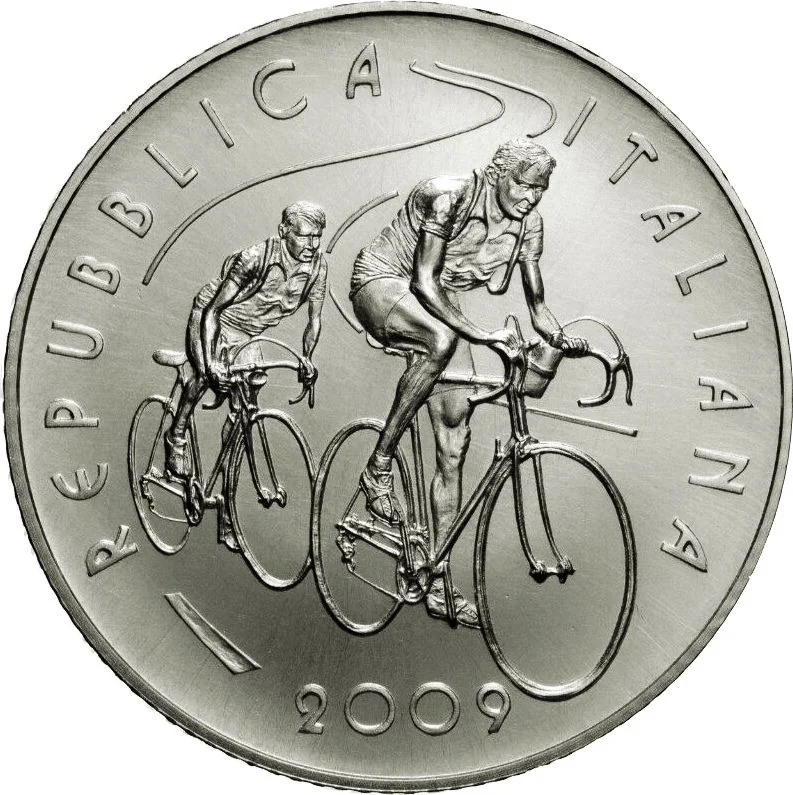
Two cyclists racing. Below, the date.
Inscription:
REPUBBLICA ITALIANA
2009
2009
Translation:
Italian Republic
2009
2009
Script: Latin
Language: Italian
Engraver: Valerio De Seta
Reverse
Description:
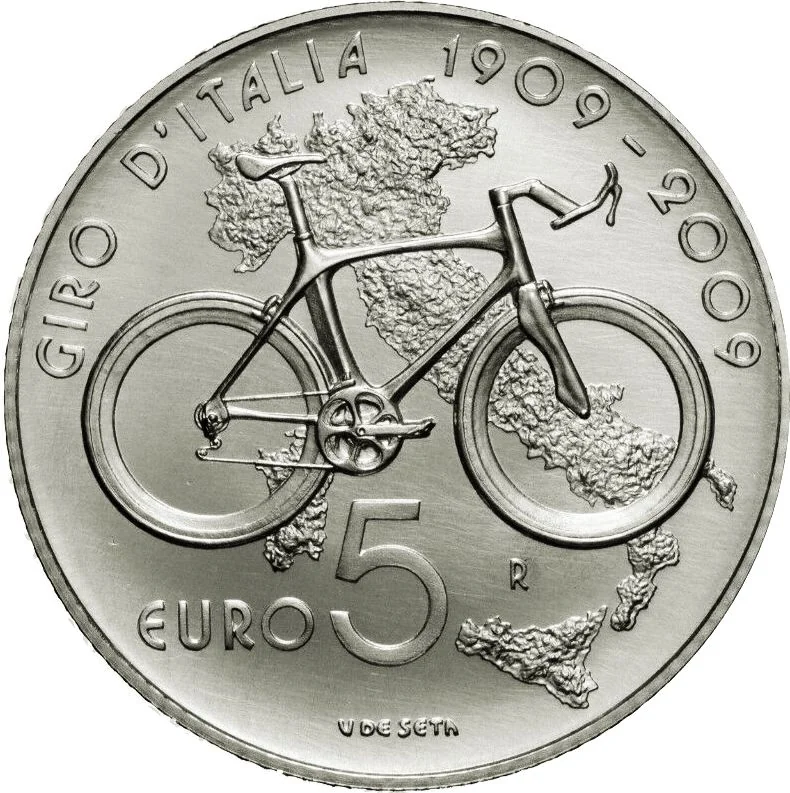
A racing bicycle in the foreground with a map of Italy in the background. Below are the value, mint mark, and author's name.
Inscription:
GIRO D'ITALIA 1909-2009
R
EURO 5
V DE SETA
R
EURO 5
V DE SETA
Script: Latin
Engraver: Valerio De Seta
Edge
Continuous coarse milled
Categories
| Sport> Cycling |
| Transportation> Bike or motorcycle |
Mints
| Name | Mark |
|---|---|
| Rome | R |
Mintings
| Year | Mint Mark | Mintage | Quality | Collection |
|---|---|---|---|---|
| 2009 | R | 11,200 | BU |
Historical background
In 2009, Italy's currency situation was defined by its membership in the Eurozone, having adopted the euro as its sole legal tender in 2002. The global financial crisis, which intensified in late 2008, presented a severe stress test for the Italian economy within the single currency. Unlike the pre-euro era, Italy could no longer devalue its national currency (the lira) to regain competitiveness or use independent monetary policy to stimulate growth. Instead, it was bound by the European Central Bank's one-size-fits-all interest rate, which was not tailored to Italy's specific needs, particularly its chronically low growth and high public debt.
The core of Italy's 2009 predicament was the interaction of a deep recession—with GDP contracting by over 5%—and its massive public debt, which exceeded 115% of GDP. The crisis exposed structural weaknesses: a lack of competitiveness against Germany within the Eurozone, rigid labor markets, and low productivity growth. While the euro provided stability and prevented a currency crisis, it also removed traditional crisis tools, forcing the government to rely solely on fiscal policy. This led to increased borrowing and a rising debt-to-GDP ratio as the economy shrank, raising early concerns among investors about long-term debt sustainability.
Consequently, 2009 marked the beginning of a prolonged period of economic vulnerability for Italy within the monetary union. The year ended with Italy facing the dual challenge of managing a severe recession while its key fiscal indicators deteriorated, setting the stage for the European sovereign debt crisis that would fully erupt in 2011. In this crisis, Italy's high debt and stagnant economy would make it a primary focus of market speculation, testing the very foundations of the Eurozone.
The core of Italy's 2009 predicament was the interaction of a deep recession—with GDP contracting by over 5%—and its massive public debt, which exceeded 115% of GDP. The crisis exposed structural weaknesses: a lack of competitiveness against Germany within the Eurozone, rigid labor markets, and low productivity growth. While the euro provided stability and prevented a currency crisis, it also removed traditional crisis tools, forcing the government to rely solely on fiscal policy. This led to increased borrowing and a rising debt-to-GDP ratio as the economy shrank, raising early concerns among investors about long-term debt sustainability.
Consequently, 2009 marked the beginning of a prolonged period of economic vulnerability for Italy within the monetary union. The year ended with Italy facing the dual challenge of managing a severe recession while its key fiscal indicators deteriorated, setting the stage for the European sovereign debt crisis that would fully erupt in 2011. In this crisis, Italy's high debt and stagnant economy would make it a primary focus of market speculation, testing the very foundations of the Eurozone.

💎 Extremely Rare