

5 francs – Togo
Add to wishlist
Togo
Context
Year: 1956
Issuer: Togo
Period:
(1946—1958)
Currency:
(1924—1956)
Demonetized: Yes
Total mintage: 10,000,000
Material
Diameter: 20 mm
Weight: 2.89 g
Shape: Round
Composition: Aluminium bronze
Magnetic: No
Technique: Milled
Alignment: Coin alignment
flip
References
KM: #
Numista: #8335
Obverse
Description:
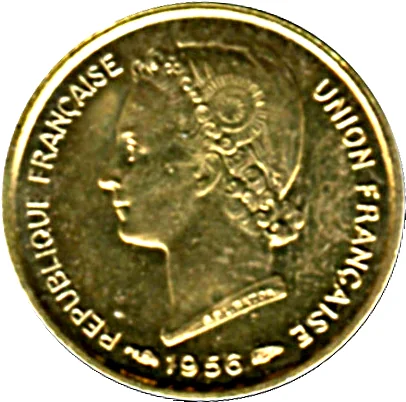
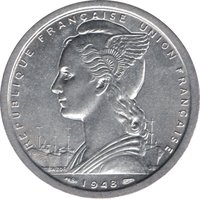
Left-facing Marianne in a Phrygian cap with a French cockade. Engraver's mark: G.B.L.BAZOR.
Inscription:
REPUBLIQUE FRANÇAISE UNION FRANÇAISE
G.B.L. BAZOR
1956
G.B.L. BAZOR
1956
Translation:
FRENCH REPUBLIC FRENCH UNION
G.B.L. BAZOR
1956
G.B.L. BAZOR
1956
Script: Latin
Language: French
Engraver: Lucien Georges Bazor
Reverse
Description:
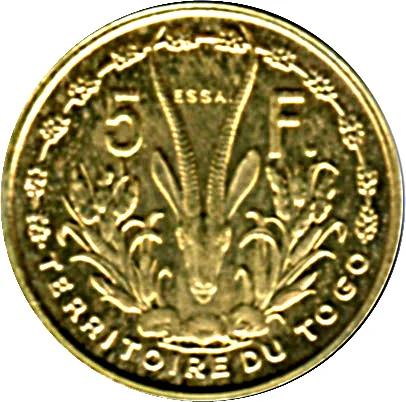
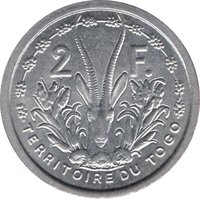
Slender-horned gazelle divides maize stocks. Border of linked sorghum. Text: "Territoire du Togo".
Inscription:
5 F.
TERRITOIRE DU TOGO
TERRITOIRE DU TOGO
Translation:
TERRITORY OF TOGO
5 FRANCS
5 FRANCS
Script: Latin
Language: French
Engraver: Lucien Georges Bazor
Edge
Plain
Mints
| Name | Mark |
|---|---|
| Monnaie de Paris | — |
Mintings
| Year | Mint Mark | Mintage | Quality | Collection |
|---|---|---|---|---|
| 1956 | — | 10,000,000 |
Historical background
In 1956, Togo existed as a dual-territory under a United Nations trusteeship, administered by France (French Togoland) and the United Kingdom (British Togoland). This political division directly dictated the currency situation. The larger French-administered territory, on the path to becoming the modern Togo, was fully integrated into the monetary system of French West Africa. Consequently, its official currency was the CFA franc (Colonies Françaises d'Afrique), issued by the Banque Centrale des États de l'Afrique de l'Ouest (BCEAO). This currency was pegged to the French franc and guaranteed by the French Treasury, ensuring stability but firmly anchoring the economy to France.
Meanwhile, the smaller British-administered strip along the western border, which would later vote to integrate with Ghana, used the British West African pound. This created a distinct economic zone separated from its French-administered neighbor by both currency and trade policy. The dual-currency reality reflected the broader geopolitical tensions of the era, as the territory was a focal point for Anglo-French influence and the emerging nationalist movements debating future unification or independence.
Therefore, the currency landscape of 1956 was one of fragmentation and external dependency. There was no singular "Togolese" currency; instead, the mediums of exchange were imposed instruments of colonial administration. This system facilitated trade within each respective bloc but complicated cross-border commerce within Togo itself. The situation was inherently transitional, poised to change with the impending political decisions of the late 1950s, which would see French Togoland gain independence in 1960 and initially retain the CFA franc as its national currency.
Meanwhile, the smaller British-administered strip along the western border, which would later vote to integrate with Ghana, used the British West African pound. This created a distinct economic zone separated from its French-administered neighbor by both currency and trade policy. The dual-currency reality reflected the broader geopolitical tensions of the era, as the territory was a focal point for Anglo-French influence and the emerging nationalist movements debating future unification or independence.
Therefore, the currency landscape of 1956 was one of fragmentation and external dependency. There was no singular "Togolese" currency; instead, the mediums of exchange were imposed instruments of colonial administration. This system facilitated trade within each respective bloc but complicated cross-border commerce within Togo itself. The situation was inherently transitional, poised to change with the impending political decisions of the late 1950s, which would see French Togoland gain independence in 1960 and initially retain the CFA franc as its national currency.
🌱 Common