

1 Rupee – Pakistan
Pakistan
Context
Years: 1979–1981
Issuer: Pakistan 
Period:
(since 1956)
Currency:
(since 1961)
Total mintage: 26,560,000
Material
Diameter: 26.5 mm
Weight: 6.5 g
Thickness: 1.5 mm
Shape: Round
Composition: Copper-nickel
Technique: Milled
Alignment: Medal alignment
flip
References
KM: #Click to copy to clipboard57.1
Numista: #114140
Value
Exchange value: 1 PKR
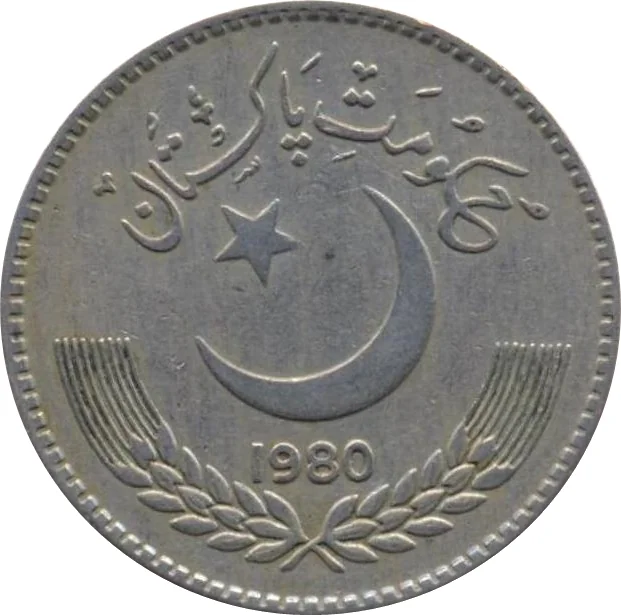
Obverse
Description:
Crescent and star above date.
Inscription:
حكومت پاکستان
1980
1980
Translation:
Government of Pakistan
1980
1980
Language: Urdu
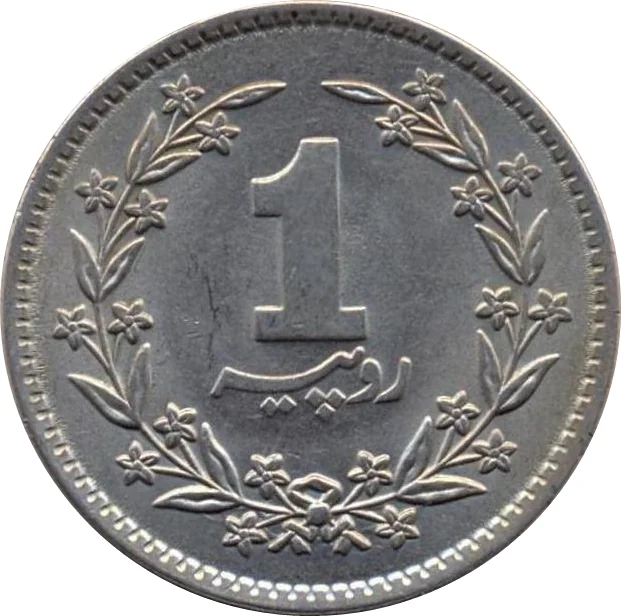
Reverse
Description:
Denomination flanked by sprays
Inscription:
1
روپيه
روپيه
Translation:
One Rupee
Language: Urdu
Edge
Reeded
Mintings
| Year | Mint Mark | Mintage | Quality | Collection |
|---|---|---|---|---|
| 1979 | — | — | ||
| 1980 | — | 14,522,000 | ||
| 1981 | — | 12,038,000 |
Historical background
In 1979, Pakistan's currency situation was characterized by a managed exchange rate system under the control of the State Bank of Pakistan. The Pakistani rupee was pegged to a basket of currencies of its major trading partners, though it was often informally linked to the US dollar. This period followed the economic nationalization policies of the early 1970s under Zulfikar Ali Bhutto, which had left the economy with structural weaknesses, including a growing trade deficit and inflationary pressures. However, the rupee's value was artificially maintained by administrative controls, leading to a significant disparity between the official exchange rate and the more active black-market rate, where the rupee traded at a considerable discount.
The year itself was a geopolitical and economic inflection point. The Soviet invasion of Afghanistan in late 1979 triggered a massive influx of Western, particularly American, aid and military assistance to Pakistan, which became a frontline state. This foreign capital inflow, along with remittances from Pakistani workers in the Gulf states (bolstered by the 1970s oil boom), provided crucial support to the country's foreign exchange reserves. These inflows helped stabilize the balance of payments and allowed the government of General Muhammad Zia-ul-Haq to sustain the managed currency regime without immediate crisis, masking some underlying economic vulnerabilities.
Despite this external financial cushion, the fundamental issues of a regulated economy persisted. The fixed exchange rate, combined with import restrictions and licensing, created distortions and inefficiencies. It discouraged exports by making them less competitive and encouraged an underground economy for foreign currency. Therefore, while 1979 did not see a dramatic currency collapse due to substantial external inflows, it represented a period of controlled stability that was unsustainable in the long term, setting the stage for future structural adjustment programs and a shift towards a more market-determined exchange rate in the subsequent decades.
The year itself was a geopolitical and economic inflection point. The Soviet invasion of Afghanistan in late 1979 triggered a massive influx of Western, particularly American, aid and military assistance to Pakistan, which became a frontline state. This foreign capital inflow, along with remittances from Pakistani workers in the Gulf states (bolstered by the 1970s oil boom), provided crucial support to the country's foreign exchange reserves. These inflows helped stabilize the balance of payments and allowed the government of General Muhammad Zia-ul-Haq to sustain the managed currency regime without immediate crisis, masking some underlying economic vulnerabilities.
Despite this external financial cushion, the fundamental issues of a regulated economy persisted. The fixed exchange rate, combined with import restrictions and licensing, created distortions and inefficiencies. It discouraged exports by making them less competitive and encouraged an underground economy for foreign currency. Therefore, while 1979 did not see a dramatic currency collapse due to substantial external inflows, it represented a period of controlled stability that was unsustainable in the long term, setting the stage for future structural adjustment programs and a shift towards a more market-determined exchange rate in the subsequent decades.
🌱 Common