

2 Frederiks d'Or – Denmark
Denmark
Context
Years: 1850–1863
Issuer: Denmark 
Ruler: Frederick VII
Currency:
(1813—1854)
Subdivision: 2 Frederiks d'Or = 10 Speciedaler
Demonetized: Yes
Total mintage: 1,205,000
Material
References
KM: #Click to copy to clipboard750
Numista: #83075
Value
Bullion value: $1988.84
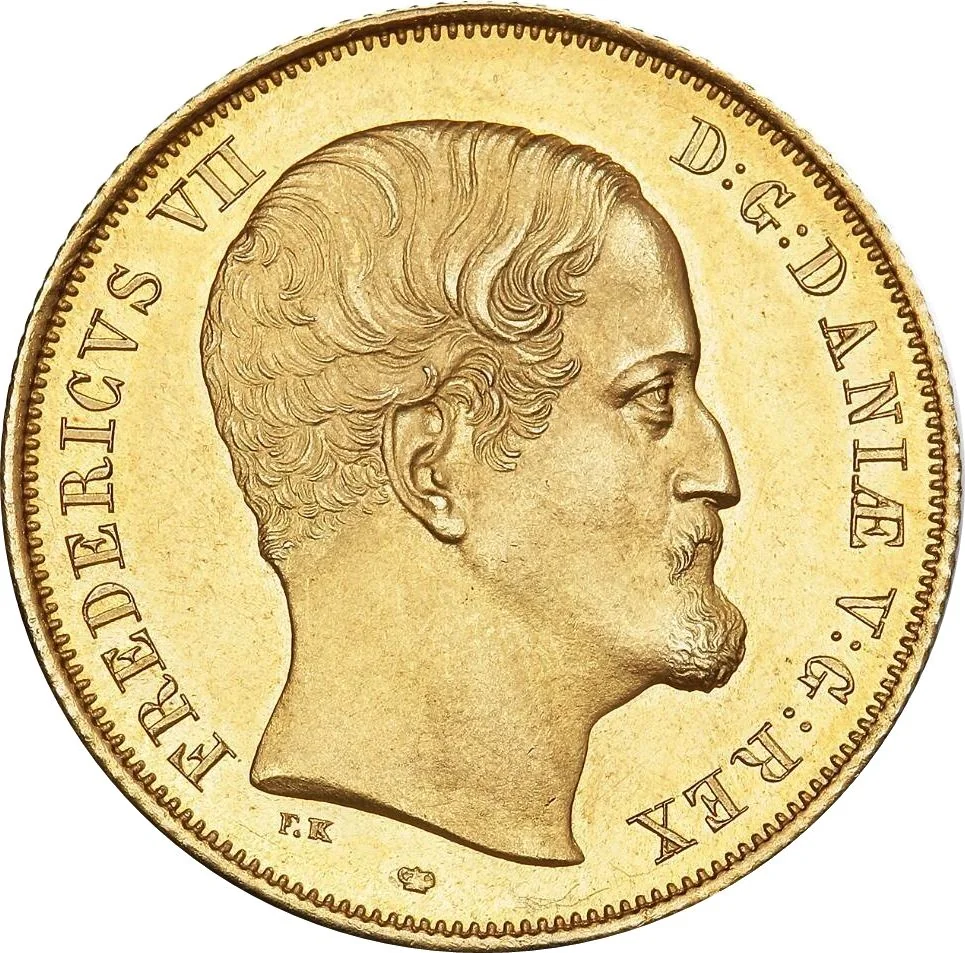
Obverse
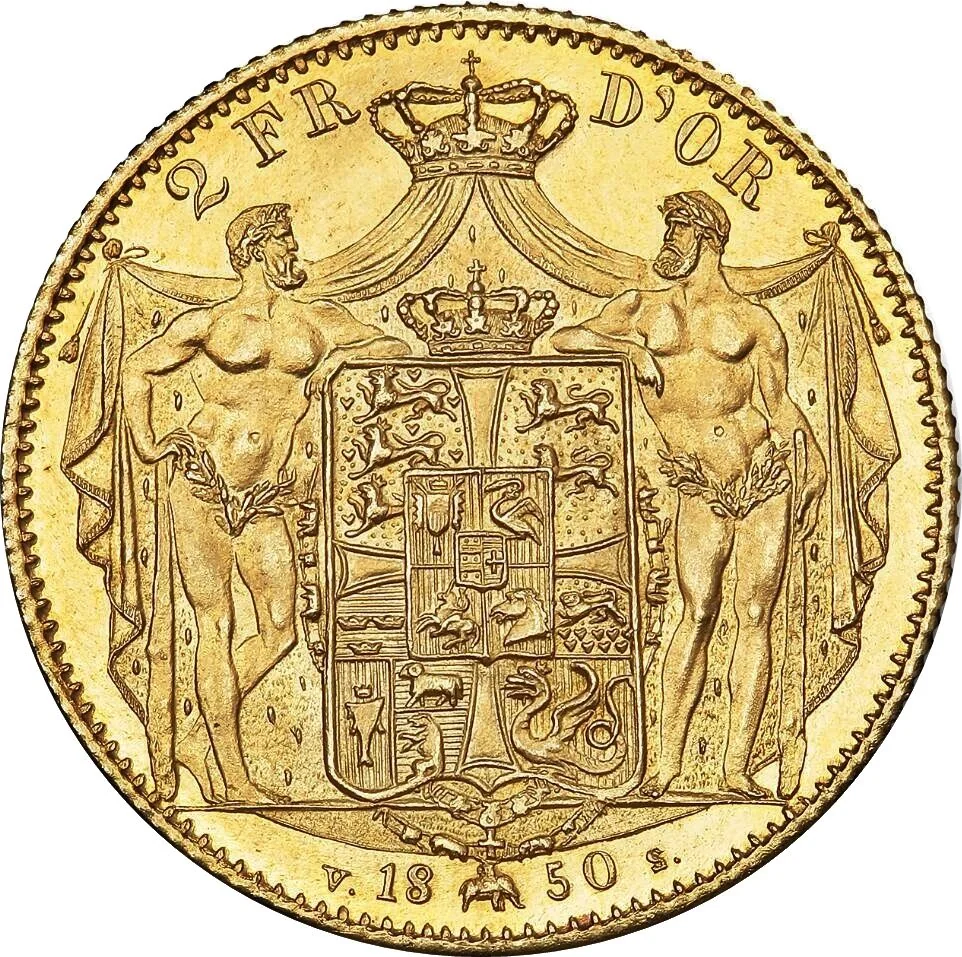
Reverse
Description:
Crowned grater shield with the Arms of Denmark and territories, supported by club-armed wildmen. A crowned mantle appears behind the shield and supporters. Value is above, date below.
Inscription:
2 FR D'OR
V. 18 | 50 S.
V. 18 | 50 S.
Script: Latin
Edge
Reeded
Mints
| Name | Mark |
|---|---|
| Altona, Schleswig-Holstein | ♁ |
| Royal Danish Mint | ♔ |
Mintings
Historical background
In 1850, Denmark's currency situation was characterized by a complex and fragmented system, a legacy of its historical union and regional divisions. The official currency was the rigsdaler, but it existed in multiple, non-interchangeable forms. Most notably, there was a distinction between the rigsdaler courant, used for everyday domestic transactions, and the rigsbankdaler (or speciedaler), which was tied to silver and used for international trade and larger contracts. Furthermore, the Duchies of Schleswig and Holstein, then under the Danish crown, used their own distinct systems based on the Hamburg Mark Banco and Schleswig-Holstein speciedaler, adding another layer of complication to commerce within the realm.
This multiplicity created significant practical problems for trade, banking, and daily life. Exchange rates between the various daler units and foreign currencies fluctuated, and the widespread use of physical silver coins alongside paper notes issued by private banks led to instability and a lack of public confidence. The system was inefficient, hindering economic integration and growth at a time when industrialization was beginning to take hold in Europe. The state's finances were also strained, particularly in the aftermath of the First Schleswig War (1848-1851), which increased pressure for monetary reform.
Consequently, the 1850s became a pivotal decade for Danish currency reform. The groundwork was being laid for a decisive shift towards a unified, modern, and decimal-based system. This culminated in the Currency Act of 1873, which introduced the krone and øre, firmly placing Denmark on the gold standard. Therefore, the situation in 1850 represents the final chapter of an outdated monetary order, with the country on the cusp of the reforms that would create the stable and simple currency system known today.
This multiplicity created significant practical problems for trade, banking, and daily life. Exchange rates between the various daler units and foreign currencies fluctuated, and the widespread use of physical silver coins alongside paper notes issued by private banks led to instability and a lack of public confidence. The system was inefficient, hindering economic integration and growth at a time when industrialization was beginning to take hold in Europe. The state's finances were also strained, particularly in the aftermath of the First Schleswig War (1848-1851), which increased pressure for monetary reform.
Consequently, the 1850s became a pivotal decade for Danish currency reform. The groundwork was being laid for a decisive shift towards a unified, modern, and decimal-based system. This culminated in the Currency Act of 1873, which introduced the krone and øre, firmly placing Denmark on the gold standard. Therefore, the situation in 1850 represents the final chapter of an outdated monetary order, with the country on the cusp of the reforms that would create the stable and simple currency system known today.
💎 Extremely Rare