

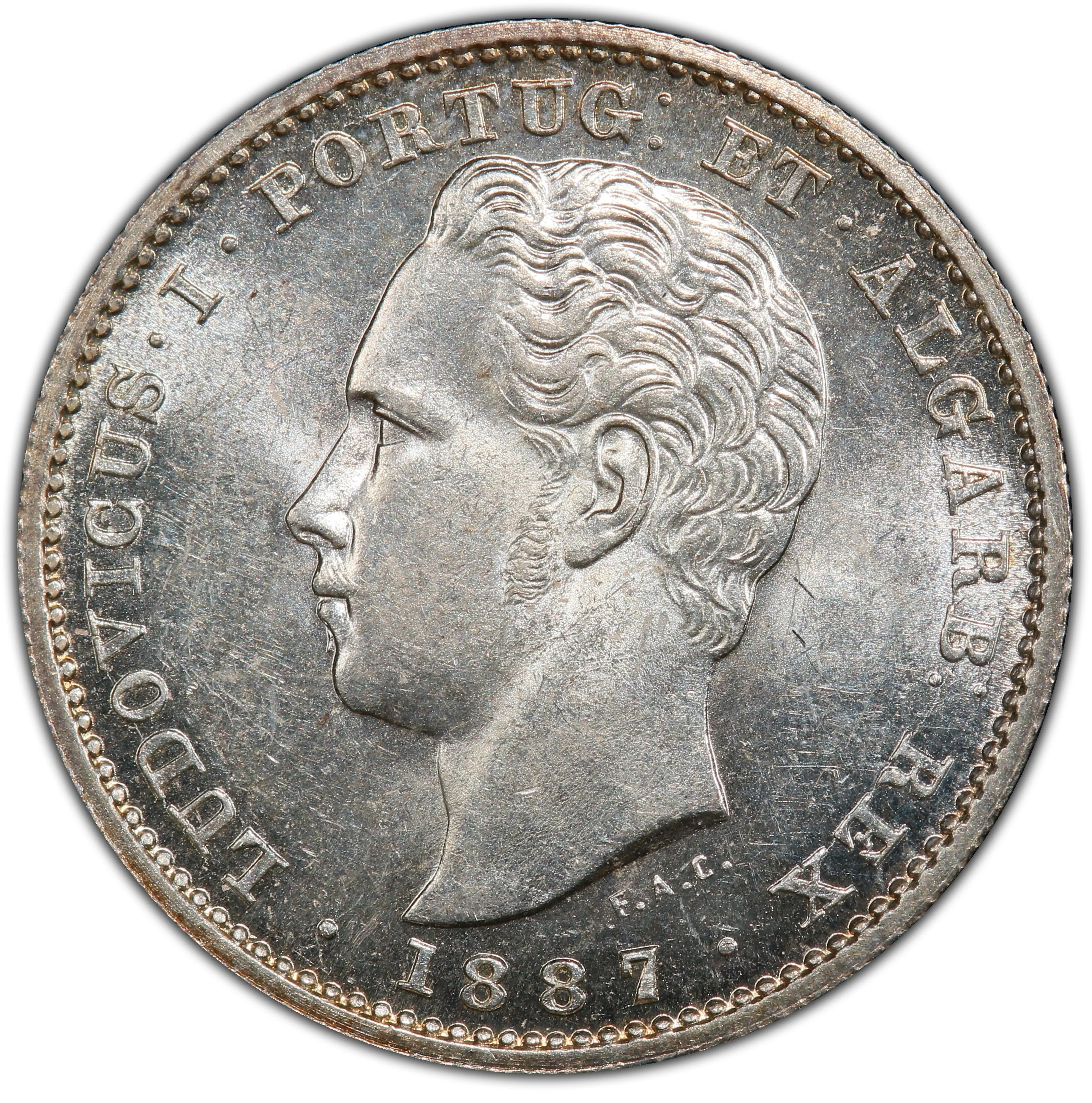
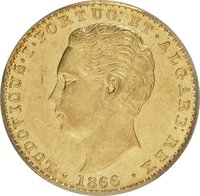
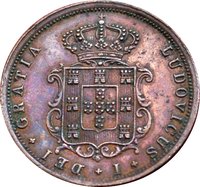
Obverse
Description:
Portrait of Luís I of Portugal.
Inscription:
LUDOVICUS·I·PORTUG: ET·ALGARB: REX
F. A.C.
· 1887 ·
F. A.C.
· 1887 ·
Translation:
Louis I, King of Portugal and the Algarves.
F. A. C.
· 1887 ·
F. A. C.
· 1887 ·
Script: Latin
Languages: Latin, Portuguese
Engraver: Frederico Augusto de Campos
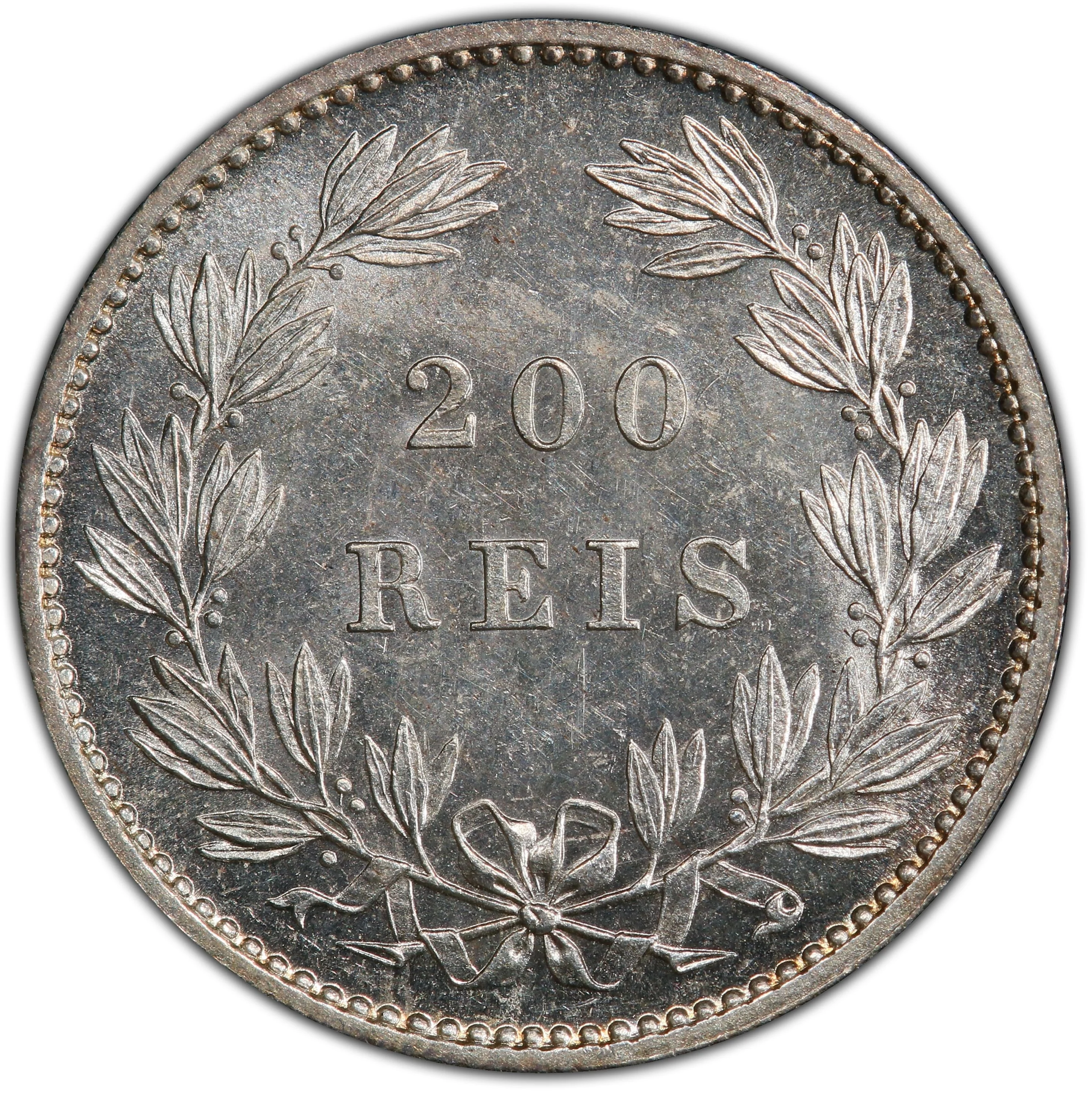
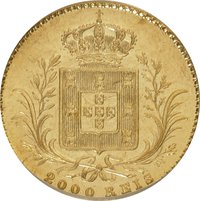
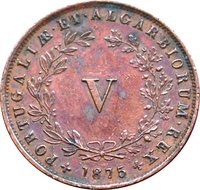
Reverse
Description:
Wreath's worth
Inscription:
200
REIS
REIS
Script: Latin
Engraver: Frederico Augusto de Campos
Edge
Reeded
Mints
| Name | Mark |
|---|---|
| Imprensa Nacional - Casa da Moeda | — |
Mintings
| Year | Mint Mark | Mintage | Quality | Collection |
|---|---|---|---|---|
| 1865 | — | 50,000 | ||
| 1866 | — | 10,000 | ||
| 1867 | — | 10,000 | ||
| 1868 | — | 5,000 | ||
| 1871 | — | 75,000 | ||
| 1872 | — | 70,000 | ||
| 1875 | — | 70,000 | ||
| 1875 | — | — | Proof | |
| 1876 | — | 80,000 | ||
| 1877 | — | 30,000 | ||
| 1878 | — | 20,000 | ||
| 1879 | — | 5,050 | ||
| 1880 | — | 150,000 | ||
| 1880 | — | — | Proof | |
| 1886 | — | 340,000 | ||
| 1886 | — | — | Proof | |
| 1887 | — | 3,600,000 | ||
| 1887 | — | — | Proof | |
| 1888 | — | 700,000 | ||
| 1888 | — | — | Proof |
Historical background
In 1865, Portugal’s currency system was in a state of transition and complexity, caught between traditional practices and the pressures of modernization. The official currency was the Portuguese real (plural: réis), a system of account that had been in use for centuries. However, the monetary reality was fragmented. Gold coins, such as the cruzado, and silver coins circulated, but their actual value often deviated from their face value due to fluctuations in the relative market prices of precious metals. This period followed the gold standard abandonment in the wake of the Napoleonic Wars, leaving Portugal with a de facto silver-based system that was increasingly unstable within the European context.
The mid-19th century saw Portugal grappling with significant budget deficits, public debt, and economic stagnation, which placed severe pressure on its currency. A major issue was the widespread circulation of foreign coins, particularly British gold sovereigns and French francs, which were often preferred for large transactions due to their trusted intrinsic value. This undermined the domestic currency. Furthermore, the government frequently resorted to issuing depreciated copper coinage to finance its deficits, leading to inflation and a loss of public confidence in the lower-denomination currency used in everyday life.
Recognizing the need for reform, Portuguese authorities were actively working toward a fundamental change. This culminated in the monetary law of 1854, which adopted a gold standard and introduced a new unit, the real based on a fixed gold weight. However, the full practical implementation of this reform was a prolonged process. Thus, by 1865, the country was in an interim phase—legally on a gold standard but still managing the practical circulation and credibility problems of its old, heterogeneous coinage while striving to integrate into the emerging international monetary order.
The mid-19th century saw Portugal grappling with significant budget deficits, public debt, and economic stagnation, which placed severe pressure on its currency. A major issue was the widespread circulation of foreign coins, particularly British gold sovereigns and French francs, which were often preferred for large transactions due to their trusted intrinsic value. This undermined the domestic currency. Furthermore, the government frequently resorted to issuing depreciated copper coinage to finance its deficits, leading to inflation and a loss of public confidence in the lower-denomination currency used in everyday life.
Recognizing the need for reform, Portuguese authorities were actively working toward a fundamental change. This culminated in the monetary law of 1854, which adopted a gold standard and introduced a new unit, the real based on a fixed gold weight. However, the full practical implementation of this reform was a prolonged process. Thus, by 1865, the country was in an interim phase—legally on a gold standard but still managing the practical circulation and credibility problems of its old, heterogeneous coinage while striving to integrate into the emerging international monetary order.
🌱 Fairly Common