

10 Zlotys (Stefan Wyszyński's birth) – Poland
Non-circulating coins
Commemoration: 100th centenary of Priest Cardinal Stefan Wyszyński's birth
Poland

Obverse
Description:
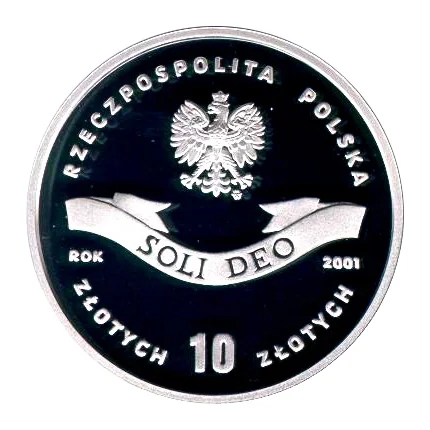
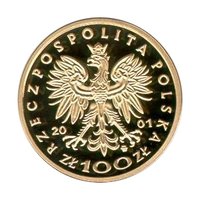
Poland's State Eagle emblem with "RZECZPOSPOLITA POLSKA" above. Below, inscriptions: "SOLI DEO" on a ribbon, "ROK 2001", and "ZŁOTYCH 10 ZŁOTYCH". Mint mark "m/w" under the Eagle's left talon.
Inscription:
RZECZPOSPOLITA POLSKA
mw
SOLI DEO
ROK 2001
ZŁOTYCH 10 ZŁOTYCH
mw
SOLI DEO
ROK 2001
ZŁOTYCH 10 ZŁOTYCH
Translation:
REPUBLIC OF POLAND
mw
TO GOD ALONE
YEAR 2001
10 ZŁOTYCH
mw
TO GOD ALONE
YEAR 2001
10 ZŁOTYCH
Script: Latin
Designer: Ewa Olszewska-Borys
Reverse
Description:
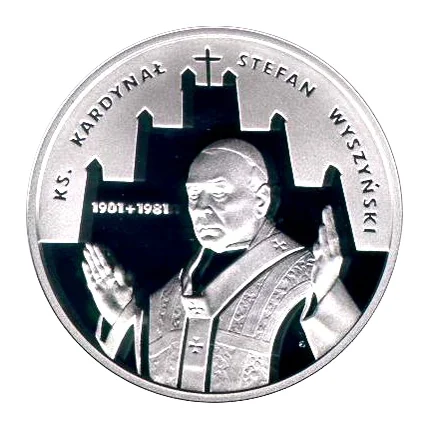
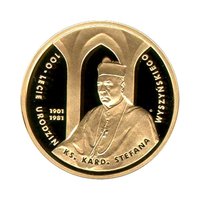
Cardinal Stefan Wyszyński before an outline of Warsaw's St. John Cathedral, with the dates 1901-1981.
Inscription:
KS. KARDYNAŁ STEFAN WYSZYŃSKI
1901 + 1981
1901 + 1981
Translation:
Cardinal Stefan Wyszyński
1901 + 1981
1901 + 1981
Script: Latin
Language: Polish
Designer: Ewa Olszewska-Borys
Edge
Smooth with inscription
Legend:
100 • ROCZNICA URODZIN ☆ 100 • ROCZNICA URODZIN ☆ 100 • ROCZNICA URODZIN ☆
Translation:
100TH ANNIVERSARY OF BIRTH ☆ 100TH ANNIVERSARY OF BIRTH ☆ 100TH ANNIVERSARY OF BIRTH ☆
Language: Polish
Categories
| Event> Birth anniversary |
| Person> Religious figure |
Mints
| Name | Mark |
|---|---|
| Mint of Poland | (MW) |
Mintings
| Year | Mint Mark | Mintage | Quality | Collection |
|---|---|---|---|---|
| 2001 | MW | 60,000 | Proof |
Historical background
In 2001, Poland's currency situation was defined by a managed float regime for the Polish złoty (PLN), which operated within a crawling peg band system. Following a period of high inflation in the early 1990s, the National Bank of Poland (NBP) had successfully used this mechanism to guide the złoty through a controlled, pre-announced devaluation, fostering stability and anchoring inflation expectations. However, by the turn of the millennium, the system was becoming increasingly rigid and costly to defend, particularly as Poland pursued its strategic goal of European Union accession, which required moving towards a free-floating currency.
The year was marked by significant external pressure and domestic economic strain. A strong dollar globally, coupled with the fallout from the Russian financial crisis and slower growth in the EU, weakened the złoty. Simultaneously, Poland faced a widening current account deficit and rising public debt, which undermined investor confidence. This led to sustained speculative attacks against the currency, forcing the NBP to spend billions of foreign reserves in costly interventions to maintain the złoty within its permitted trading band, highlighting the system's vulnerability.
Recognizing these unsustainable pressures, the NBP enacted a pivotal reform in April 2001 by switching to a free-floating exchange rate regime. This decisive move, accompanied by a shift to a direct inflation-targeting monetary policy, was intended to absorb external shocks more efficiently and eliminate the one-way bet for speculators. While the immediate effect was a sharp depreciation of the złoty, the reform was a crucial step towards modernizing Poland's financial framework, granting the central bank greater monetary policy independence and aligning the country with the requirements for future Eurozone membership.
The year was marked by significant external pressure and domestic economic strain. A strong dollar globally, coupled with the fallout from the Russian financial crisis and slower growth in the EU, weakened the złoty. Simultaneously, Poland faced a widening current account deficit and rising public debt, which undermined investor confidence. This led to sustained speculative attacks against the currency, forcing the NBP to spend billions of foreign reserves in costly interventions to maintain the złoty within its permitted trading band, highlighting the system's vulnerability.
Recognizing these unsustainable pressures, the NBP enacted a pivotal reform in April 2001 by switching to a free-floating exchange rate regime. This decisive move, accompanied by a shift to a direct inflation-targeting monetary policy, was intended to absorb external shocks more efficiently and eliminate the one-way bet for speculators. While the immediate effect was a sharp depreciation of the złoty, the reform was a crucial step towards modernizing Poland's financial framework, granting the central bank greater monetary policy independence and aligning the country with the requirements for future Eurozone membership.
💎 Very Rare