

10 Zlotys (Fryderyk Chopin) – Poland
Non-circulating coins
Commemoration: 150th anniversary of Fryderyk Chopin's death
Poland
Obverse
Description:
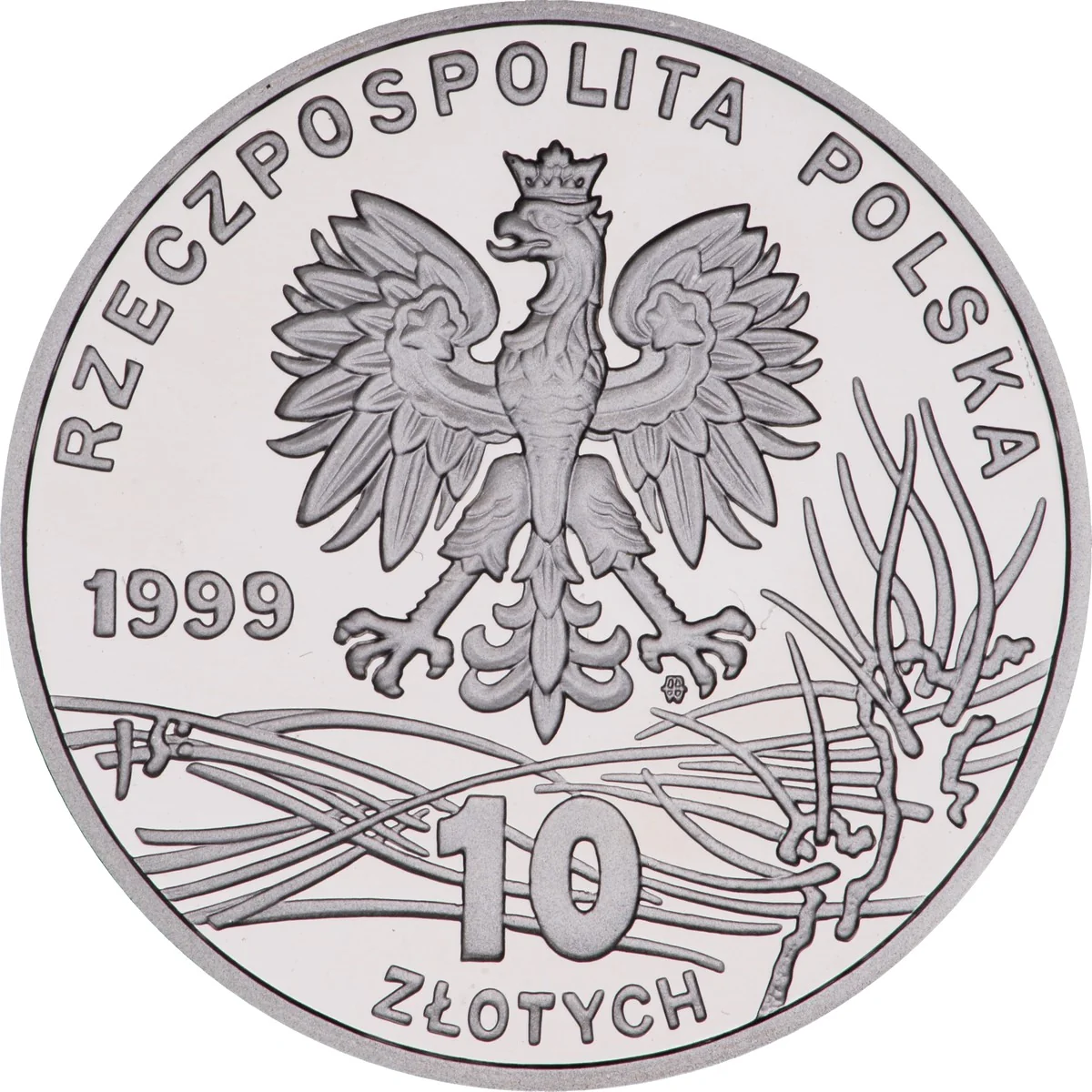
Central image of Poland's eagle state emblem. Below, stylized stave and willows. Left: year 1999. Top semicircular inscription: RZECZPOSPOLITA POLSKA. Bottom: 10 ZŁOTYCH. Mint mark (m/w) under eagle's left talon.
Inscription:
RZECZPOSPOLITA POLSKA
1999
mw
10
ZŁOTYCH
1999
mw
10
ZŁOTYCH
Translation:
REPUBLIC OF POLAND
1999
mw
10
ZŁOTYCH
1999
mw
10
ZŁOTYCH
Script: Latin
Language: Polish
Designer: Roussanka Nowakowska
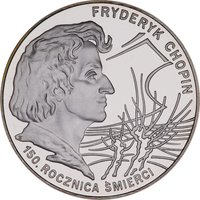
Reverse
Description:
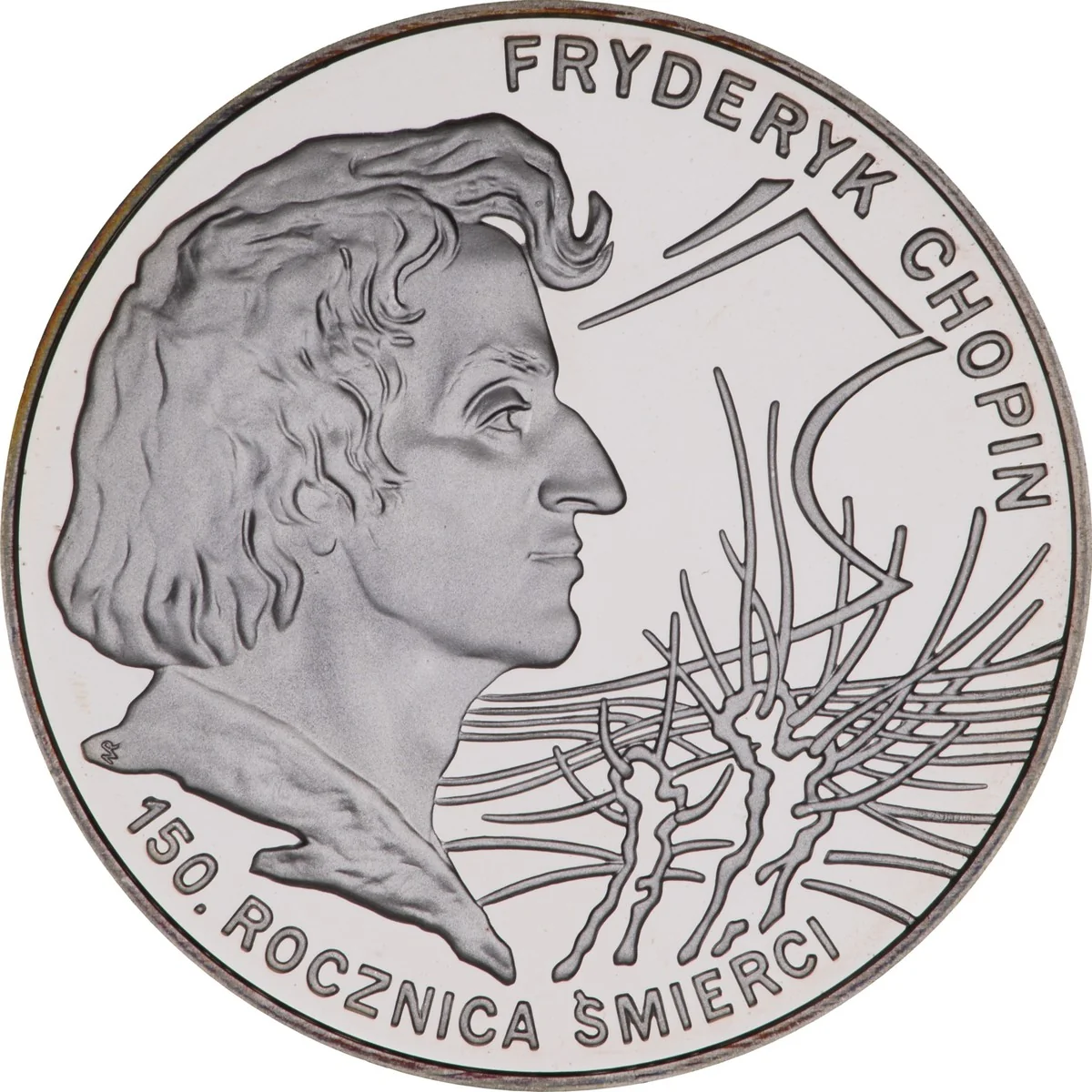
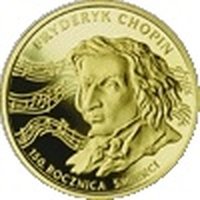
Fryderyk Chopin's right profile, with stylized piano and willows. Above: FRYDERYK CHOPIN. Below: 150. ROCZNICA ŚMIERCI.
Inscription:
FRYDERYK CHOPIN
150. ROCZNICA ŚMIERCI
150. ROCZNICA ŚMIERCI
Translation:
FRYDERYK CHOPIN
150TH ANNIVERSARY OF DEATH
150TH ANNIVERSARY OF DEATH
Script: Latin
Language: Polish
Designer: Roussanka Nowakowska
Edge
Plain
Categories
| Event> Death anniversary |
Mints
| Name | Mark |
|---|---|
| Mint of Poland | (MW) |
Mintings
| Year | Mint Mark | Mintage | Quality | Collection |
|---|---|---|---|---|
| 1999 | MW | 27,000 | Proof |
Historical background
In 1999, Poland's currency situation was defined by a period of strategic stability and preparation for European integration. The Polish złoty (PLN) was operating under a managed floating exchange rate regime, but with a clear anchor: a crawling peg to a currency basket (initially the USD and DEM, later shifting to the EUR as the Euro was introduced that year). This mechanism allowed the złoty to depreciate at a pre-announced, controlled rate (the "crawl") of approximately 0.3% per month. This policy, managed by the National Bank of Poland (NBP), aimed to balance competing goals: maintaining export competitiveness through a modest, predictable depreciation while firmly anchoring inflation expectations and preventing volatile market swings.
The broader economic context was one of robust growth and macroeconomic consolidation following the shock therapy reforms of the early 1990s. Inflation, though significantly tamed from hyperinflationary levels, remained a concern, hovering around 7-8% in 1999. The central bank's disciplined exchange rate policy was a crucial tool in the ongoing disinflation process. Furthermore, 1999 was a landmark year as Poland formally entered the first stage of European Exchange Rate Mechanism (ERM) preparation, having joined NATO in March and actively pursuing EU membership. The currency basket's shift to the Euro reflected this strategic reorientation toward the European Union's economic structures.
Consequently, the currency situation was not one of crisis but of deliberate transition. The stability of the crawling peg provided a predictable environment for foreign investment, which was flowing in steadily. However, discussions were already underway among policymakers and economists about the eventual need to move to a more flexible exchange rate regime—first to a free float and later, as EU accession neared, to participation in ERM II—as a final step before adopting the Euro. Thus, 1999 represented a calm yet purposeful phase, where the złoty's management was a key component in Poland's steady march toward integration with Western economic and political institutions.
The broader economic context was one of robust growth and macroeconomic consolidation following the shock therapy reforms of the early 1990s. Inflation, though significantly tamed from hyperinflationary levels, remained a concern, hovering around 7-8% in 1999. The central bank's disciplined exchange rate policy was a crucial tool in the ongoing disinflation process. Furthermore, 1999 was a landmark year as Poland formally entered the first stage of European Exchange Rate Mechanism (ERM) preparation, having joined NATO in March and actively pursuing EU membership. The currency basket's shift to the Euro reflected this strategic reorientation toward the European Union's economic structures.
Consequently, the currency situation was not one of crisis but of deliberate transition. The stability of the crawling peg provided a predictable environment for foreign investment, which was flowing in steadily. However, discussions were already underway among policymakers and economists about the eventual need to move to a more flexible exchange rate regime—first to a free float and later, as EU accession neared, to participation in ERM II—as a final step before adopting the Euro. Thus, 1999 represented a calm yet purposeful phase, where the złoty's management was a key component in Poland's steady march toward integration with Western economic and political institutions.
💎 Extremely Rare