

1 Ducat – Sweden
Sweden
Context
Year: 1801
Issuer: Sweden 
Ruler: Gustav IV Adolf
Currency:
(1798—1830)
Demonetized: Yes
Total mintage: 900
Material
References
KM: #Click to copy to clipboard562
Numista: #100888
Value
Bullion value: $566.30
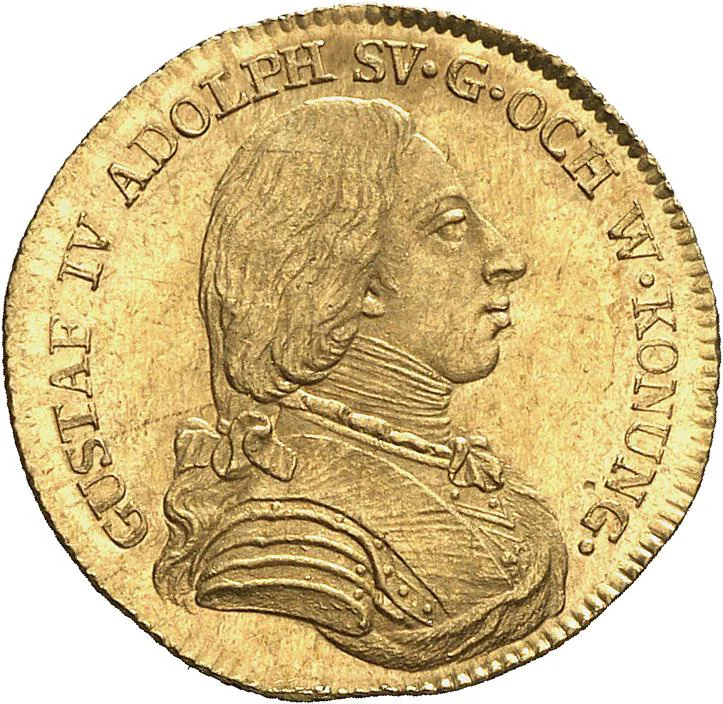
Obverse
Reverse
Description:
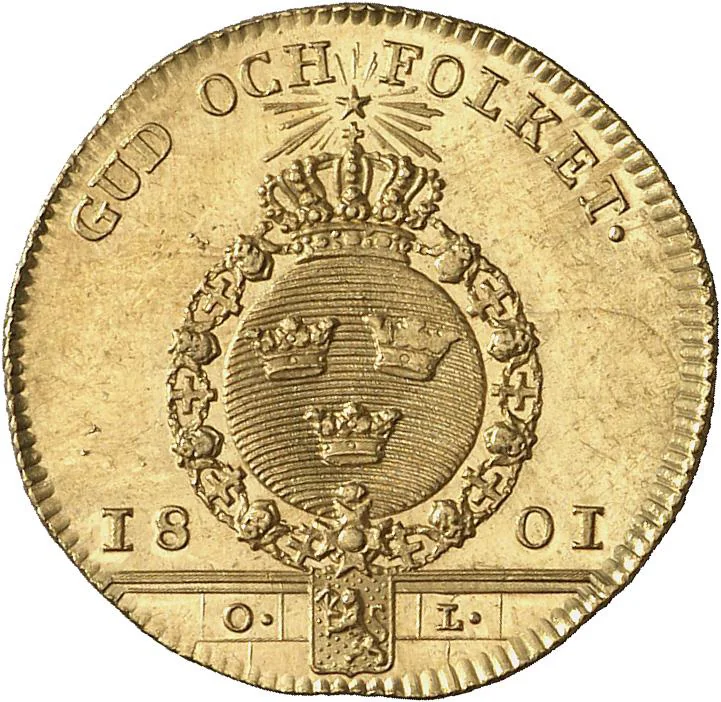
A crowned, lined orb encircled by the Order of Seraphim's chain, featuring Sweden's three crowns. A radiant star and the King's motto are above. The date is flanked by the chain, below which are the Arms of Småland—a rampant lion with a crossbow—on a brick pattern, denoting the gold's origin from Ädelfors mine.
Inscription:
GUD OCH FOLKET •
O• L•
18 01
O• L•
18 01
Translation:
Good and the People •
O • L •
18 01
O • L •
18 01
Script: Latin
Language: Swedish
Edge
Categories
| Symbols> Coat of Arms |
Mintings
| Year | Mint Mark | Mintage | Quality | Collection |
|---|---|---|---|---|
| 1801 | OL | 900 |
Historical background
In 1801, Sweden operated under a complex and strained monetary system, a legacy of the 18th century's frequent wars and economic policies. The nation was officially on a silver standard, with the riksdaler riksmynt as the primary unit of account. However, the reality was a chaotic circulation of multiple coin types, including older riksdaler specie (valued higher due to higher silver content), foreign coins, and a substantial volume of depreciated paper money. This paper currency, first issued by the Riksens Ständers Bank (precursor to the Riksbank) to finance war, had led to inflation and a severe loss of public confidence.
The situation was defined by a significant and problematic gap between the nominal value of the banknotes and their real value in silver. Notes traded at a steep discount, creating a dual-price system where goods had one price in coin and a higher price in paper. This instability hampered trade and economic planning. Furthermore, the state's finances were deeply troubled, with the government relying heavily on the bank to fund its operations through further note issuance, creating a vicious cycle of depreciation.
Consequently, 1801 fell within a prolonged period of monetary disorder that would persist until the major reforms of the 1830s. The Riksbank struggled to maintain convertibility, and debates on stabilization were ongoing. The economy functioned, but under the constant friction of an unreliable currency, highlighting the urgent need for the fiscal discipline and monetary standardization that would eventually restore stability later in the century.
The situation was defined by a significant and problematic gap between the nominal value of the banknotes and their real value in silver. Notes traded at a steep discount, creating a dual-price system where goods had one price in coin and a higher price in paper. This instability hampered trade and economic planning. Furthermore, the state's finances were deeply troubled, with the government relying heavily on the bank to fund its operations through further note issuance, creating a vicious cycle of depreciation.
Consequently, 1801 fell within a prolonged period of monetary disorder that would persist until the major reforms of the 1830s. The Riksbank struggled to maintain convertibility, and debates on stabilization were ongoing. The economy functioned, but under the constant friction of an unreliable currency, highlighting the urgent need for the fiscal discipline and monetary standardization that would eventually restore stability later in the century.
✨ Legendary