

25 euro – Austria
Add to wishlist
Non-circulating coins
Commemoration: Time.
Austria
Context
Material
References
KM: #
Numista: #82795
Value
Exchange value: 25 EUR
Inflation-adjusted value: 34.37 EUR
Obverse
Description:
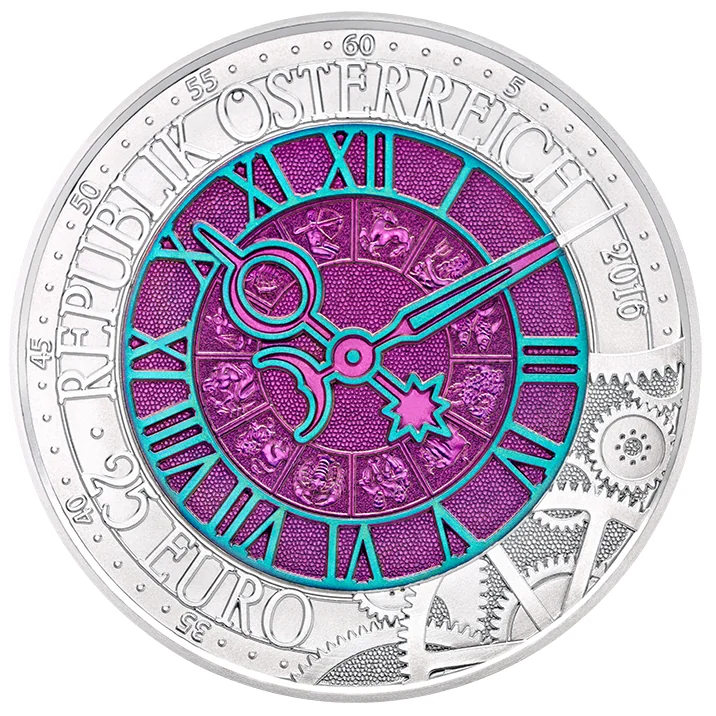
A zodiac clock.
Inscription:
35 40 45 50 55 60 5
I III IV V VI VII VIII IX X XI XII
REPUBLIK ÖSTERREICH 2016
· 25 EURO
I III IV V VI VII VIII IX X XI XII
REPUBLIK ÖSTERREICH 2016
· 25 EURO
Translation:
REPUBLIC OF AUSTRIA 2016
· 25 EURO
· 25 EURO
Script: Latin
Engraver: Helmut Andexlinger
Reverse
Description:
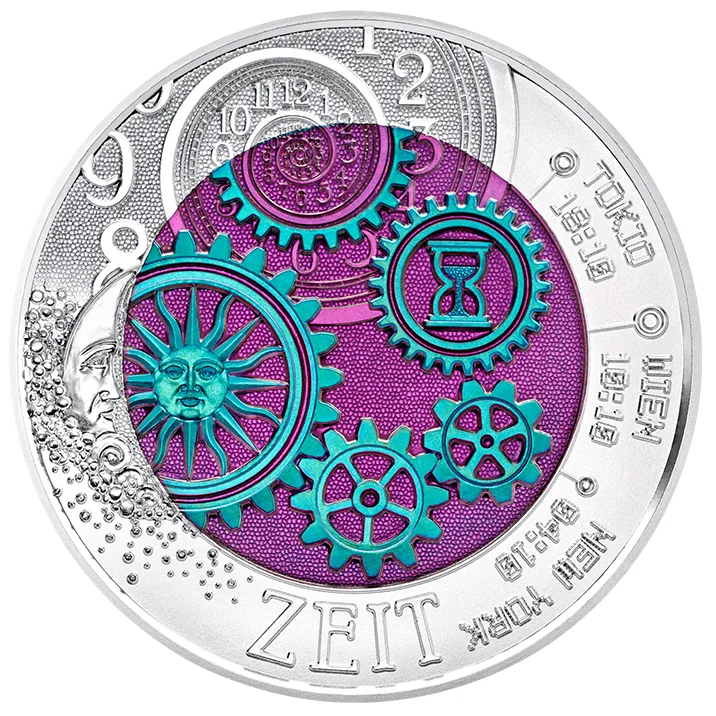
Clockwork with time symbols: hourglass, sun, moon, spiral.
Inscription:
ZEIT
TOKIO WIEN NEW-YORK
18:10 10:10 04:10
1 2 3 4 5 6 7 8 9 10 11 12
TOKIO WIEN NEW-YORK
18:10 10:10 04:10
1 2 3 4 5 6 7 8 9 10 11 12
Script: Latin
Engraver: Helmut Andexlinger
Edge
Plain
Categories
| Astrology> Western astrological sign |
Mints
| Name | Mark |
|---|---|
| Münze Österreich | — |
Mintings
| Year | Mint Mark | Mintage | Quality | Collection |
|---|---|---|---|---|
| 2016 | — | 65,000 |
Historical background
In 2016, Austria, as a member of the Eurozone, operated with the euro (€) as its official currency, a status it had held since the currency's physical introduction in 2002. The country's monetary policy was therefore set by the European Central Bank (ECB), which was engaged in expansive measures to combat low inflation and stimulate the euro area economy following the European debt crisis. Key policies included historically low interest rates and a large-scale asset purchase programme (quantitative easing), which were generally supported by Austrian authorities but also sparked domestic debate about potential long-term risks like asset bubbles and the impact on savers.
Domestically, the Austrian economy was stable but faced challenges that influenced currency-related discussions. There was persistent concern among some political groups and parts of the population regarding the loss of monetary sovereignty and a nostalgic sentiment for the former national currency, the schilling. Furthermore, the 2015 European migration crisis had significant fiscal implications for Austria, raising questions about public spending and economic stability, albeit without directly threatening the country's strong credit rating or its position within the core of the Eurozone.
The year also saw the currency situation indirectly affected by broader European politics. The Brexit referendum in June 2016 created significant volatility in the euro's exchange rate and fueled speculation about the future of the European Union and its single currency. While Austria remained a committed euro member, these events intensified domestic political discourse, with right-wing parties like the FPÖ increasingly critical of the euro and EU integration, setting the stage for electoral debates that would culminate in the 2017 parliamentary elections.
Domestically, the Austrian economy was stable but faced challenges that influenced currency-related discussions. There was persistent concern among some political groups and parts of the population regarding the loss of monetary sovereignty and a nostalgic sentiment for the former national currency, the schilling. Furthermore, the 2015 European migration crisis had significant fiscal implications for Austria, raising questions about public spending and economic stability, albeit without directly threatening the country's strong credit rating or its position within the core of the Eurozone.
The year also saw the currency situation indirectly affected by broader European politics. The Brexit referendum in June 2016 created significant volatility in the euro's exchange rate and fueled speculation about the future of the European Union and its single currency. While Austria remained a committed euro member, these events intensified domestic political discourse, with right-wing parties like the FPÖ increasingly critical of the euro and EU integration, setting the stage for electoral debates that would culminate in the 2017 parliamentary elections.
🌟 Limited