

5 pounds – Guernsey
Non-circulating coins
Commemoration: Wedding of Prince Edward and Sophie Rhys-Jones
Context
Year: 1999
Country: British Crown dependencies
Issuer: Guernsey
Ruler: Elizabeth II
Currency:
(since 1971)
Total mintage: 30,000
Material
References
KM: #Click to copy to clipboard92a
Numista: #82707
Value
Exchange value: 5 GGP
Bullion value: $78.98
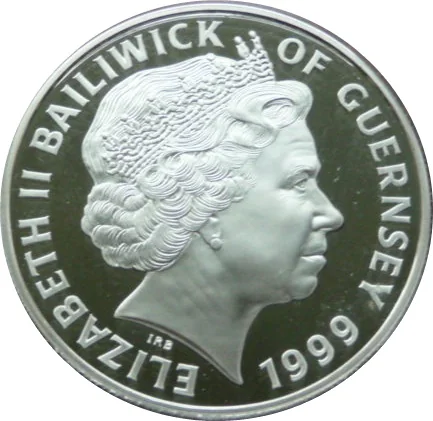
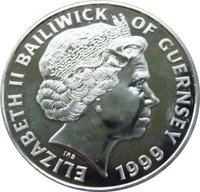
Obverse
Description:
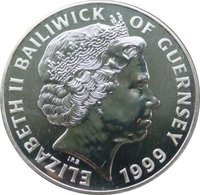
Bust of Elizabeth II
Inscription:
ELIZABETH II
BAILIWICK OF GUERNSEY
IRB
1999
BAILIWICK OF GUERNSEY
IRB
1999
Script: Latin
Engraver: Ian Rank-Broadley
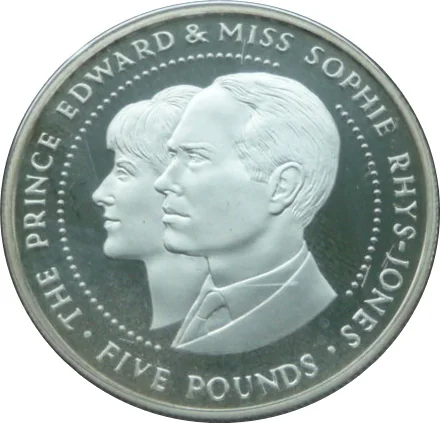
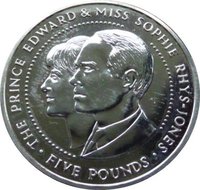
Reverse
Description:
Prince Edward and Sophie Rhys-Jones
Inscription:
THE PRINCE EDWARD & MISS SOPHIE RHYS-JONES
· FIVE POUNDS ·
· FIVE POUNDS ·
Script: Latin
Edge
Milled
Mintings
| Year | Mint Mark | Mintage | Quality | Collection |
|---|---|---|---|---|
| 1999 | — | 30,000 | Proof |
Historical background
In 1999, Guernsey's currency situation was characterised by a stable and long-established dual-currency system, underpinned by its constitutional position as a British Crown Dependency. The primary circulating currency was, and remains, the Guernsey pound (GGP), which is a local issue of sterling. These notes and coins were issued by the States of Guernsey Treasury and Resources Department and were legally local currency, but they maintained a 1:1 parity with the UK pound sterling (GBP). Sterling itself also circulated freely and was accepted interchangeably on the island, forming the bedrock of the monetary system.
This arrangement provided Guernsey with monetary stability and seamless economic integration with its largest trading partner, the United Kingdom, while retaining a symbolic element of fiscal and political identity. Importantly, the island had no central bank; currency issuance was backed by reserves held in sterling assets and UK government securities. A key feature of the system was that Guernsey pounds were not legal tender in the UK, though they could often be exchanged there at commercial banks, whereas UK sterling was always accepted in Guernsey.
The year 1999 was significant as it marked the launch of the Euro in the European Union. This event had no direct impact on Guernsey's domestic currency arrangements, as the island was not an EU member. However, it subtly reinforced the strategic importance of Guernsey's link to sterling, as the UK had opted to retain the pound. The island's financial services sector, a cornerstone of its economy, continued to operate predominantly in sterling and other major global currencies, with the new Euro becoming an additional important currency for its international banking and investment business, without disturbing the local dual-currency circulation.
This arrangement provided Guernsey with monetary stability and seamless economic integration with its largest trading partner, the United Kingdom, while retaining a symbolic element of fiscal and political identity. Importantly, the island had no central bank; currency issuance was backed by reserves held in sterling assets and UK government securities. A key feature of the system was that Guernsey pounds were not legal tender in the UK, though they could often be exchanged there at commercial banks, whereas UK sterling was always accepted in Guernsey.
The year 1999 was significant as it marked the launch of the Euro in the European Union. This event had no direct impact on Guernsey's domestic currency arrangements, as the island was not an EU member. However, it subtly reinforced the strategic importance of Guernsey's link to sterling, as the UK had opted to retain the pound. The island's financial services sector, a cornerstone of its economy, continued to operate predominantly in sterling and other major global currencies, with the new Euro becoming an additional important currency for its international banking and investment business, without disturbing the local dual-currency circulation.
💎 Extremely Rare