

2 pounds – Jersey
Add to wishlist
Non-circulating coins
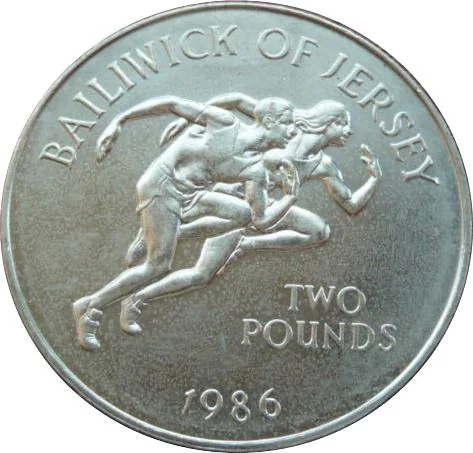
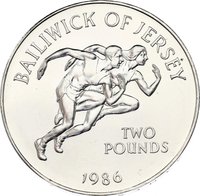
Commemoration: XIII Commonwealth Games, Edinburgh 1986
Context
Year: 1986
Country: British Crown dependencies
Issuer: Jersey
Ruler: Elizabeth II
Currency:
(since 1971)
Total mintage: 50,000
Material
Diameter: 38.28 mm
Weight: 28.28 g
Thickness: 3 mm
Shape: Round
Composition: Copper-nickel
Technique: Milled
Alignment: Medal alignment
flip
References
KM: #
Numista: #82627
Value
Exchange value: 2 JEP
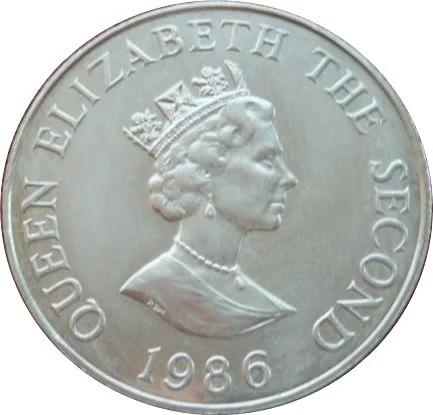
Obverse
Description:
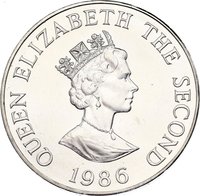
Queen Elizabeth III crowned, facing right, wearing the George IV State Diadem.
Inscription:
QUEEN ELIZABETH THE SECOND
RDM
1986
RDM
1986
Script: Latin
Engraver: Raphael David Maklouf
Reverse
Edge
Plain
Legend:
XIII COMMONWEALTH GAMES
Categories
| Sport> Commonwealth Games |
Mints
| Name | Mark |
|---|---|
| Royal Mint | — |
Mintings
| Year | Mint Mark | Mintage | Quality | Collection |
|---|---|---|---|---|
| 1986 | — | 50,000 |
Historical background
In 1986, Jersey's currency situation was characterised by a unique and complex dual-circulation system. The island, as a British Crown Dependency, issued its own banknotes and coinage (Jersey pounds, £), which were strictly local in nature. However, these existed alongside Bank of England notes, with both forms of sterling being accepted at par value in everyday transactions. This created a practical asymmetry: while Jersey notes were not generally accepted in the United Kingdom, English notes flowed freely into and within the island, leading to a persistent outflow of Jersey's own currency.
The system was underpinned by the Jersey Currency Fund, established in 1971, which held sterling reserves to ensure full convertibility and maintain confidence. For every Jersey pound note issued, an equivalent amount of sterling assets (primarily UK government securities) was held, effectively pegging the Jersey pound 1:1 to the pound sterling. This orthodox and conservative monetary framework meant Jersey had no independent monetary policy; its interest rates and broader financial conditions were directly influenced by the Bank of England. The island's economy was prosperous, with finance, tourism, and agriculture driving growth, but its currency remained a satellite of the UK system.
By the mid-1980s, this arrangement was stable but highlighted Jersey's constitutional and economic paradox: a high degree of domestic autonomy yet deep financial dependency on the UK. There were no significant currency crises in 1986, but ongoing discussions focused on the cost and logistical inefficiencies of the dual circulation, and the symbolic importance of the local note issue as a marker of identity. The period solidified a model that continues today, where Jersey manages its own currency issue as a strict subset of sterling, prioritising stability and parity with the UK above all else.
The system was underpinned by the Jersey Currency Fund, established in 1971, which held sterling reserves to ensure full convertibility and maintain confidence. For every Jersey pound note issued, an equivalent amount of sterling assets (primarily UK government securities) was held, effectively pegging the Jersey pound 1:1 to the pound sterling. This orthodox and conservative monetary framework meant Jersey had no independent monetary policy; its interest rates and broader financial conditions were directly influenced by the Bank of England. The island's economy was prosperous, with finance, tourism, and agriculture driving growth, but its currency remained a satellite of the UK system.
By the mid-1980s, this arrangement was stable but highlighted Jersey's constitutional and economic paradox: a high degree of domestic autonomy yet deep financial dependency on the UK. There were no significant currency crises in 1986, but ongoing discussions focused on the cost and logistical inefficiencies of the dual circulation, and the symbolic importance of the local note issue as a marker of identity. The period solidified a model that continues today, where Jersey manages its own currency issue as a strict subset of sterling, prioritising stability and parity with the UK above all else.
💎 Very Rare