

5 Pounds (Prince William) – Guernsey
Non-circulating coins
Commemoration: 21st Birthday of Prince William
Context
Year: 2003
Country: British Crown dependencies
Issuer: Guernsey
Ruler: Elizabeth II
Currency:
(since 1971)
Total mintage: 5,000
Material
References
KM: #Click to copy to clipboard143a
Numista: #82440
Value
Exchange value: 5 GGP
Bullion value: $75.81
Obverse
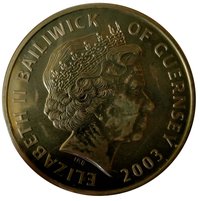
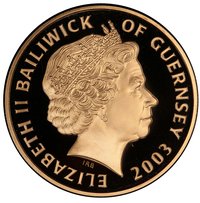
Description:
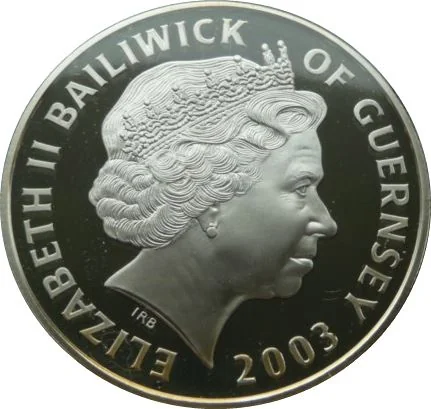
Bust of Elizabeth II
Inscription:
ELIZABETH II
BAILIWICK OF GUERNSEY
IRB
2003
BAILIWICK OF GUERNSEY
IRB
2003
Script: Latin
Engraver: Ian Rank-Broadley
Reverse
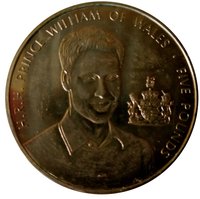
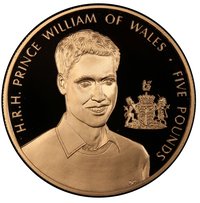
Description:
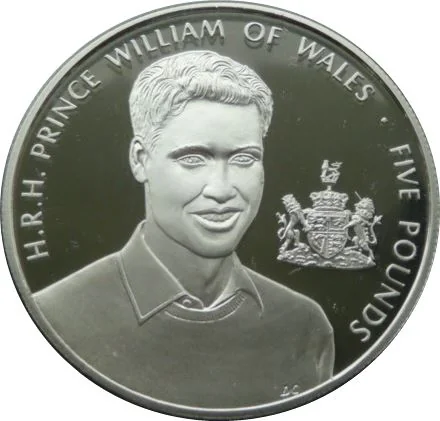
Prince William in a sweater, crest to right.
Inscription:
H.R.H. PRINCE WILLIAM OF WALES ·
FIVE POUNDS
FIVE POUNDS
Script: Latin
Edge
Milled
Mints
| Name | Mark |
|---|---|
| Royal Mint | — |
Mintings
| Year | Mint Mark | Mintage | Quality | Collection |
|---|---|---|---|---|
| 2003 | — | 5,000 | Proof |
Historical background
In 2003, Guernsey's currency situation was defined by its long-standing and stable dual-currency system, with both UK sterling and local Guernsey notes circulating as legal tender. The island's own currency, the Guernsey pound (GGP), was pegged at par with sterling and issued by the States of Guernsey Treasury and Resources Department. While UK banknotes were universally accepted on the island, Guernsey's distinctive notes were not automatically accepted in the UK, requiring exchange at banks or bureaux de change, a practical reality for returning travellers.
This system functioned smoothly, underpinned by Guernsey's substantial fiscal reserves held in sterling, which fully backed the local note issue. The year 2003 saw no major monetary crises or significant changes to this arrangement. However, the period was one of ongoing vigilance, as the island's authorities carefully managed the money supply to control inflation and maintain economic stability, mindful of their dependency on the UK's monetary policy set by the Bank of England.
The context was also one of gradual modernization. Guernsey was continuing to enhance its financial services sector—a cornerstone of its economy—while ensuring its currency practices met international standards. Discussions regarding the potential introduction of polymer banknotes for improved durability and security were in their early stages, but the core framework of a sterling-pegged, locally issued currency remained—and remains—a fundamental and uncontroversial aspect of Guernsey's economic identity.
This system functioned smoothly, underpinned by Guernsey's substantial fiscal reserves held in sterling, which fully backed the local note issue. The year 2003 saw no major monetary crises or significant changes to this arrangement. However, the period was one of ongoing vigilance, as the island's authorities carefully managed the money supply to control inflation and maintain economic stability, mindful of their dependency on the UK's monetary policy set by the Bank of England.
The context was also one of gradual modernization. Guernsey was continuing to enhance its financial services sector—a cornerstone of its economy—while ensuring its currency practices met international standards. Discussions regarding the potential introduction of polymer banknotes for improved durability and security were in their early stages, but the core framework of a sterling-pegged, locally issued currency remained—and remains—a fundamental and uncontroversial aspect of Guernsey's economic identity.
✨ Legendary