

100 Lei (Queen Marie) – Romania
Non-circulating coins
Commemoration: 135 years since the birth of Queen Marie
Romania

Obverse
Description:
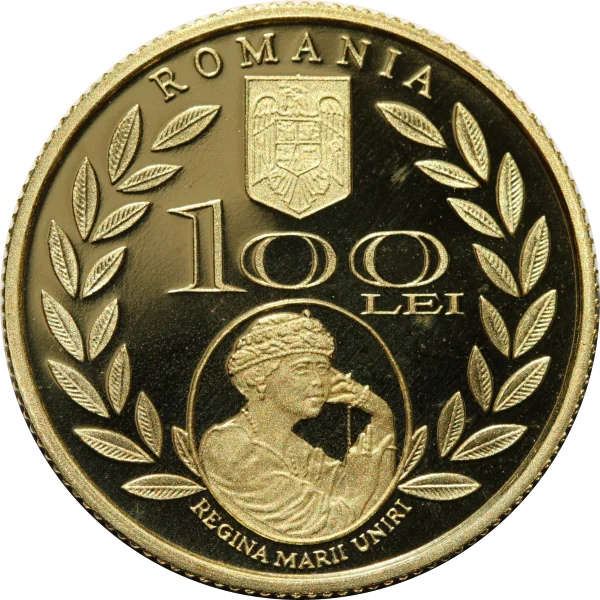
Top to bottom: "ROMANIA" arched, Romania's coat of arms, "100 LEI", a medallion of Queen Marie with "REGINA MARII UNIRI" below it, all surrounded by a laurel wreath.
Inscription:
ROMANIA
100 LEI
REGINA MARII UNIRI
100 LEI
REGINA MARII UNIRI
Script: Latin
Reverse
Description:
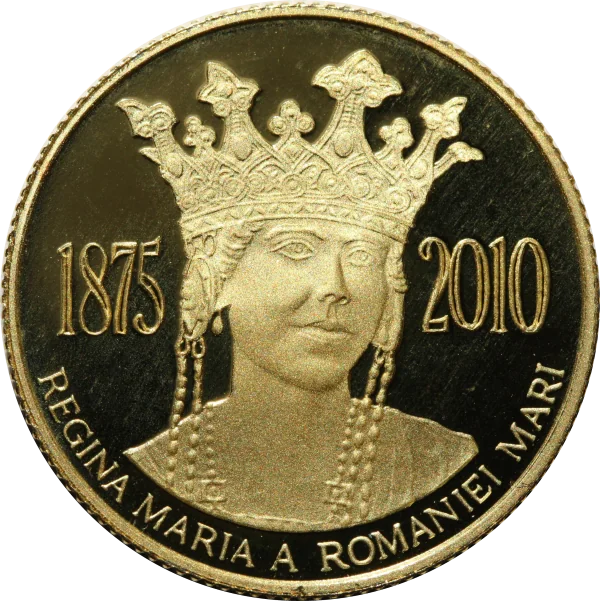
Center: Queen Marie's crowned coronation portrait. Flanking it, the years "1875" and "2010". Below, the arched inscription "REGINA MARIA A ROMANIEI MARI".
Inscription:
1875
2010
REGINA MARIA A ROMANIEI MARI
2010
REGINA MARIA A ROMANIEI MARI
Script: Latin
Edge
Milled
Mintings
| Year | Mint Mark | Mintage | Quality | Collection |
|---|---|---|---|---|
| 2010 | — | 1,000 | Proof |
Historical background
In 2010, Romania was in the midst of a severe economic crisis and under strict international supervision. The country had been hit hard by the global financial downturn, leading to a deep recession, a large budget deficit, and a drastic drop in foreign investment. To avoid economic collapse, Romania secured a €20 billion bailout package from the International Monetary Fund (IMF), the European Union, and the World Bank in 2009. A key condition of this rescue was the implementation of harsh austerity measures, including a 25% cut in public sector wages and a 15% reduction in pensions, which sparked significant social unrest and political instability.
The currency situation was defined by a managed float regime for the Romanian Leu (RON), but with heavy intervention from the National Bank of Romania (BNR) to prevent excessive volatility. The BNR's primary objective was to maintain stability and avoid a sudden, damaging devaluation that would spike inflation and cripple households and businesses with foreign currency debt (many mortgages were in Swiss Francs or Euros). Consequently, the leu experienced controlled depreciation against the euro, losing roughly 10% of its value between late 2009 and the end of 2010, as the BNR carefully balanced market pressures with the need for stability.
This period was marked by a tense duality: external stability was maintained through the IMF agreement and currency management, but internally, the economy was contracting under austerity. The currency's relative stability came at a high cost, as tight monetary policy and limited liquidity constrained economic growth. By the end of 2010, the situation had stabilized from the brink of disaster, but the economy remained fragile, with the leu's value and the country's financial health deeply dependent on continued external support and a fragile political consensus.
The currency situation was defined by a managed float regime for the Romanian Leu (RON), but with heavy intervention from the National Bank of Romania (BNR) to prevent excessive volatility. The BNR's primary objective was to maintain stability and avoid a sudden, damaging devaluation that would spike inflation and cripple households and businesses with foreign currency debt (many mortgages were in Swiss Francs or Euros). Consequently, the leu experienced controlled depreciation against the euro, losing roughly 10% of its value between late 2009 and the end of 2010, as the BNR carefully balanced market pressures with the need for stability.
This period was marked by a tense duality: external stability was maintained through the IMF agreement and currency management, but internally, the economy was contracting under austerity. The currency's relative stability came at a high cost, as tight monetary policy and limited liquidity constrained economic growth. By the end of 2010, the situation had stabilized from the brink of disaster, but the economy remained fragile, with the leu's value and the country's financial health deeply dependent on continued external support and a fragile political consensus.

✨ Legendary