

100 Lei (Nicolae Iorga) – Romania
Non-circulating coins
Commemoration: 140 years since the birth of Nicolae Iorga
Romania
Obverse
Description:
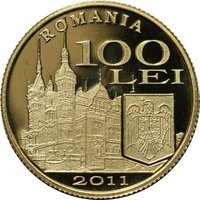
A depiction of Prince Michael the Brave's 1599 entry into Alba Iulia, overlaid on a historic document by Nicolae Iorga, with the arched inscription "ROMANIA," the national coat of arms, the year "2011," and the face value "100 LEI."
Inscription:
ROMANIA
100 LEI
2011
100 LEI
2011
Script: Latin
Reverse
Description:
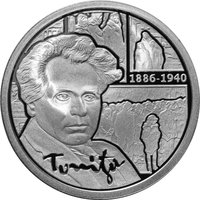
Portrait of Nicolae Iorga with his signature, the arched inscription "140 DE ANI DE LA NASTERE," and his lifespan: 1871–1940.
Inscription:
140 DE ANI DE LA NASTERE
1871
1940
1871
1940
Script: Latin
Edge
Milled
Mintings
| Year | Mint Mark | Mintage | Quality | Collection |
|---|---|---|---|---|
| 2011 | — | 500 | Proof |
Historical background
In 2011, Romania was navigating the complex aftermath of the 2008-09 global financial crisis, which had hit the country hard, leading to a deep recession and a controversial €20 billion bailout from the IMF, EU, and World Bank in 2009. A central element of this economic landscape was the currency situation, defined by a managed float regime for the Romanian Leu (RON). The National Bank of Romania (NBR) did not target a fixed exchange rate but actively intervened in the foreign exchange market to curb excessive volatility, often seeking to prevent a sharp depreciation that could exacerbate inflation and increase the burden of foreign-currency-denominated debts held by many households and businesses.
The year was marked by significant political and external uncertainty, which put pressure on the leu. Domestically, a major political crisis in mid-2011 led to the fall of the government, raising concerns about the continuity of austerity measures and reforms required by the international lenders. Externally, the escalating Eurozone sovereign debt crisis, particularly fears of contagion from Greece, created a risk-averse environment, leading investors to pull capital from emerging European markets like Romania. Consequently, the leu weakened against the euro, trading at around 4.2-4.3 RON/EUR for much of the year, a depreciation from pre-crisis levels that reflected these combined pressures.
Despite this pressure, the currency situation remained relatively stable compared to the intense volatility of 2009. This was largely due to the NBR's interventions and the safety net provided by the ongoing IMF agreement, which bolstered international reserves and investor confidence. The central bank also maintained a high key policy interest rate (initially 6.25%, raised to 6.5% in May) to combat inflation and support the currency, even as it constrained economic growth. Thus, 2011 was a year of fragile stability for the leu, managed through careful policy amidst a challenging climate of political turmoil and regional financial instability.
The year was marked by significant political and external uncertainty, which put pressure on the leu. Domestically, a major political crisis in mid-2011 led to the fall of the government, raising concerns about the continuity of austerity measures and reforms required by the international lenders. Externally, the escalating Eurozone sovereign debt crisis, particularly fears of contagion from Greece, created a risk-averse environment, leading investors to pull capital from emerging European markets like Romania. Consequently, the leu weakened against the euro, trading at around 4.2-4.3 RON/EUR for much of the year, a depreciation from pre-crisis levels that reflected these combined pressures.
Despite this pressure, the currency situation remained relatively stable compared to the intense volatility of 2009. This was largely due to the NBR's interventions and the safety net provided by the ongoing IMF agreement, which bolstered international reserves and investor confidence. The central bank also maintained a high key policy interest rate (initially 6.25%, raised to 6.5% in May) to combat inflation and support the currency, even as it constrained economic growth. Thus, 2011 was a year of fragile stability for the leu, managed through careful policy amidst a challenging climate of political turmoil and regional financial instability.
✨ Legendary