

10 kroner – Denmark
Add to wishlist
Denmark
Context
Years: 1989–1993
Issuer: Denmark
Ruler: Margrethe II
Currency:
(since 1873)
Total mintage: 53,157,000
Material
References
KM: #
Numista: #817
Value
Exchange value: 10 DKK
Inflation-adjusted value: 20.76 DKK
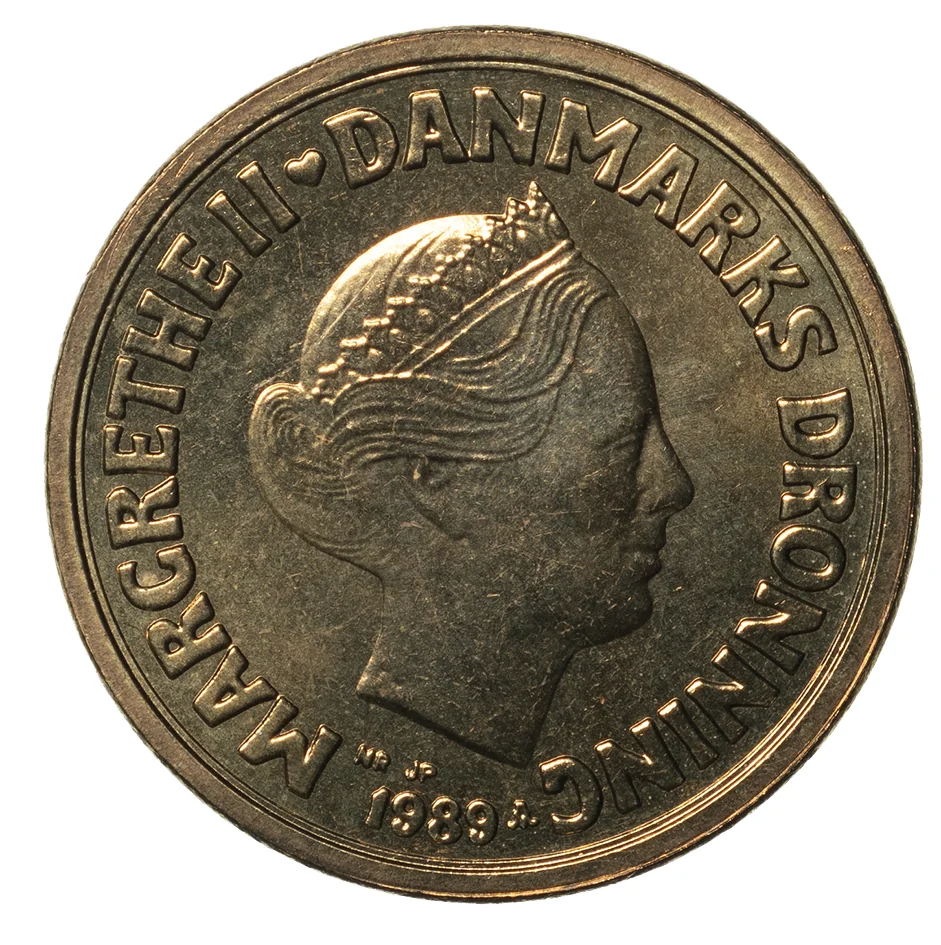
Obverse
Description:
Margrethe II facing right, second portrait.
Inscription:
MARGRETHE II ♥ DANMARKS DRONNING
LG JP
1990 A
LG JP
1990 A
Translation:
Margrethe II, Queen of Denmark
LG JP
1990 A
LG JP
1990 A
Script: Latin
Language: Danish
Engravers: Jan Petersen, Hanne Varming
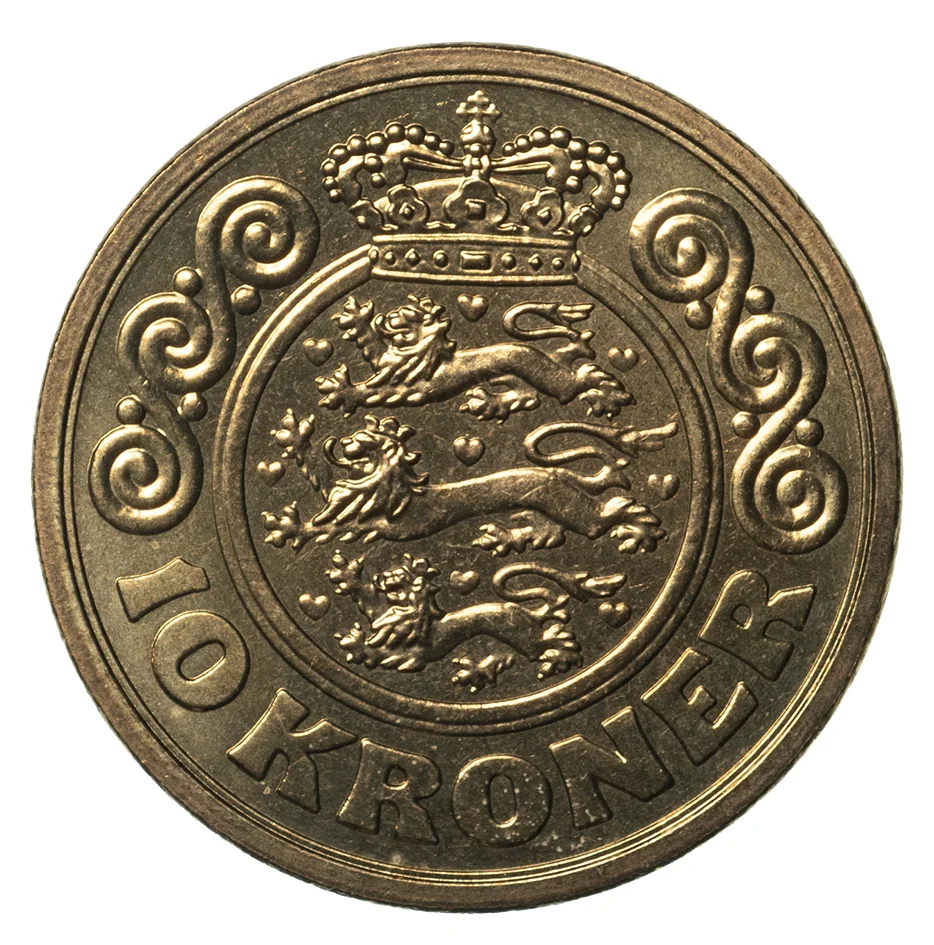
Reverse
Description:
Crowned Danish arms within a circle, decorative border.
Inscription:
10 KRONER
Script: Latin
Engraver: Johan Alkjaer
Edge
Plain
Mints
| Name | Mark |
|---|---|
| Royal Danish Mint | — |
Mintings
| Year | Mint Mark | Mintage | Quality | Collection |
|---|---|---|---|---|
| 1989 | NR;JP;A | 38,346,000 | ||
| 1990 | LG;JP;A | 12,193,000 | ||
| 1991 | LG;JP;A | 1,065,000 | ||
| 1992 | LG;JP;A | 484,000 | ||
| 1993 | LG;JP;A | 1,069,000 |
Historical background
In 1989, Denmark's currency situation was defined by its pivotal role within the European Monetary System (EMS), specifically its participation in the Exchange Rate Mechanism (ERM). The Danish krone (DKK) was pegged to the European Currency Unit (ECU) within narrow fluctuation bands of ±2.25%, a policy aimed at ensuring monetary stability and low inflation by anchoring the krone to the Deutsche Mark, the system's strongest currency. This commitment to a fixed exchange rate was a cornerstone of Danish economic policy, supported by the central bank's (Danmarks Nationalbank) willingness to use interest rates and direct intervention to maintain the peg, prioritizing stability over independent monetary policy.
Domestically, this regime enjoyed broad political and public consensus, seen as a necessary discipline following the high inflation and volatility of the 1970s. However, it was not without economic cost. To defend the krone's parity, Denmark was often forced to maintain higher interest rates than its major trading partner, Germany, which could dampen domestic growth and investment. The policy also meant that Denmark effectively imported the monetary policy decisions of the German Bundesbank, limiting its own tools to respond to local economic conditions.
The year 1989 itself was a period of relative calm within the EMS, but it set the stage for the severe crises to come. The system was under growing strain from divergent economic performances and capital flows among member states. Just three years later, in 1992, this tension would erupt, forcing the British pound and Italian lira out of the ERM. Denmark, however, would successfully defend the krone peg in a dramatic referendum and through substantial interest rate hikes, reaffirming its deep commitment to a fixed exchange rate—a policy stance that continues to define its relationship with the euro to this day.
Domestically, this regime enjoyed broad political and public consensus, seen as a necessary discipline following the high inflation and volatility of the 1970s. However, it was not without economic cost. To defend the krone's parity, Denmark was often forced to maintain higher interest rates than its major trading partner, Germany, which could dampen domestic growth and investment. The policy also meant that Denmark effectively imported the monetary policy decisions of the German Bundesbank, limiting its own tools to respond to local economic conditions.
The year 1989 itself was a period of relative calm within the EMS, but it set the stage for the severe crises to come. The system was under growing strain from divergent economic performances and capital flows among member states. Just three years later, in 1992, this tension would erupt, forcing the British pound and Italian lira out of the ERM. Denmark, however, would successfully defend the krone peg in a dramatic referendum and through substantial interest rate hikes, reaffirming its deep commitment to a fixed exchange rate—a policy stance that continues to define its relationship with the euro to this day.
🌱 Very Common