

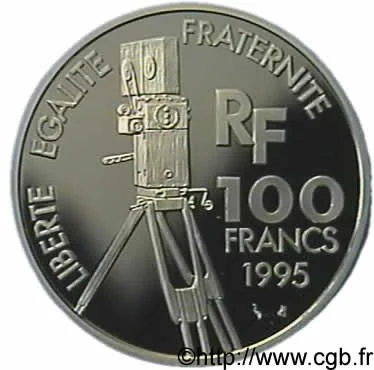

100 Francs (Cinema) – France
Non-circulating coins
Commemoration: Centenary of Cinema
France
Obverse
Reverse
Description:
Gérard Philipe, left.
Inscription:
CENTENAIRE DU CINÉMA JEAN RENOIR
Translation:
Centenary of Cinema Jean Renoir
Script: Latin
Language: French
Engraver: Atelier de Paris
Edge
Plain
Mints
| Name | Mark |
|---|---|
| Monnaie de Paris | — |
Mintings
| Year | Mint Mark | Mintage | Quality | Collection |
|---|---|---|---|---|
| 1995 | — | 15,000 |
Historical background
In 1995, France's currency situation was defined by its pivotal role within the European Exchange Rate Mechanism (ERM), the system designed to stabilize currencies ahead of the planned single currency, the euro. The French franc was a cornerstone of this mechanism, maintaining a strong and stable parity with the German Deutsche Mark within narrow fluctuation bands. This stability, known as the "franc fort" (strong franc) policy, was a central tenet of French economic strategy, pursued by both center-right and socialist governments to anchor low inflation and demonstrate France's commitment to European monetary integration, even at the cost of higher interest rates and constrained growth.
The domestic economic context, however, created significant tension. To maintain the franc's peg to the Deutsche Mark, the Banque de France was compelled to keep interest rates high, which contributed to sluggish economic growth and persistently high unemployment, hovering around 11%. This policy trade-off fueled public discontent, which erupted in major social unrest in November and December 1995. While the massive strikes led by public sector workers were directly triggered by welfare reform plans, they were fundamentally rooted in broader economic malaise, part of which was attributed to the austerity required to uphold the strong currency policy.
Ultimately, 1995 proved to be a final, successful test of France's resolve. Despite the social and economic pressures, the government and the Banque de France held firm, successfully defending the franc's parity. This unwavering commitment was crucial in meeting the strict convergence criteria outlined in the Maastricht Treaty. The year thus ended with France firmly on track to be a founding member of the European Monetary Union, with the franc's stability in 1995 serving as its definitive qualifying exam for the launch of the euro in 1999.
The domestic economic context, however, created significant tension. To maintain the franc's peg to the Deutsche Mark, the Banque de France was compelled to keep interest rates high, which contributed to sluggish economic growth and persistently high unemployment, hovering around 11%. This policy trade-off fueled public discontent, which erupted in major social unrest in November and December 1995. While the massive strikes led by public sector workers were directly triggered by welfare reform plans, they were fundamentally rooted in broader economic malaise, part of which was attributed to the austerity required to uphold the strong currency policy.
Ultimately, 1995 proved to be a final, successful test of France's resolve. Despite the social and economic pressures, the government and the Banque de France held firm, successfully defending the franc's parity. This unwavering commitment was crucial in meeting the strict convergence criteria outlined in the Maastricht Treaty. The year thus ended with France firmly on track to be a founding member of the European Monetary Union, with the franc's stability in 1995 serving as its definitive qualifying exam for the launch of the euro in 1999.


💎 Very Rare