

200 Escudos – Portugal
Circulating commemorative coins
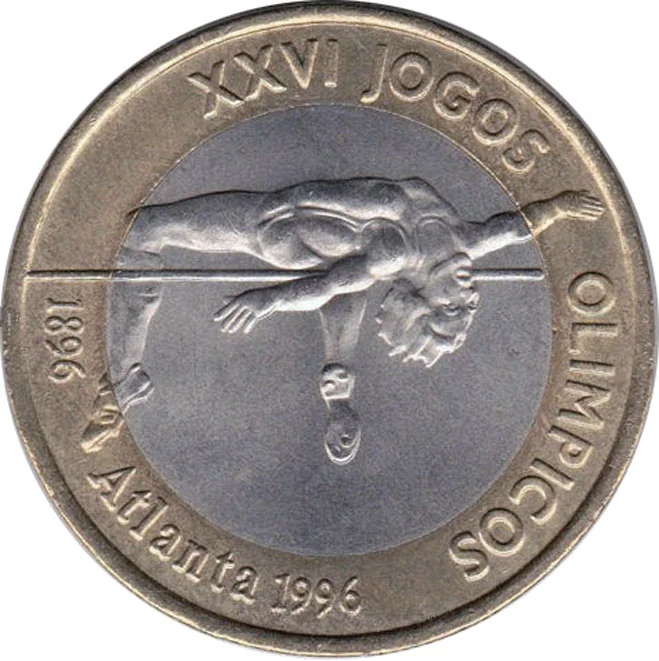
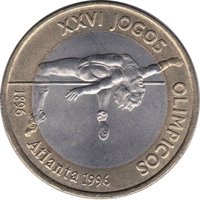
Commemoration: 1996 Jogos Olímpicos, Atlanta
Portugal
Context
Year: 1996
Issuer: Portugal 
Period:
(since 1974)
Currency:
(1911—2001)
Demonetized: Yes
Total mintage: 1,020,012
Material
References
KM: #Click to copy to clipboard687
Numista: #10380
Value
Exchange value: 200 PTE
Inflation-adjusted value: 372.51 PTE
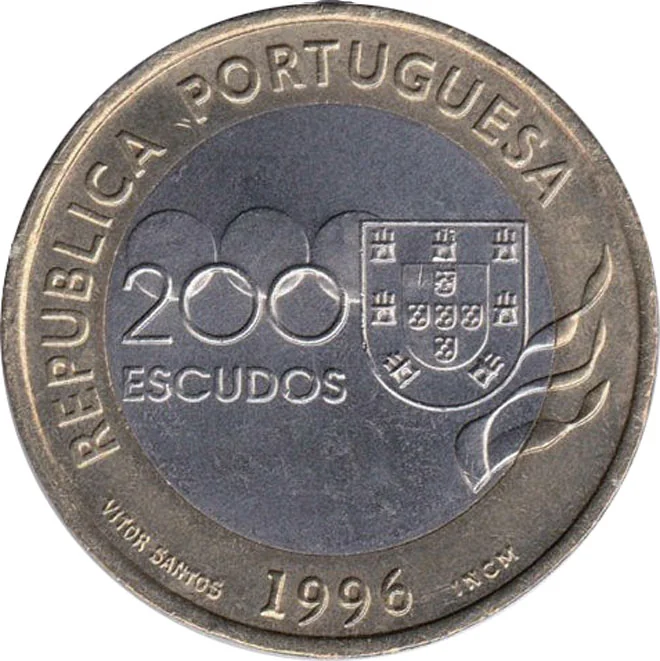
Obverse
Inscription:
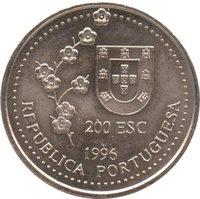
REPUBLICA PORTUGUESA
200 ESCUDOS
1996
VITOR SANTOS INCM
200 ESCUDOS
1996
VITOR SANTOS INCM
Translation:
PORTUGUESE REPUBLIC
200 ESCUDOS
1996
VITOR SANTOS INCM
200 ESCUDOS
1996
VITOR SANTOS INCM
Script: Latin
Language: Portuguese
Engraver: Vitor Santos
Reverse
Edge
Segmented reeding
Categories
| Symbols> Coat of Arms |
| Sport> Summer Olympic Games |
Mints
| Name | Mark |
|---|---|
| Imprensa Nacional - Casa da Moeda | incm |
Mintings
Historical background
In 1996, Portugal's currency situation was defined by its pivotal position within the European integration process. The country was a member of the European Union's Exchange Rate Mechanism (ERM), having joined in April 1992. The Portuguese escudo (PTE) was pegged to a central rate against other European currencies, primarily the Deutsche Mark, as part of a deliberate strategy to align its economy with the core of Europe and ensure low inflation and monetary stability. This period was one of convergence, where Portugal worked diligently to meet the strict Maastricht Treaty criteria—on inflation, interest rates, budget deficits, and public debt—necessary to qualify for the planned single European currency, the euro.
The macroeconomic context was broadly positive. After a turbulent entry into the ERM, which included a forced 6% devaluation of the escudo in late 1992 and further downward adjustments in 1993 and 1995 to maintain competitiveness, the currency had stabilized by 1996. The government, led by Prime Minister António Guterres, pursued tight fiscal and monetary policies to reinforce this stability and build credibility with international markets and European partners. Inflation was under control, having fallen dramatically from the high double-digits of the 1980s, and economic growth was robust, fostering optimism about Portugal's imminent inclusion in the eurozone's first wave.
Consequently, 1996 was a year of preparation and anticipation rather than crisis. The focus was less on day-to-day currency fluctuations and more on the irreversible path toward monetary union. National discourse centered on the structural reforms and fiscal discipline required to irrevocably lock the escudo's exchange rate, a step seen as the final gateway to deeper European integration and expected to bring lower transaction costs, reduced interest rates, and enhanced economic security. The escudo's days were effectively numbered, with its replacement by the euro scheduled for January 1, 1999, for electronic transactions, followed by physical notes and coins in 2002.
The macroeconomic context was broadly positive. After a turbulent entry into the ERM, which included a forced 6% devaluation of the escudo in late 1992 and further downward adjustments in 1993 and 1995 to maintain competitiveness, the currency had stabilized by 1996. The government, led by Prime Minister António Guterres, pursued tight fiscal and monetary policies to reinforce this stability and build credibility with international markets and European partners. Inflation was under control, having fallen dramatically from the high double-digits of the 1980s, and economic growth was robust, fostering optimism about Portugal's imminent inclusion in the eurozone's first wave.
Consequently, 1996 was a year of preparation and anticipation rather than crisis. The focus was less on day-to-day currency fluctuations and more on the irreversible path toward monetary union. National discourse centered on the structural reforms and fiscal discipline required to irrevocably lock the escudo's exchange rate, a step seen as the final gateway to deeper European integration and expected to bring lower transaction costs, reduced interest rates, and enhanced economic security. The escudo's days were effectively numbered, with its replacement by the euro scheduled for January 1, 1999, for electronic transactions, followed by physical notes and coins in 2002.
🌱 Very Common