

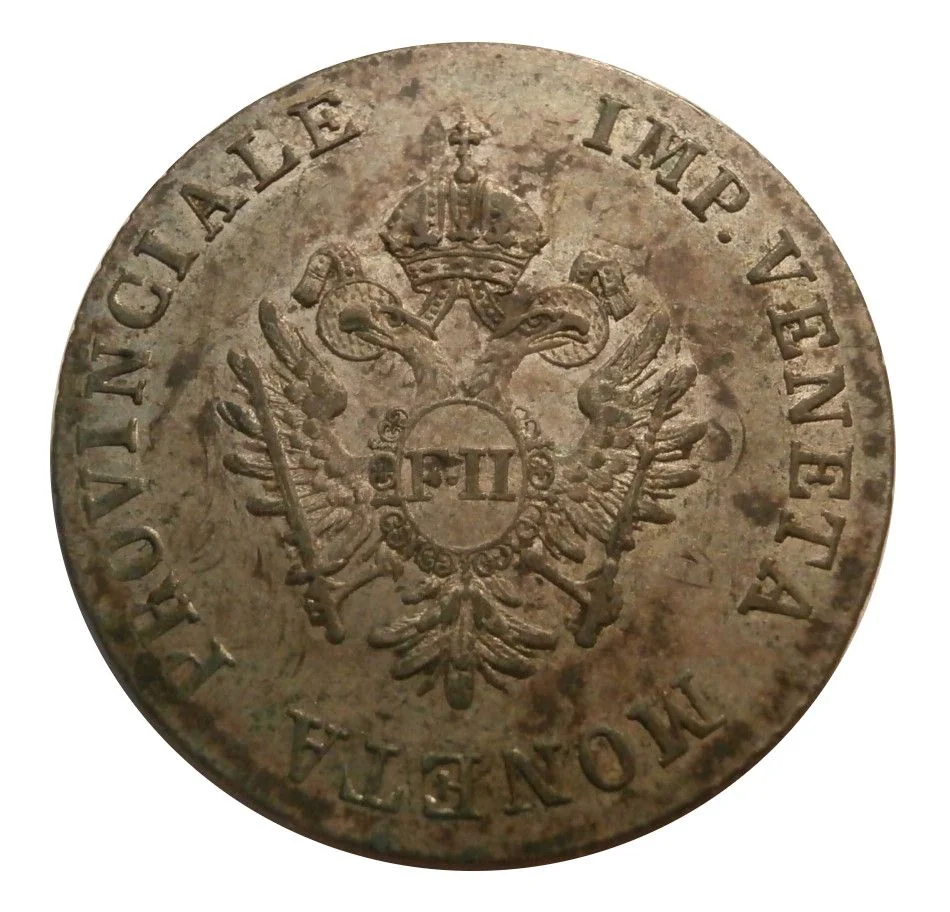
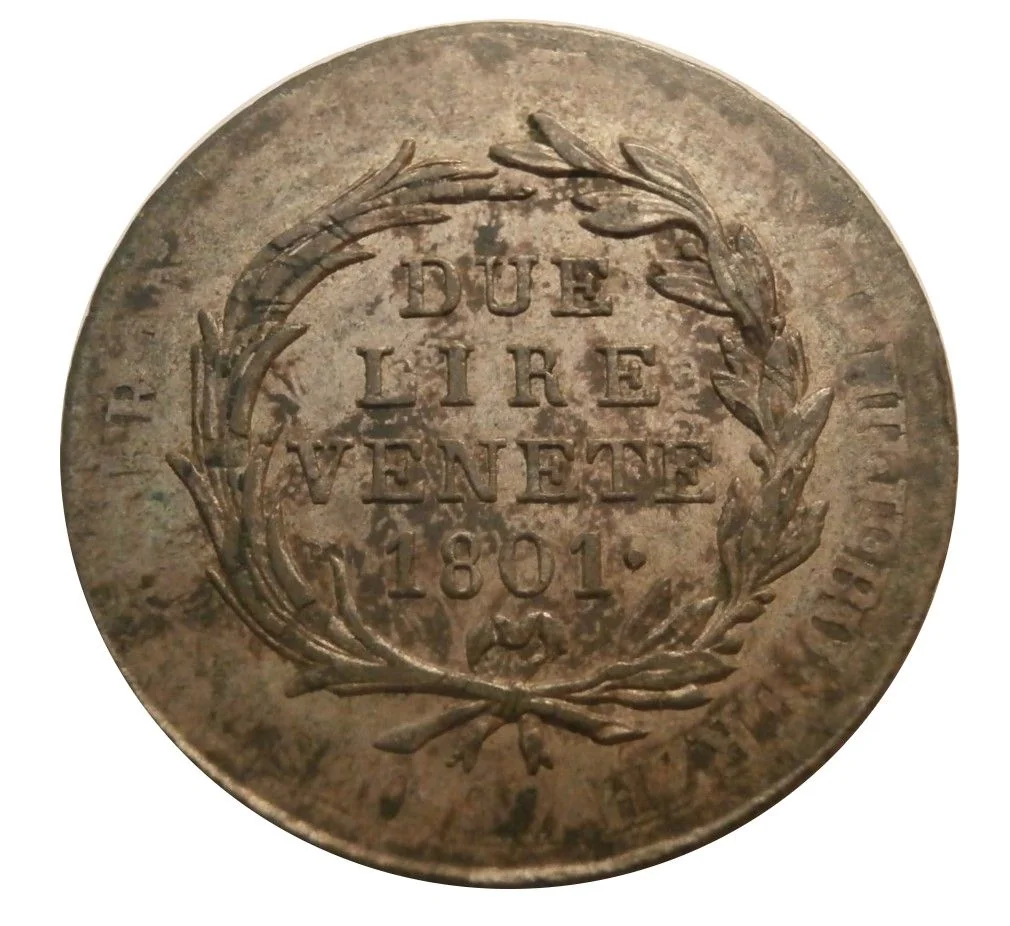
2 lire – Habsburg Venetian Province
Add to wishlist
Italy
Context
Year: 1801
Country: Italy
Issuer: Habsburg Venetian Province
Ruler: Francis II
Currency:
(1752—1805)
Demonetized: Yes
Material
References
KM: #
Numista: #81644
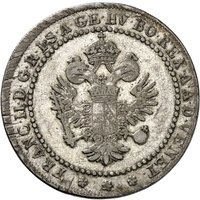
Obverse
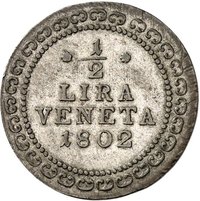
Reverse
Edge
Chain ornament
Mints
| Name | Mark |
|---|---|
| Venice | — |
Mintings
| Year | Mint Mark | Mintage | Quality | Collection |
|---|---|---|---|---|
| 1801 | — | — |
Historical background
In 1801, the currency situation in the Habsburg Venetian Province (formally the Venetian Province of the Austrian Empire) was complex and transitional, reflecting the region's recent political upheaval. The province, comprising the former territories of the Venetian Republic, had been under Austrian control since the Treaty of Campo Formio in 1797. The Habsburg administration sought to integrate the local economy into the imperial system, but found a monetary landscape fragmented by the legacy of Venetian rule, the brief French interregnum, and the circulation of diverse foreign coins. The old Venetian lira, the lira veneta, alongside its subsidiary coins like the ducato and scudo, remained in widespread daily use among the populace, creating a dual system alongside the official imperial currency.
The official currency was the Conventionsthaler (or Konventionsthaler) of the Austrian monetary convention, with its subunit, the Conventionkreuzer. However, establishing its supremacy was a slow process. The government fixed exchange rates between the old Venetian and new Austrian units, but these official rates often conflicted with market realities, leading to confusion and facilitating arbitrage. Furthermore, the economic strain of the Napoleonic Wars meant that Vienna often resorted to issuing depreciated paper money (Bancozettel), which also circulated in the province, adding a layer of instability and inflation to an already complicated system.
Consequently, daily commerce was conducted amidst significant confusion. Merchants, bankers, and ordinary citizens had to navigate between at least three concurrent systems: the lingering Venetian coins, the official Austrian silver and copper coins, and the fluctuating paper banknotes. This monetary pluralism hindered trade, complicated tax collection, and was a persistent administrative headache for Habsburg officials, who viewed monetary unification as a key pillar of political integration. Thus, in 1801, the currency situation was defined by an incomplete and struggling transition from Venetian to Austrian standards, marked by practical coexistence and persistent friction between old and new monetary realities.
The official currency was the Conventionsthaler (or Konventionsthaler) of the Austrian monetary convention, with its subunit, the Conventionkreuzer. However, establishing its supremacy was a slow process. The government fixed exchange rates between the old Venetian and new Austrian units, but these official rates often conflicted with market realities, leading to confusion and facilitating arbitrage. Furthermore, the economic strain of the Napoleonic Wars meant that Vienna often resorted to issuing depreciated paper money (Bancozettel), which also circulated in the province, adding a layer of instability and inflation to an already complicated system.
Consequently, daily commerce was conducted amidst significant confusion. Merchants, bankers, and ordinary citizens had to navigate between at least three concurrent systems: the lingering Venetian coins, the official Austrian silver and copper coins, and the fluctuating paper banknotes. This monetary pluralism hindered trade, complicated tax collection, and was a persistent administrative headache for Habsburg officials, who viewed monetary unification as a key pillar of political integration. Thus, in 1801, the currency situation was defined by an incomplete and struggling transition from Venetian to Austrian standards, marked by practical coexistence and persistent friction between old and new monetary realities.
💎 Extremely Rare