

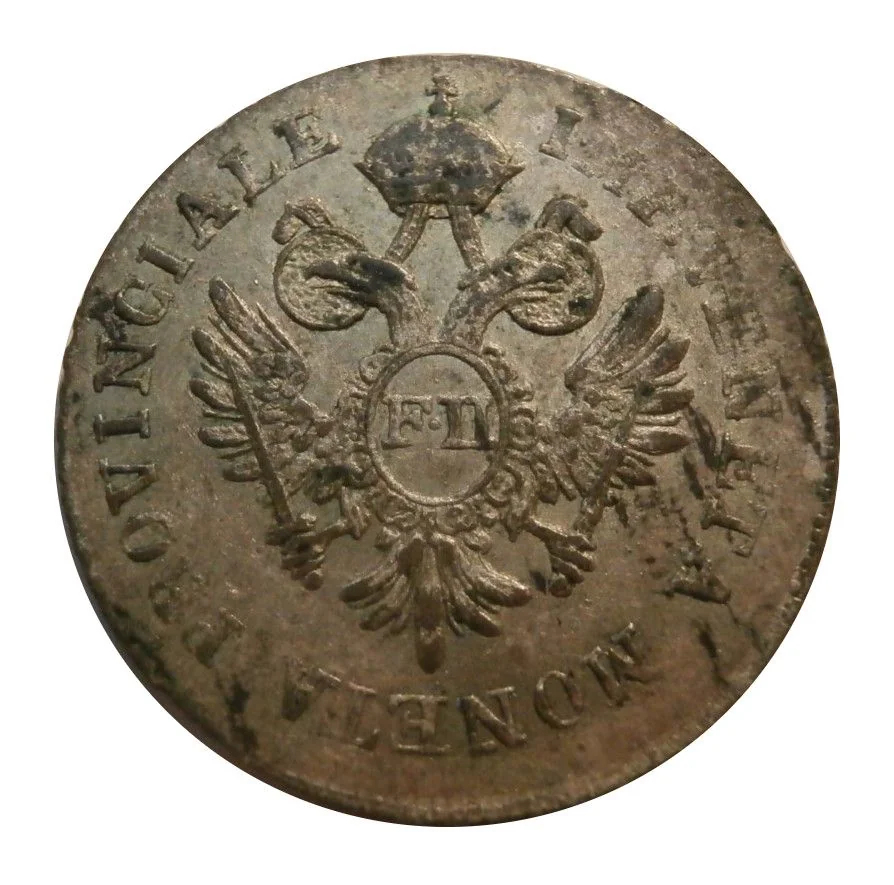
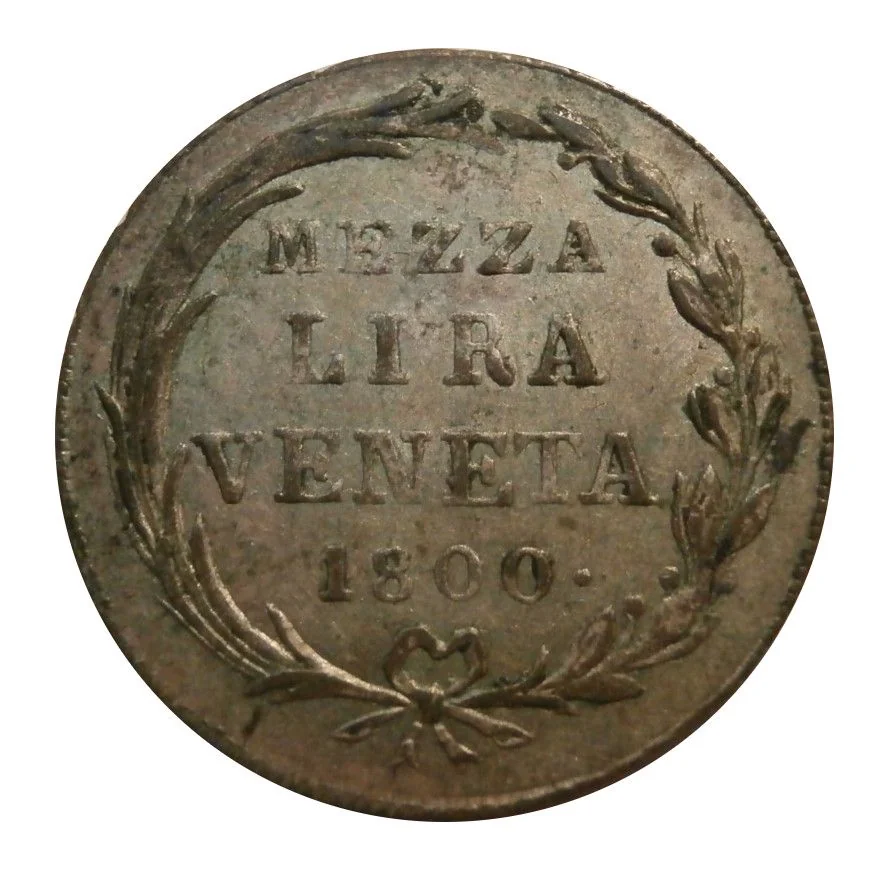
½ lira – Habsburg Venetian Province
Add to wishlist
Italy
Context
Year: 1800
Country: Italy
Issuer: Habsburg Venetian Province
Ruler: Francis II
Currency:
(1752—1805)
Demonetized: Yes
References
KM: #
Numista: #81626
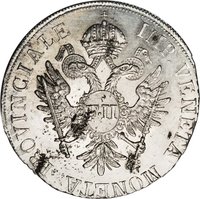
Obverse
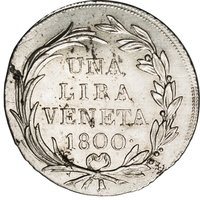
Reverse
Description:
Dated inscription in four-line wreath.
Inscription:
MEZZA
LIRA
VENETA
1800.
LIRA
VENETA
1800.
Script: Latin
Edge
Chain ornament
Mints
| Name | Mark |
|---|---|
| Venice | — |
Mintings
| Year | Mint Mark | Mintage | Quality | Collection |
|---|---|---|---|---|
| 1800 | — | — |
Historical background
In 1800, the currency situation in the Habsburg-controlled Venetian Province was complex and transitional, reflecting the recent political upheaval. The region, comprising the former Venetian Republic, had been ceded to Austria in 1797 and then briefly lost to France in 1798 before being reclaimed by Habsburg forces in 1799. This rapid change of sovereignty left a monetary system in disarray, with a circulation of multiple coinages. The most prominent were the old Venetian lira, soldo, and ducato, alongside new Austrian imperial coins (gulden and kreuzer) introduced by the Habsburg administration, and even residual French revolutionary coins and mandati from the brief period of French control.
The Habsburg authorities, under Emperor Francis II, sought to impose monetary order and integrate the province into the wider Austrian financial system. A central aim was to standardize the currency on the Austrian Conventionsthaler (or gulden) system, establishing fixed exchange rates between the old Venetian and new Austrian units. However, this process was fraught with difficulty. The public, accustomed to the Venetian system, was often distrustful, and the coexistence of multiple currencies led to confusion, arbitrage, and localized inflation, hampering trade and taxation.
Ultimately, the monetary landscape was one of enforced duality and slow integration. While official transactions and state finances were increasingly conducted in Austrian currency, the Venetian lira and its subdivisions remained deeply embedded in everyday local commerce and among the populace. This period thus represents a tense interim where the Habsburg state's modernizing centralism clashed with the entrenched economic habits of a newly acquired territory, a situation that would only gradually resolve through persistent administrative pressure over the following decade.
The Habsburg authorities, under Emperor Francis II, sought to impose monetary order and integrate the province into the wider Austrian financial system. A central aim was to standardize the currency on the Austrian Conventionsthaler (or gulden) system, establishing fixed exchange rates between the old Venetian and new Austrian units. However, this process was fraught with difficulty. The public, accustomed to the Venetian system, was often distrustful, and the coexistence of multiple currencies led to confusion, arbitrage, and localized inflation, hampering trade and taxation.
Ultimately, the monetary landscape was one of enforced duality and slow integration. While official transactions and state finances were increasingly conducted in Austrian currency, the Venetian lira and its subdivisions remained deeply embedded in everyday local commerce and among the populace. This period thus represents a tense interim where the Habsburg state's modernizing centralism clashed with the entrenched economic habits of a newly acquired territory, a situation that would only gradually resolve through persistent administrative pressure over the following decade.
✨ Legendary