

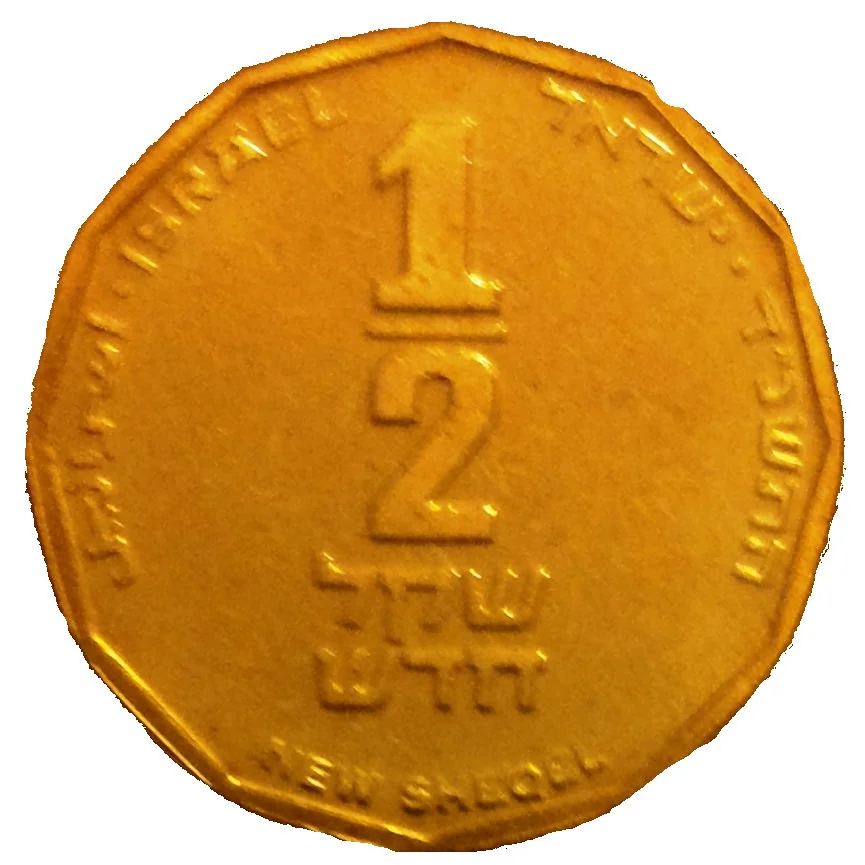
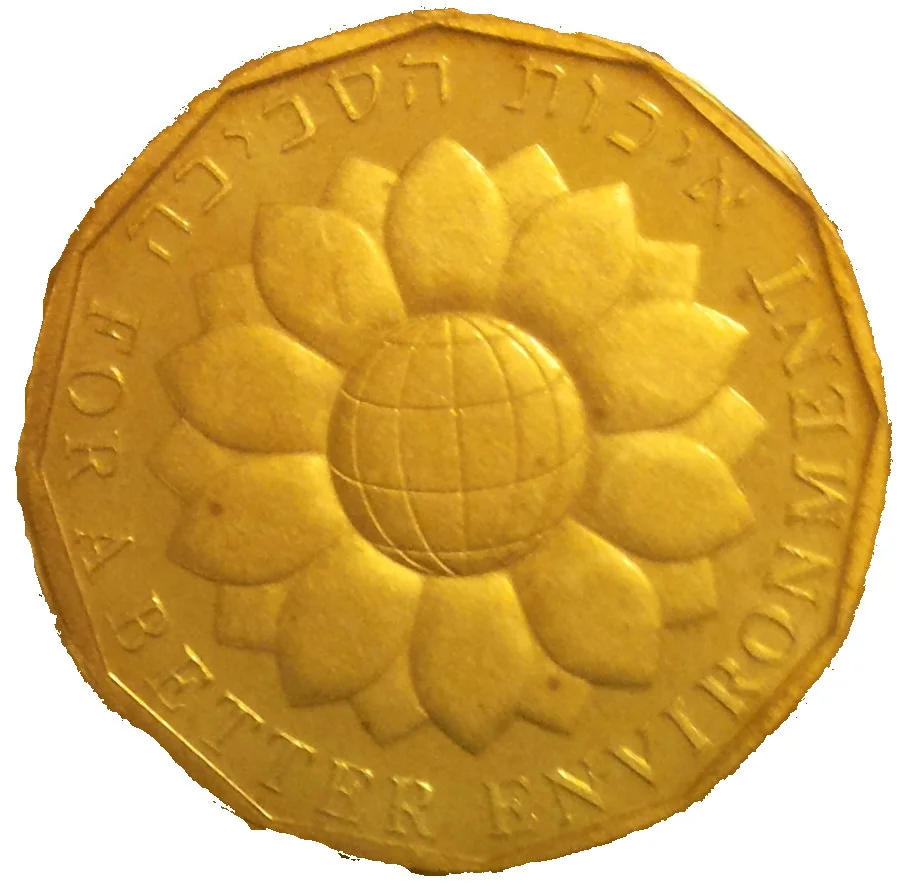
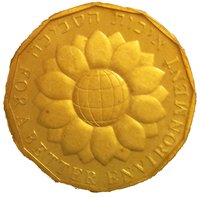
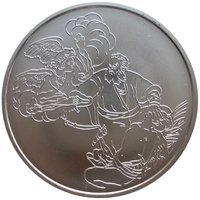
½ New Sheqel (Israel's Environment) – Israel
Non-circulating coins
Commemoration: Environment; Israel's 46th Anniversary
Israel
Context
Material
Diameter: 26 mm
Weight: 14.5 g
Thickness: 3.8 mm
Shape: Dodecagonal
Composition: Aluminium bronze
Magnetic: No
Technique: Milled
Alignment: Medal alignment
flip
References
KM: #Click to copy to clipboard368
Numista: #81366
Value
Exchange value: ½ ILS = $0.16
Inflation-adjusted value: 1.28 ILS
Obverse
Reverse
Edge
Plain
Mints
| Name | Mark |
|---|---|
| Royal Dutch Mint | — |
Mintings
| Year | Mint Mark | Mintage | Quality | Collection |
|---|---|---|---|---|
| 1994 | — | 12,000 |
Historical background
In 1994, Israel's currency situation was characterized by a period of relative stability and strategic liberalization, underpinned by the Bank of Israel's managed float exchange rate regime. The New Israeli Shekel (NIS), introduced in 1985 as part of the successful Economic Stabilization Plan that ended hyperinflation, was firmly established. Inflation, which had been tamed to an annual rate of around 14.5% in 1993, dropped further to approximately 12.2% in 1994, allowing for more predictable monetary policy. The shekel's exchange rate was not freely floating but was managed against a basket of currencies, heavily weighted by the US Dollar, with the central bank intervening to smooth out excessive volatility.
This period was also marked by significant steps toward integrating Israel into the global economy. The early 1990s saw major capital market reforms, including the full liberalization of foreign currency controls in 1992. By 1994, these changes were facilitating increased foreign investment, spurred by optimism from the Oslo Peace Accords signed the previous year. The economy was growing rapidly, with GDP expanding by over 6.5% in 1994, creating a complex environment for monetary authorities who had to balance growth, inflation control, and exchange rate stability amidst substantial capital inflows.
However, challenges persisted. The central bank maintained relatively high interest rates to anchor inflation expectations, a necessity given the economy's history. This policy, while stabilizing the currency, also attracted short-term speculative capital, complicating management. Furthermore, the government's fiscal policy remained a point of concern, with public debt still high at roughly 100% of GDP. Thus, the currency stability of 1994 was a hard-won achievement, actively managed within a framework designed to ensure the shekel's credibility while navigating the pressures of a rapidly opening and growing economy.
This period was also marked by significant steps toward integrating Israel into the global economy. The early 1990s saw major capital market reforms, including the full liberalization of foreign currency controls in 1992. By 1994, these changes were facilitating increased foreign investment, spurred by optimism from the Oslo Peace Accords signed the previous year. The economy was growing rapidly, with GDP expanding by over 6.5% in 1994, creating a complex environment for monetary authorities who had to balance growth, inflation control, and exchange rate stability amidst substantial capital inflows.
However, challenges persisted. The central bank maintained relatively high interest rates to anchor inflation expectations, a necessity given the economy's history. This policy, while stabilizing the currency, also attracted short-term speculative capital, complicating management. Furthermore, the government's fiscal policy remained a point of concern, with public debt still high at roughly 100% of GDP. Thus, the currency stability of 1994 was a hard-won achievement, actively managed within a framework designed to ensure the shekel's credibility while navigating the pressures of a rapidly opening and growing economy.
💎 Very Rare