

¼ piastre – Cyprus
Add to wishlist
Cyprus
Context
Years: 1902–1908
Issuer: Cyprus
Ruler: Edward VII
Currency:
(1879—1955)
Demonetized: Yes
Total mintage: 530,000
Material
References
KM: #
Numista: #8136
Obverse
Description:
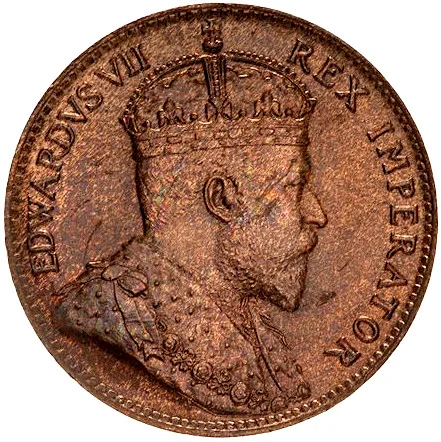
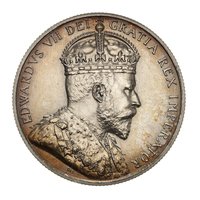
King Edward VII bust right, encircled by clockwise inscription. Beaded rim.
Inscription:
EDWARDUS VII REX IMPERATOR
DES
DES
Translation:
Edward VII King Emperor
Script: Latin
Engraver: George William de Saulles
Reverse
Description:
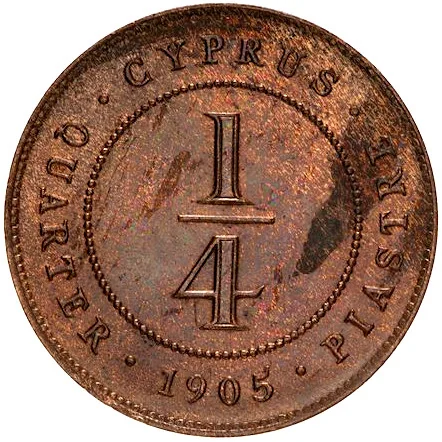
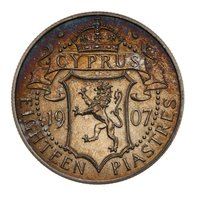
Center denomination within a beaded circle, surrounded by clockwise lettering. A beaded ring outlines the rim.
Inscription:
· CYPRUS ·
1/4
QUARTER · 1905 · PIASTRE
1/4
QUARTER · 1905 · PIASTRE
Script: Latin
Edge
Plain
Mints
| Name | Mark |
|---|---|
| Royal Mint (Tower Hill) | — |
Mintings
| Year | Mint Mark | Mintage | Quality | Collection |
|---|---|---|---|---|
| 1902 | — | 72,000 | ||
| 1905 | — | 422,000 | ||
| 1908 | — | 36,000 |
Historical background
In 1902, Cyprus operated under a complex and somewhat unstable currency system, a direct legacy of its recent political transition. The island had been under British administration since 1878, but it remained formally part of the Ottoman Empire until its annexation by Britain in 1914. Consequently, the official currency was the Ottoman piastre (or kuruş), a silver-based coin that was often clipped and debased. Alongside this, British gold sovereigns and Turkish gold lira circulated for larger transactions, while a multitude of foreign silver coins from nations like France, Italy, and Austria-Hungary (Maria Theresa thalers) were also in common use, creating a confusing monetary environment for trade and administration.
The British administration faced significant challenges due to this fragmented system. The fluctuating value of silver against gold on the international market (a global phenomenon of the period) caused the value of the silver piastre to be unstable, disrupting government finances and commerce. Furthermore, the poor and inconsistent quality of the Ottoman silver coins in circulation led to widespread distrust. To address this, the British had introduced a specific "Cyprus piastre" in 1879, pegged to sterling, but it failed to supplant the older Ottoman coins and mixed foreign currency in daily public use.
Therefore, in 1902, the currency situation was in a state of unsatisfactory limbo. The government was collecting taxes in a depreciating silver standard while its obligations were largely in stable gold sterling, creating a budgetary strain. This untenable position was a key factor leading to a major monetary reform just a few years later. In 1905, the British administration would finally demonetize the Ottoman piastre and formally peg the Cypriot currency directly to the British pound sterling, establishing a new, unified "Cyprus pound" and bringing much-needed stability to the island's economy.
The British administration faced significant challenges due to this fragmented system. The fluctuating value of silver against gold on the international market (a global phenomenon of the period) caused the value of the silver piastre to be unstable, disrupting government finances and commerce. Furthermore, the poor and inconsistent quality of the Ottoman silver coins in circulation led to widespread distrust. To address this, the British had introduced a specific "Cyprus piastre" in 1879, pegged to sterling, but it failed to supplant the older Ottoman coins and mixed foreign currency in daily public use.
Therefore, in 1902, the currency situation was in a state of unsatisfactory limbo. The government was collecting taxes in a depreciating silver standard while its obligations were largely in stable gold sterling, creating a budgetary strain. This untenable position was a key factor leading to a major monetary reform just a few years later. In 1905, the British administration would finally demonetize the Ottoman piastre and formally peg the Cypriot currency directly to the British pound sterling, establishing a new, unified "Cyprus pound" and bringing much-needed stability to the island's economy.
🌟 Limited