

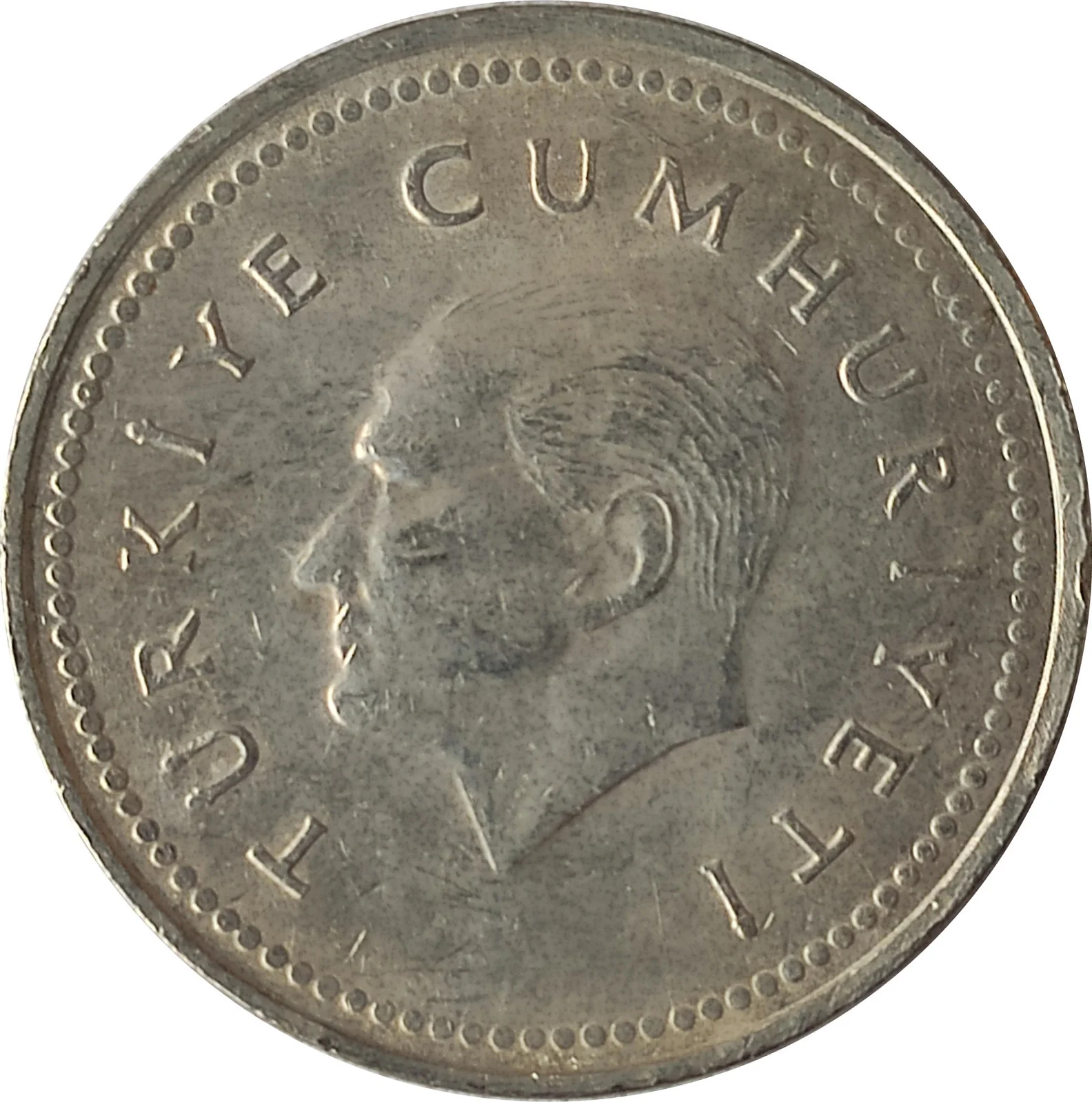

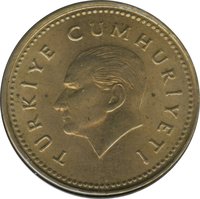
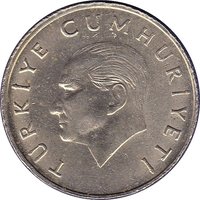
Obverse
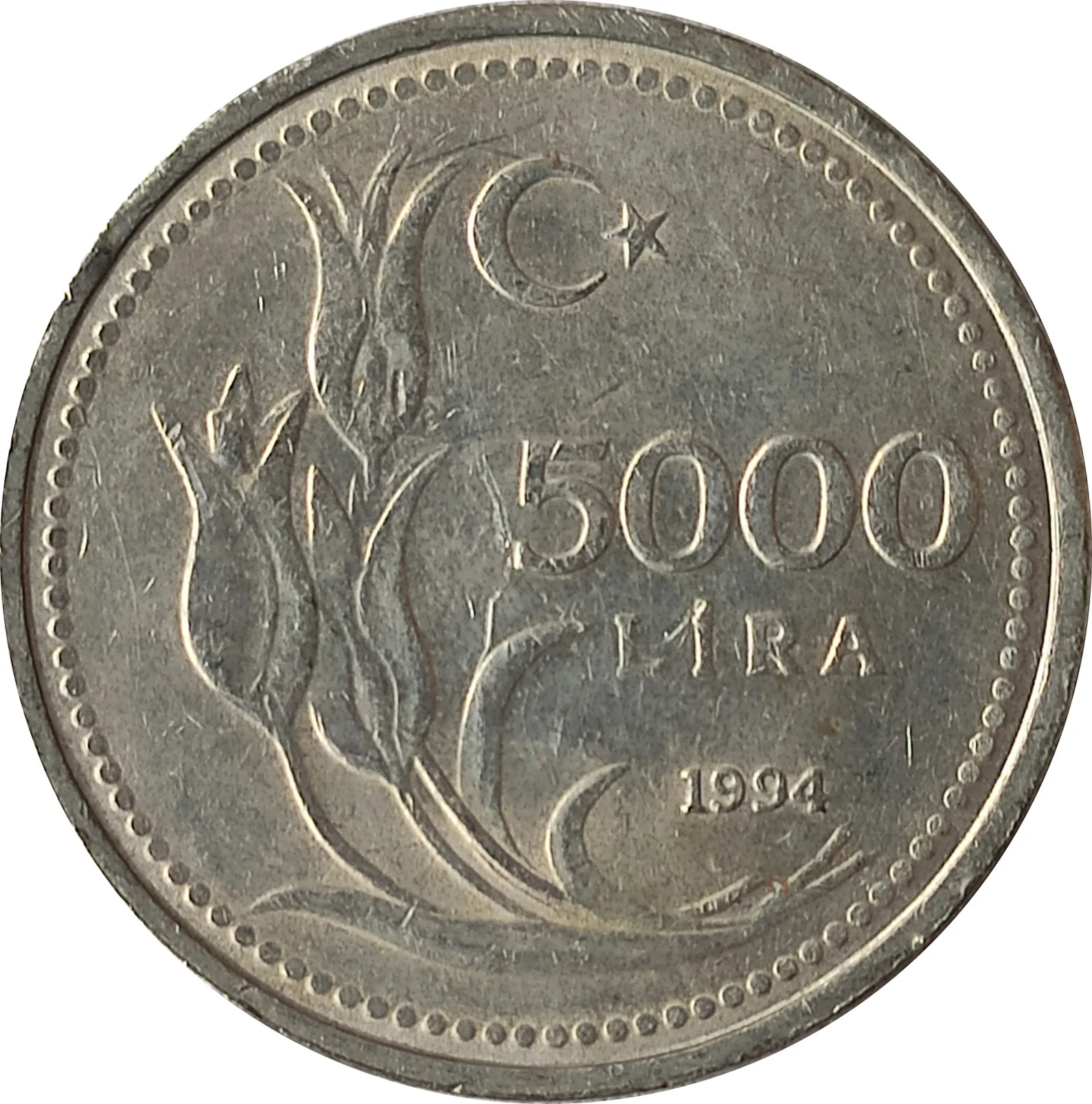
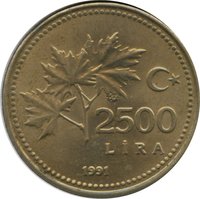
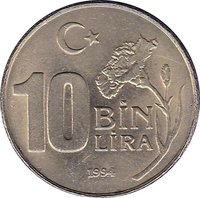
Reverse
Edge
Plain with inscription
Legend:
TÜRKIYE <> CUMHURIYETI <>
Translation:
REPUBLIC OF TURKEY
Language: Turkish
Mintings
| Year | Mint Mark | Mintage | Quality | Collection |
|---|---|---|---|---|
| 1992 | — | 23,560,000 | ||
| 1992 | — | — | Proof | |
| 1993 | — | 13,240,000 | ||
| 1994 | — | 65,792,000 |
Historical background
In 1992, Turkey's currency situation was characterized by chronic high inflation and a deeply unstable Turkish Lira (TL), continuing a pattern that had defined the economy for over a decade. The government, led by Prime Minister Süleyman Demirel, operated under a "managed float" exchange rate regime, but in practice, the Central Bank frequently intervened to control a gradual, pre-announced devaluation against a basket of currencies, primarily the US Dollar. This policy aimed to provide some predictability for trade but failed to address the root causes of inflation, which remained stubbornly high, ending the year at approximately 70%.
The underlying drivers were fundamentally fiscal. Persistent large public sector deficits, driven by heavy subsidies to state-owned enterprises and expansive populist spending, were financed primarily by the Central Bank printing money. This monetization of debt directly fueled inflationary pressures. Furthermore, financial liberalization policies begun in the 1980s had opened the capital account, making the economy vulnerable to speculative flows. Confidence in the lira was extremely low, leading to widespread "dollarization," where both businesses and individuals preferred to hold savings and conduct major transactions in foreign currencies as a hedge against the lira's rapid erosion of purchasing power.
Consequently, 1992 was a year of continued economic strain rather than crisis or major reform. The lira depreciated significantly over the year, losing roughly half of its value against the US dollar. The high-inflation, high-devaluation environment created severe distortions, discouraging long-term investment and punishing fixed-income earners. This period set the stage for the more acute financial volatility that would follow later in the 1990s, as the unsustainable mix of loose fiscal policy, political fragmentation, and a fragile banking system continued unabated.
The underlying drivers were fundamentally fiscal. Persistent large public sector deficits, driven by heavy subsidies to state-owned enterprises and expansive populist spending, were financed primarily by the Central Bank printing money. This monetization of debt directly fueled inflationary pressures. Furthermore, financial liberalization policies begun in the 1980s had opened the capital account, making the economy vulnerable to speculative flows. Confidence in the lira was extremely low, leading to widespread "dollarization," where both businesses and individuals preferred to hold savings and conduct major transactions in foreign currencies as a hedge against the lira's rapid erosion of purchasing power.
Consequently, 1992 was a year of continued economic strain rather than crisis or major reform. The lira depreciated significantly over the year, losing roughly half of its value against the US dollar. The high-inflation, high-devaluation environment created severe distortions, discouraging long-term investment and punishing fixed-income earners. This period set the stage for the more acute financial volatility that would follow later in the 1990s, as the unsustainable mix of loose fiscal policy, political fragmentation, and a fragile banking system continued unabated.
🌱 Very Common