

1 Centavo – Dominican Republic
Dominican Republic
Context
Years: 1968–1975
Issuer: Dominican Republic 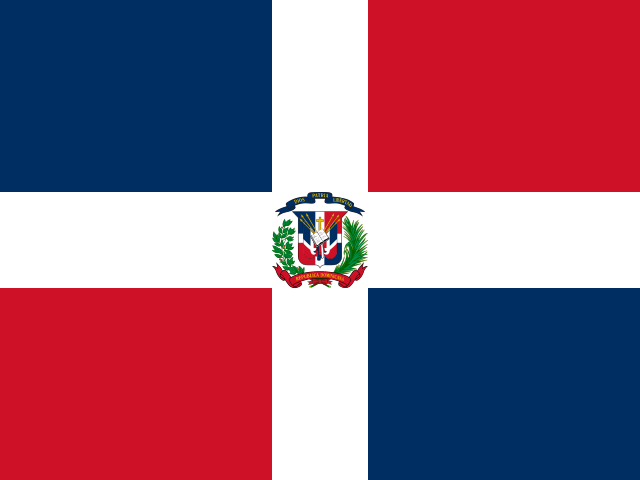
Period:
(since 1966)
Currency:
(since 1937)
Total mintage: 14,500,500
Material
References
KM: #Click to copy to clipboard31
Numista: #8113
Value
Exchange value: 0.01 DOP
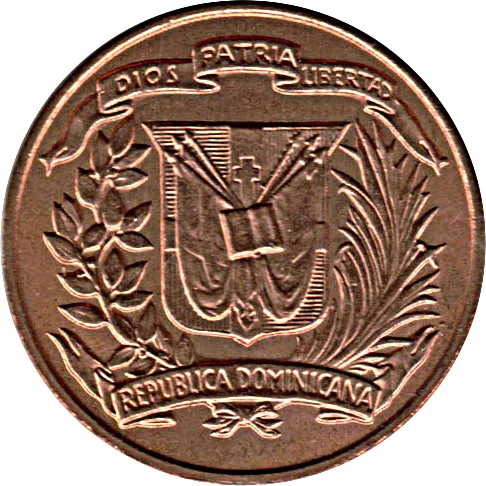
Obverse
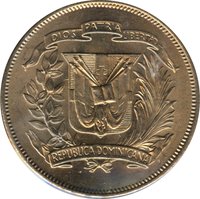
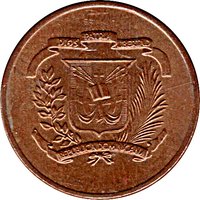
Description:
National emblem
Inscription:
DIOS PATRIA LIBERTAD
REPUBLICA DOMINICANA
REPUBLICA DOMINICANA
Translation:
God, Fatherland, Liberty
Dominican Republic
Dominican Republic
Script: Latin
Language: Spanish
Engraver: Casimiro Nemesio de Moya
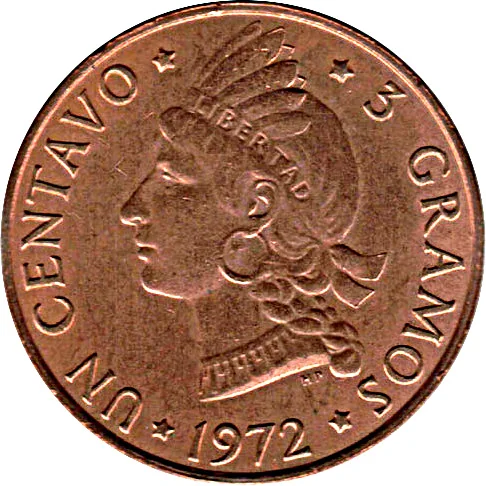
Reverse
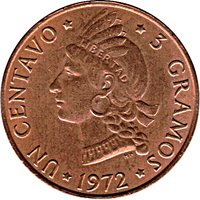
Description:
Indian Liberty
Inscription:
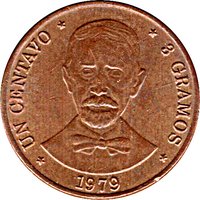
UN CENTAVO
3 GRAMOS
LIBERTAD
HP
1972
3 GRAMOS
LIBERTAD
HP
1972
Translation:
One Cent
3 Grams
Liberty
HP
1972
3 Grams
Liberty
HP
1972
Script: Latin
Language: Spanish
Engraver: Thomas Humphrey Paget
Edge
Plain
Categories
| Symbol> Allegory |
| Symbols> Coat of Arms |
Mints
| Name | Mark |
|---|---|
| Royal Mint (Tower Hill) | — |
Mintings
| Year | Mint Mark | Mintage | Quality | Collection |
|---|---|---|---|---|
| 1968 | — | 5,000,000 | ||
| 1971 | — | 6,000,000 | ||
| 1972 | — | 3,000,000 | ||
| 1972 | — | 500 | Proof | |
| 1975 | — | 500,000 |
Historical background
In 1968, the Dominican Republic's currency situation was characterized by relative stability under the authoritarian rule of President Joaquín Balaguer, who had taken power in 1966 following the 1965 civil war and U.S. intervention. The country operated with the Dominican peso (DOP), which was pegged to the U.S. dollar at a fixed exchange rate of 1 peso = 1 dollar. This peg, a legacy from the Trujillo era, was a cornerstone of government policy aimed at providing monetary stability and attracting foreign investment to rebuild the nation's shattered economy. The Central Bank maintained strict controls over foreign exchange transactions to defend this parity, requiring most conversions to go through official channels.
However, this official stability masked underlying economic pressures. The economy was heavily dependent on sugar exports, whose volatile global prices created balance-of-payment strains. Furthermore, the government's significant spending on infrastructure projects and a growing public sector, while stimulative, fueled inflationary pressures that the fixed exchange rate could not fully suppress. These factors, combined with a limited supply of U.S. dollar reserves, led to the emergence of a small parallel black market for currency, where U.S. dollars traded at a slight premium to the official rate, indicating some market distrust in the peso's long-term viability at the one-to-one parity.
Overall, 1968 represented a period of calibrated control rather than crisis. Balaguer's government prioritized the fixed exchange rate as a symbol of recovery and order, successfully avoiding a devaluation that year. The primary challenges were managing inflation and diversifying an economy still recovering from political turmoil, all while maintaining sufficient reserves to uphold the cherished dollar peg. This stability, however, was administratively enforced and would face increasing tests in the coming decades as economic realities gradually eroded the peso's artificial parity.
However, this official stability masked underlying economic pressures. The economy was heavily dependent on sugar exports, whose volatile global prices created balance-of-payment strains. Furthermore, the government's significant spending on infrastructure projects and a growing public sector, while stimulative, fueled inflationary pressures that the fixed exchange rate could not fully suppress. These factors, combined with a limited supply of U.S. dollar reserves, led to the emergence of a small parallel black market for currency, where U.S. dollars traded at a slight premium to the official rate, indicating some market distrust in the peso's long-term viability at the one-to-one parity.
Overall, 1968 represented a period of calibrated control rather than crisis. Balaguer's government prioritized the fixed exchange rate as a symbol of recovery and order, successfully avoiding a devaluation that year. The primary challenges were managing inflation and diversifying an economy still recovering from political turmoil, all while maintaining sufficient reserves to uphold the cherished dollar peg. This stability, however, was administratively enforced and would face increasing tests in the coming decades as economic realities gradually eroded the peso's artificial parity.
🌱 Common