

1 cent – The Bahamas
Add to wishlist
Bahamas
Context
Year: 1970
Country: Bahamas
Issuer: The Bahamas
Ruler: Elizabeth II
Currency:
(since 1966)
Demonetization: 31 December 2020
Total mintage: 148,296
Material
Diameter: 19.05 mm
Weight: 3.11 g
Thickness: 1.42 mm
Shape: Round
Standard: Gold tenth ounce
Magnetic: No
Technique: Milled
Alignment: Medal alignment
flip
References
KM: #
Numista: #8112
Value
Exchange value: 0.01 BSD
Obverse
Description:
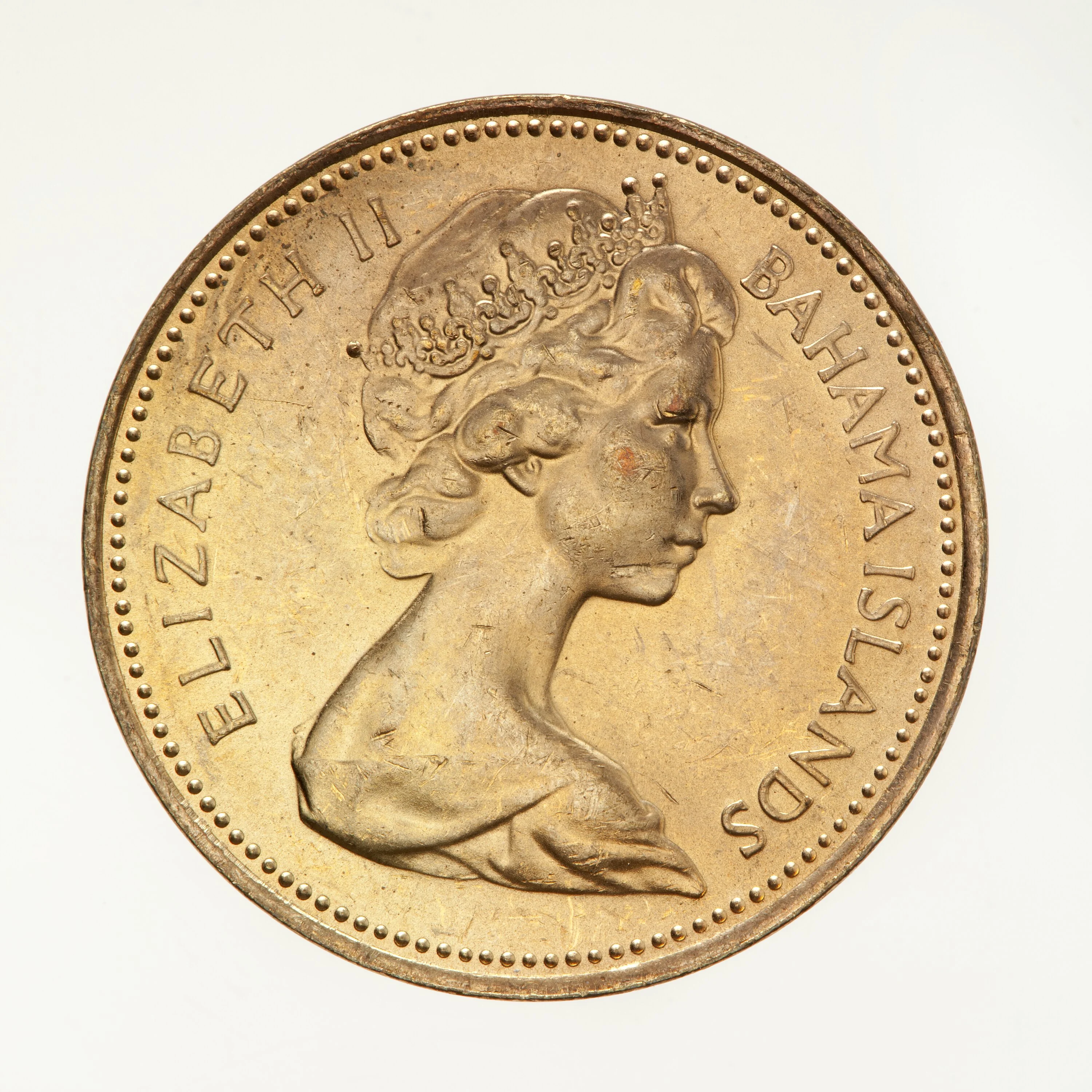
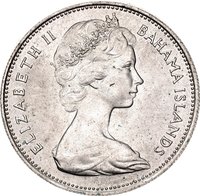
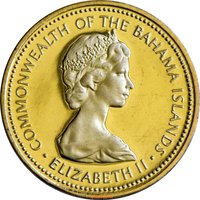
Bust of Queen Elizabeth II in right profile.
Inscription:
ELIZABETH II BAHAMA ISLANDS
Translation:
ELIZABETH II BAHAMA ISLANDS
Script: Latin
Language: English
Engraver: Arnold Machin
Reverse
Description:
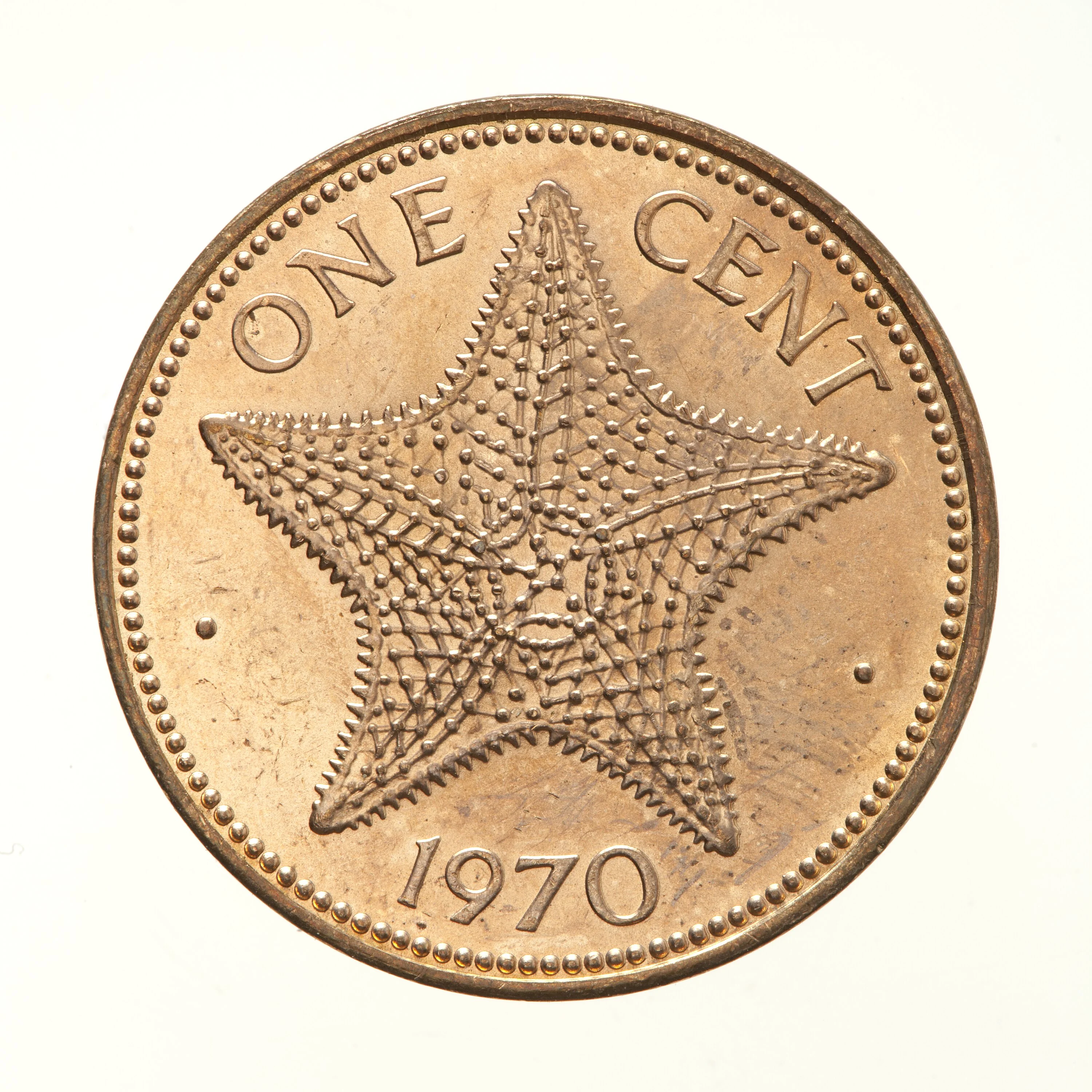
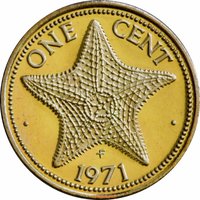
Starfish splitting the top value and bottom date.
Inscription:
ONE CENT
· ·
1970
· ·
1970
Script: Latin
Engraver: Arnold Machin
Edge
Plain
Mints
| Name | Mark |
|---|---|
| Franklin Mint | — |
Mintings
| Year | Mint Mark | Mintage | Quality | Collection |
|---|---|---|---|---|
| 1970 | — | 125,469 | ||
| 1970 | — | 22,827 | Proof |
Historical background
In 1970, The Bahamas was on the cusp of a significant monetary transition, moving away from the long-standing colonial system. At the time, the official currency was the Bahamian pound, which was pegged to and interchangeable with the British pound sterling. This system reflected the nation's status as a British colony, with banknotes issued by a private Canadian bank, the Royal Bank of Canada, under a contractual agreement with the government. However, this arrangement was increasingly seen as anachronistic for a nation that had achieved internal self-government in 1964 and was actively preparing for full independence, which would be realized in 1973.
The push for a distinct national currency was driven by both symbolic and practical economic considerations. Symbolically, a sovereign nation required its own monetary identity, separate from the former colonial power. Economically, the peg to the British pound was becoming less advantageous, especially as the Bahamian economy was increasingly tied to tourism and investment from the United States. The US dollar was already widely circulated and accepted informally throughout the islands, highlighting the practical need for a currency more aligned with the nation's primary economic partner.
Consequently, 1970 served as the pivotal preparatory year for this change. The Bahamian government passed the Central Bank of The Bahamas Act in June, establishing the institution that would assume control over monetary policy and issue a new decimal currency. This set the stage for the official introduction of the Bahamian dollar in 1966, which replaced the Bahamian pound at a rate of 1 dollar = 7 shillings (or 1 pound = $2.80), and was pegged on par with the US dollar, a parity that has been maintained ever since. Thus, the currency situation in 1970 was one of deliberate and strategic planning, marking the final chapter of the colonial monetary system and the foundation of a modern, sovereign financial framework.
The push for a distinct national currency was driven by both symbolic and practical economic considerations. Symbolically, a sovereign nation required its own monetary identity, separate from the former colonial power. Economically, the peg to the British pound was becoming less advantageous, especially as the Bahamian economy was increasingly tied to tourism and investment from the United States. The US dollar was already widely circulated and accepted informally throughout the islands, highlighting the practical need for a currency more aligned with the nation's primary economic partner.
Consequently, 1970 served as the pivotal preparatory year for this change. The Bahamian government passed the Central Bank of The Bahamas Act in June, establishing the institution that would assume control over monetary policy and issue a new decimal currency. This set the stage for the official introduction of the Bahamian dollar in 1966, which replaced the Bahamian pound at a rate of 1 dollar = 7 shillings (or 1 pound = $2.80), and was pegged on par with the US dollar, a parity that has been maintained ever since. Thus, the currency situation in 1970 was one of deliberate and strategic planning, marking the final chapter of the colonial monetary system and the foundation of a modern, sovereign financial framework.
🌱 Fairly Common