

10 forint – Hungary
Add to wishlist
Hungary
Context
Years: 1983–1989
Issuer: Hungary
Period:
(1949—1989)
Currency:
(since 1946)
Demonetization: 31 December 1995
Total mintage: 113,330,000
Material
Diameter: 25.5 mm
Weight: 6.01 g
Thickness: 1.7 mm
Shape: Round
Composition: Aluminium bronze
Magnetic: No
Technique: Milled
Alignment: Medal alignment
flip
References
KM: #
Numista: #811
Value
Exchange value: 10 HUF
Inflation-adjusted value: 508.20 HUF
Obverse
Description:
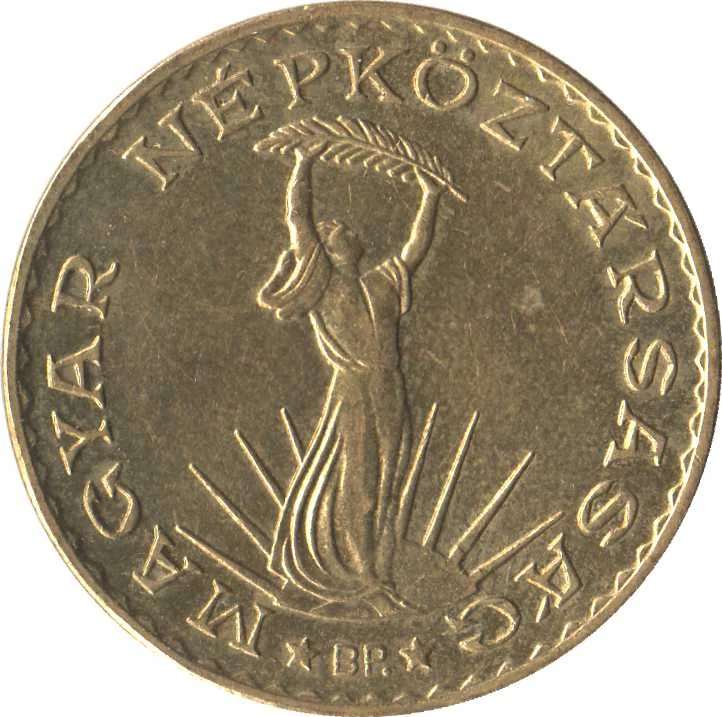
Strobl’s Liberty: a woman facing right, raising a frond with both hands before a radiant sun.
Inscription:
MAGYAR NÉPKÖZTÁRSASÁG
* BP. *
* BP. *
Translation:
HUNGARIAN PEOPLE'S REPUBLIC
* BUDAPEST *
* BUDAPEST *
Script: Latin
Language: Hungarian
Engraver: Dezső Kovács
Reverse
Description:
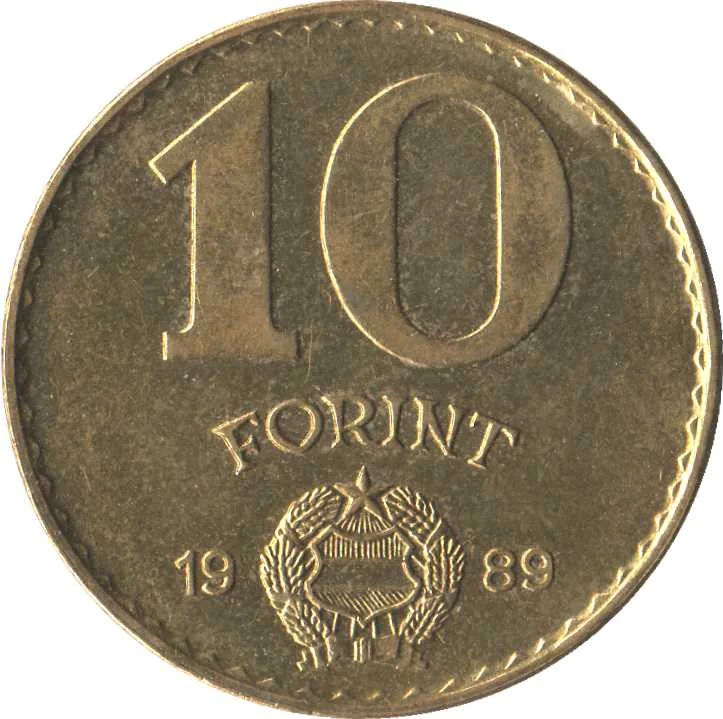
Coat of arms in wreath, splits date, denomination above.
Inscription:
10
FORINT
1989
FORINT
1989
Script: Latin
Engraver: Sándor Boldogfai Farkas
Edge
Smooth. Elegant leaf motif
Mints
| Name | Mark |
|---|---|
| Hungarian mint | BP. |
Mintings
Historical background
In 1983, Hungary's currency situation was characterized by the complexities of operating within the Soviet Bloc's command economy while attempting limited market-oriented reforms. Officially, the Hungarian Forint (HUF) was a non-convertible, centrally managed currency with an exchange rate fixed by the National Bank of Hungary. However, this official rate was largely symbolic for international trade, which was conducted through a system of bilateral clearing agreements, primarily with fellow Comecon countries using the transferable ruble. This insulated the forint from global markets but created significant distortions and inefficiencies.
Domestically, Hungary was notable within the Eastern Bloc for its relative economic liberalization, known as "Goulash Communism." This led to a unique and tolerated "dual economy," where a second, parallel market existed alongside the state sector. While the official forint was used for salaries and most goods, a vibrant black market for hard currencies like the US dollar and Deutsche Mark operated openly. This shadow economy was essential for accessing scarce imported goods and services, effectively creating a multi-tiered currency system that undermined the state's monetary control.
The underlying pressure stemmed from a growing hard currency debt crisis. Since the 1970s, Hungary had borrowed extensively from Western creditors to finance imports and maintain living standards, accumulating one of the highest per capita foreign debts in Eastern Europe. By 1983, servicing this debt consumed a massive portion of export earnings, leading to persistent trade deficits and inflationary pressures. The government was forced to implement austerity measures, but the fundamental contradiction between a rigid currency system and the need for Western capital and goods created a slow-burning economic crisis that would intensify later in the decade.
Domestically, Hungary was notable within the Eastern Bloc for its relative economic liberalization, known as "Goulash Communism." This led to a unique and tolerated "dual economy," where a second, parallel market existed alongside the state sector. While the official forint was used for salaries and most goods, a vibrant black market for hard currencies like the US dollar and Deutsche Mark operated openly. This shadow economy was essential for accessing scarce imported goods and services, effectively creating a multi-tiered currency system that undermined the state's monetary control.
The underlying pressure stemmed from a growing hard currency debt crisis. Since the 1970s, Hungary had borrowed extensively from Western creditors to finance imports and maintain living standards, accumulating one of the highest per capita foreign debts in Eastern Europe. By 1983, servicing this debt consumed a massive portion of export earnings, leading to persistent trade deficits and inflationary pressures. The government was forced to implement austerity measures, but the fundamental contradiction between a rigid currency system and the need for Western capital and goods created a slow-burning economic crisis that would intensify later in the decade.
🌱 Very Common