

10 baisa – Oman
Add to wishlist
Circulating commemorative coins
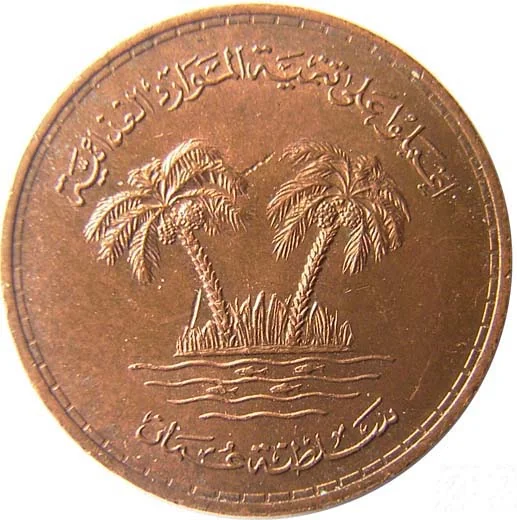
Commemoration: F.A.O.
Oman
Context
Year: 1975
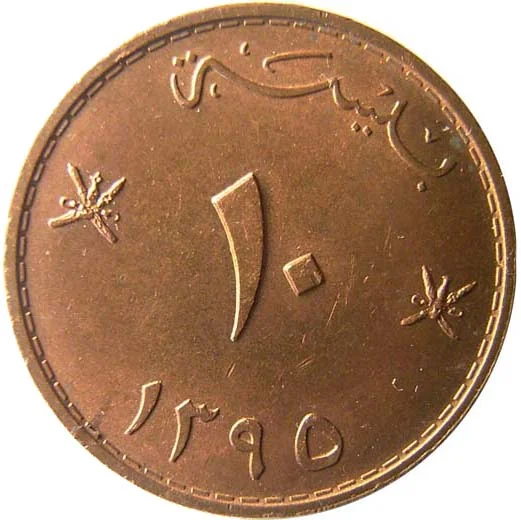
Islamic (Hijri) Year:: 1395
Issuer: Oman
Ruler: Qaboos bin Said
Currency:
(since 1972)
Total mintage: 1,000,000
Material
References
KM: #
Numista: #8088
Value
Exchange value: 0.01 OMR
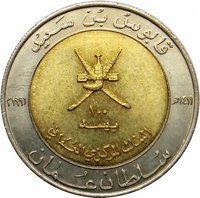
Obverse
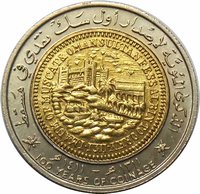
Reverse
Edge
Plain
Categories
| Organization> FAO |
| Plant> Tree |
| Symbols> Coat of Arms |
| Object> Cold weapons |
Mints
| Name | Mark |
|---|---|
| Royal Mint | — |
Mintings
| Year | Mint Mark | Mintage | Quality | Collection |
|---|---|---|---|---|
| 1975 | — | 1,000,000 |
Historical background
In 1975, Oman's currency situation was fundamentally defined by its use of the Gulf Rupee (XPGR), a currency issued by the Government of India and the Reserve Bank of India. This was a legacy of Oman's deep historical trade links with the Indian subcontinent and British political influence in the region. The Gulf Rupee was not a sovereign Omani currency but an external variant of the Indian Rupee, created specifically for circulation in the Persian Gulf states to prevent strain on India's foreign exchange reserves. Its use underscored Oman's economic dependence and its position within a broader regional monetary system controlled from outside.
However, this arrangement was becoming increasingly untenable. The 1970 accession of Sultan Qaboos bin Said had initiated a period of rapid modernization and national assertion, fueled by growing oil revenues. Using another nation's currency was seen as incompatible with Oman's newfound political sovereignty and economic ambitions. Furthermore, the devaluation of the Indian Rupee in 1966 had already caused instability in the Gulf, leading neighboring states like Kuwait, Bahrain, Qatar, and the UAE to introduce their own independent currencies. Oman was the last remaining user of the Gulf Rupee, creating pressure to align with regional trends and secure its monetary independence.
Consequently, 1975 was a year of decisive transition. The Omani government prepared to replace the Gulf Rupee with a new, fully sovereign currency. This culminated in the introduction of the Omani Rial (OMR) in early 1976, which was pegged to the US Dollar at a rate of 1 OMR = 2.895 USD, a highly valued parity reflecting the country's oil wealth. Therefore, the currency situation in 1975 was one of the final chapters of a colonial-era monetary system, with the nation on the cusp of launching its own currency as a cornerstone of a modern, independent state.
However, this arrangement was becoming increasingly untenable. The 1970 accession of Sultan Qaboos bin Said had initiated a period of rapid modernization and national assertion, fueled by growing oil revenues. Using another nation's currency was seen as incompatible with Oman's newfound political sovereignty and economic ambitions. Furthermore, the devaluation of the Indian Rupee in 1966 had already caused instability in the Gulf, leading neighboring states like Kuwait, Bahrain, Qatar, and the UAE to introduce their own independent currencies. Oman was the last remaining user of the Gulf Rupee, creating pressure to align with regional trends and secure its monetary independence.
Consequently, 1975 was a year of decisive transition. The Omani government prepared to replace the Gulf Rupee with a new, fully sovereign currency. This culminated in the introduction of the Omani Rial (OMR) in early 1976, which was pegged to the US Dollar at a rate of 1 OMR = 2.895 USD, a highly valued parity reflecting the country's oil wealth. Therefore, the currency situation in 1975 was one of the final chapters of a colonial-era monetary system, with the nation on the cusp of launching its own currency as a cornerstone of a modern, independent state.
🌱 Common