

1 Baht – Thailand
Circulating commemorative coins
Commemoration: Graduation ceremony for Prince Vajiralongkorn (September 15)
Thailand
Context
Year: 1978
Thai Year: 2521
Issuer: Thailand 
Ruler: Bhumibol Adulyadej
Currency:
(since 1897)
Demonetized: Yes
Total mintage: 5,000,000
Material
Diameter: 25 mm
Weight: 7 g
Thickness: 1.5 mm
Shape: Round
Composition: Copper-nickel
Technique: Milled
Alignment: Medal alignment
flip
References
Y: #Click to copy to clipboard127
Numista: #8085
Value
Exchange value: 1 THB = $0.03
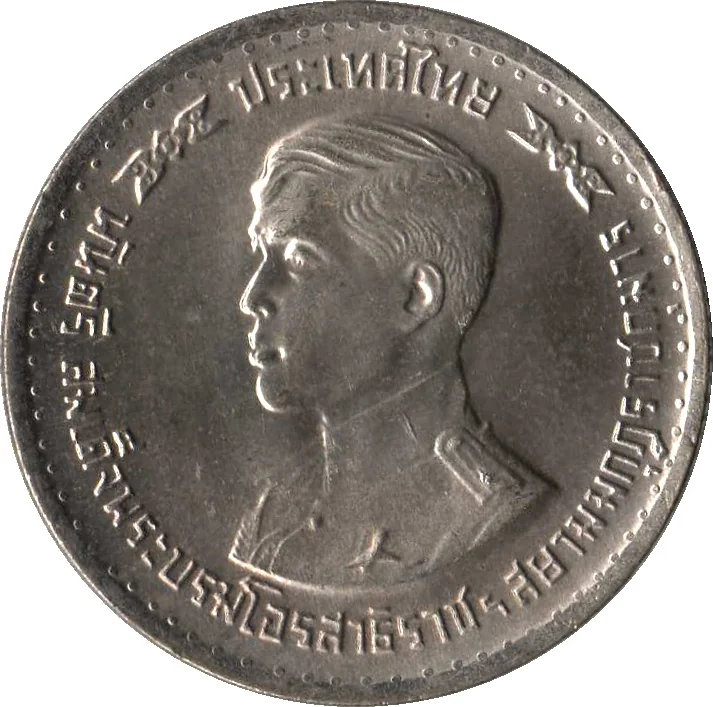
Obverse
Description:
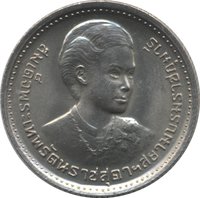
Prince Vajiralongkorn, left profile.
Inscription:
ประเทศไทย
พันตรี สมเด็จพระบรมโอรสาธิราชฯ สยามมกุฏราชกุมาร
พันตรี สมเด็จพระบรมโอรสาธิราชฯ สยามมกุฏราชกุมาร
Translation:
Thailand
Major General, His Royal Highness the Crown Prince, the Siam Rajakumara
Major General, His Royal Highness the Crown Prince, the Siam Rajakumara
Language: Thai
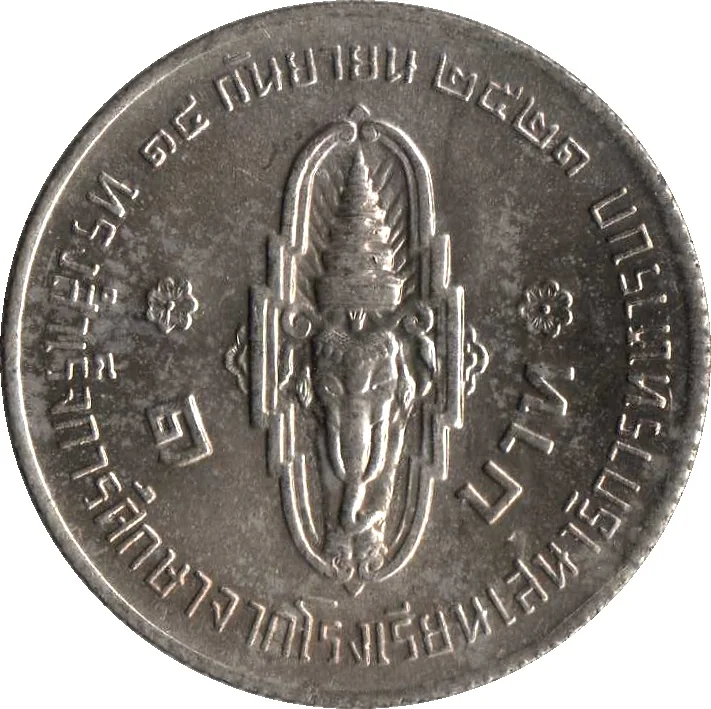
Reverse
Description:
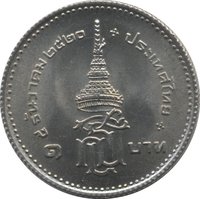
Elephant’s oval crown.
Inscription:
๑๔ กันยายน ๒๕๒๑
๑ บาท
ทรงสำเร็จการศึกษาจากโรงเรียนเสนาธิการทหารบก
๑ บาท
ทรงสำเร็จการศึกษาจากโรงเรียนเสนาธิการทหารบก
Translation:
14 September 1978
1 Baht
Graduated from the Army War College.
1 Baht
Graduated from the Army War College.
Language: Thai
Edge
Reeded
Mintings
| Year | Mint Mark | Mintage | Quality | Collection |
|---|---|---|---|---|
| 1978 | — | 5,000,000 |
Historical background
In 1978, Thailand's currency situation was characterized by relative stability under a fixed exchange rate regime, managed by the Bank of Thailand. The Thai baht was pegged to a basket of currencies, heavily weighted toward the U.S. dollar, which provided a predictable environment for trade and investment during a period of significant economic transition. This stability was a cornerstone of the government's strategy to promote export-oriented industrialization, a shift from the previous agricultural focus, and it supported the country's integration into the global economy.
This period followed the major devaluation of the baht in 1975, when it was adjusted from approximately 20 baht to 20.50 baht per U.S. dollar. By 1978, the rate had settled around 20.25 baht per dollar, reflecting a managed adjustment. The fixed peg helped control inflation and provided certainty for foreign businesses, which was crucial as Thailand began to attract manufacturing investment, particularly from Japan. However, maintaining the peg required consistent foreign exchange reserves and careful monetary policy to manage the balance of payments.
The stability of 1978, however, existed against a backdrop of regional volatility and internal pressures. The collapse of the Bretton Woods system earlier in the decade and the second oil shock of 1979 would soon test the sustainability of the fixed rate. Furthermore, Thailand's growing current account deficits, driven by imports of capital goods for industrialization, hinted at future pressures that would eventually lead to a series of gradual devaluations in the early 1980s, setting the stage for the more dramatic financial challenges decades later.
This period followed the major devaluation of the baht in 1975, when it was adjusted from approximately 20 baht to 20.50 baht per U.S. dollar. By 1978, the rate had settled around 20.25 baht per dollar, reflecting a managed adjustment. The fixed peg helped control inflation and provided certainty for foreign businesses, which was crucial as Thailand began to attract manufacturing investment, particularly from Japan. However, maintaining the peg required consistent foreign exchange reserves and careful monetary policy to manage the balance of payments.
The stability of 1978, however, existed against a backdrop of regional volatility and internal pressures. The collapse of the Bretton Woods system earlier in the decade and the second oil shock of 1979 would soon test the sustainability of the fixed rate. Furthermore, Thailand's growing current account deficits, driven by imports of capital goods for industrialization, hinted at future pressures that would eventually lead to a series of gradual devaluations in the early 1980s, setting the stage for the more dramatic financial challenges decades later.
🌱 Common