

200 Lei (St. Joseph’s Roman Catholic Cathedral in Bucharest) – Romania
Non-circulating coins
Commemoration: 140 years since the laying of the cornerstone of St. Joseph’s Roman Catholic Cathedral in Bucharest
Romania
Context

Material
Diameter: 27 mm
Weight: 15.55 g
Gold weight: 15.53 g
Shape: Round
Composition: 99.9% Gold
Standard: Silver half ounce
Magnetic: No
Technique: Milled
References
KM: #Click to copy to clipboard409
Numista: #80786
Value
Exchange value: 200 RON = $46.38
Bullion value: $2590.71
Inflation-adjusted value: 306.66 RON
Obverse
Description:
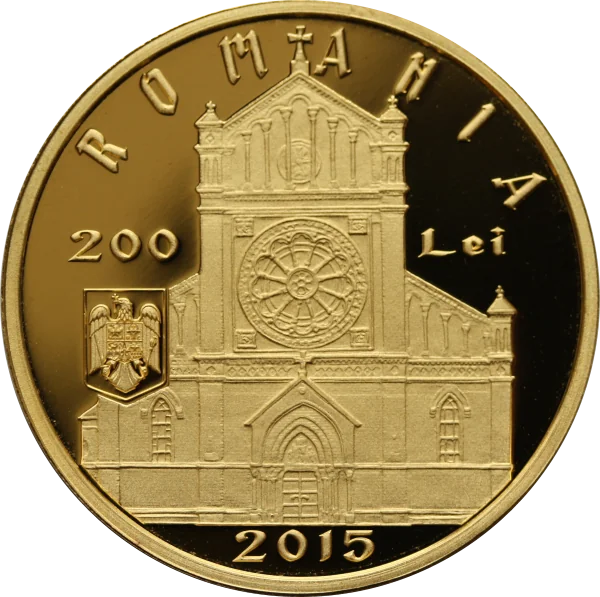
St. Joseph's Cathedral in Bucharest, "ROMANIA", 200 Lei, Romania's coat of arms, and the year 2015.
Inscription:
ROMANIA
200 Lei
2015
200 Lei
2015
Reverse
Description:
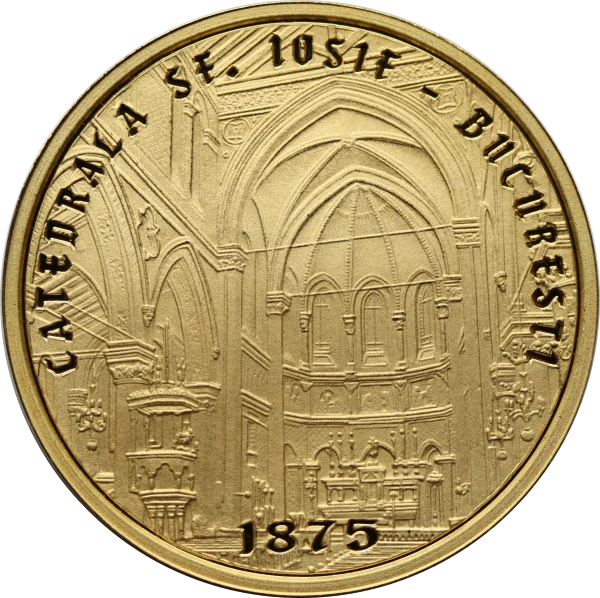
Inside Bucharest's St. Joseph’s Cathedral, an arched inscription reads “CATEDRALA SF. IOSIF - BUCURESTI” with the cornerstone year “1875”.
Inscription:
CATEDRALA SF. IOSIF - BUCURESTI
1875
1875
Edge
Plain
Mintings
| Year | Mint Mark | Mintage | Quality | Collection |
|---|---|---|---|---|
| 2015 | — | 150 | Proof |
Historical background
In 2015, Romania's currency situation was characterized by a period of relative stability and cautious optimism for the Romanian Leu (RON), following a period of significant volatility. The National Bank of Romania (NBR) maintained a managed float regime, actively intervening in the foreign exchange market to smooth out excessive fluctuations without targeting a specific exchange rate. This approach was largely successful, with the EUR/RON exchange rate remaining within a relatively narrow band, typically between 4.4 and 4.5 lei per euro for much of the year. This stability was underpinned by strong macroeconomic fundamentals, including robust GDP growth (one of the highest in the EU), falling inflation, and a narrowing current account deficit.
Key factors supporting the leu included a series of proactive interest rate cuts by the NBR, which aimed to stimulate lending and economic growth while keeping inflation in check. Furthermore, Romania's successful conclusion of a precautionary standby agreement with the International Monetary Fund (IMF) in September 2015 bolstered investor confidence. This agreement, though not requiring immediate drawdown of funds, served as a policy anchor and a safety net, reassuring markets of the country's fiscal discipline and economic management. Inflows of European Union funds also provided structural support for the currency.
However, the stability was not without underlying pressures and vulnerabilities. Political instability, including a high-profile corruption scandal and a nightclub fire that led to mass protests and a government resignation, periodically rattled investor sentiment. Externally, the lingering effects of the Eurozone debt crisis and uncertainty surrounding global monetary policy, particularly the U.S. Federal Reserve's moves, created a cautious environment. Consequently, while the leu ended 2015 stronger than it began against the euro, the NBR remained vigilant, ready to use its reserves to counteract any speculative attacks or sudden capital outflows, ensuring the currency's resilience in a fragile global context.
Key factors supporting the leu included a series of proactive interest rate cuts by the NBR, which aimed to stimulate lending and economic growth while keeping inflation in check. Furthermore, Romania's successful conclusion of a precautionary standby agreement with the International Monetary Fund (IMF) in September 2015 bolstered investor confidence. This agreement, though not requiring immediate drawdown of funds, served as a policy anchor and a safety net, reassuring markets of the country's fiscal discipline and economic management. Inflows of European Union funds also provided structural support for the currency.
However, the stability was not without underlying pressures and vulnerabilities. Political instability, including a high-profile corruption scandal and a nightclub fire that led to mass protests and a government resignation, periodically rattled investor sentiment. Externally, the lingering effects of the Eurozone debt crisis and uncertainty surrounding global monetary policy, particularly the U.S. Federal Reserve's moves, created a cautious environment. Consequently, while the leu ended 2015 stronger than it began against the euro, the NBR remained vigilant, ready to use its reserves to counteract any speculative attacks or sudden capital outflows, ensuring the currency's resilience in a fragile global context.

✨ Legendary