

Obverse
Description:
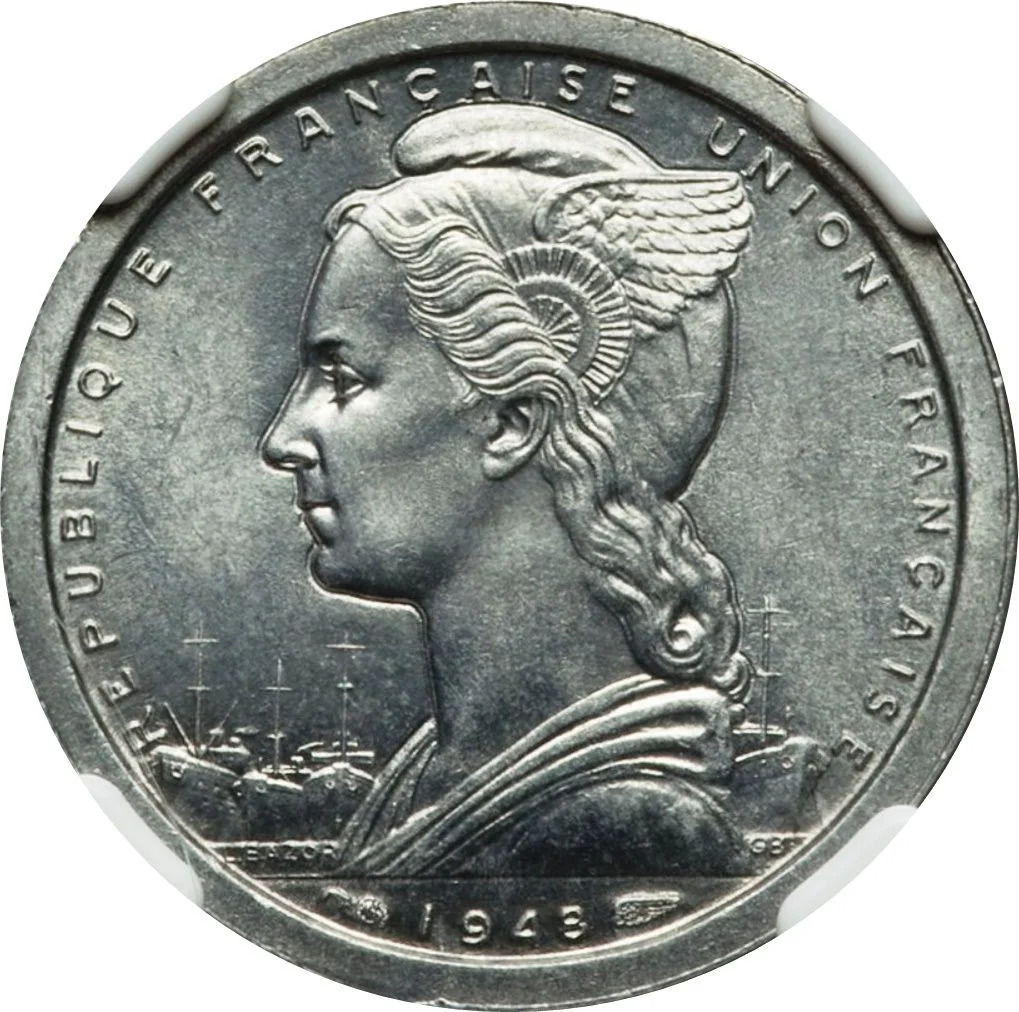
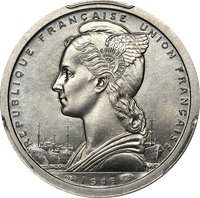
Marianne facing left in a Phrygian cap, with four ships behind her and the date beneath.
Inscription:
RÉPUBLIQUE FRANÇAISE UNION FRANÇAISE
L.BAZOR GB
1948
L.BAZOR GB
1948
Translation:
FRENCH REPUBLIC FRENCH UNION
L.BAZOR GB
1948
L.BAZOR GB
1948
Script: Latin
Language: French
Engraver: Lucien Georges Bazor
Reverse
Description:
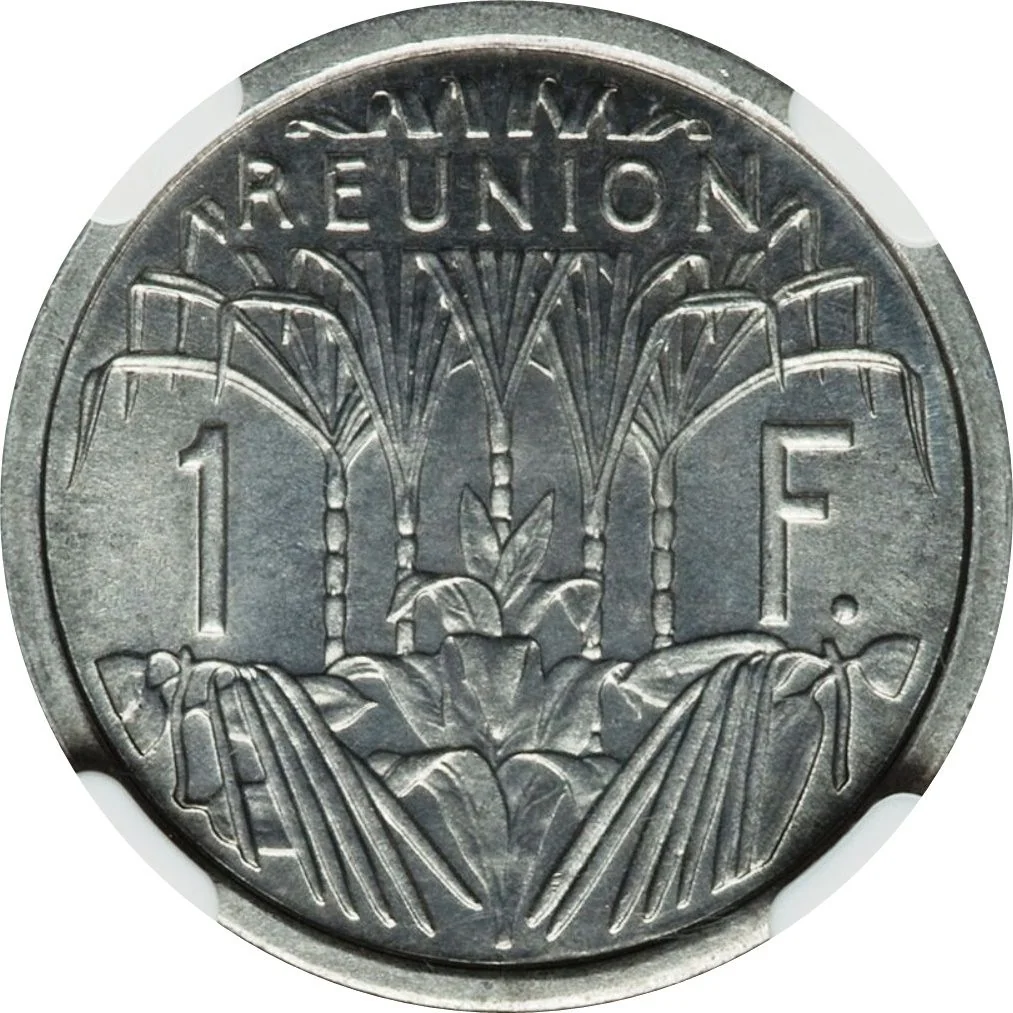
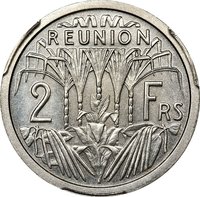
Sugar cane shares value.
Inscription:
RÉUNION
1 F.
1 F.
Translation:
REUNION
1 FRANC
1 FRANC
Script: Latin
Language: French
Engraver: Lucien Georges Bazor
Edge
Plain
Categories
| Agriculture |
| Symbol> Allegory |
| Symbol> Phrygian cap |
| Transportation> Watercraft |
Mints
| Name | Mark |
|---|---|
| Monnaie de Paris | — |
Mintings
| Year | Mint Mark | Mintage | Quality | Collection |
|---|---|---|---|---|
| 1948 | — | 500 |
Historical background
In 1948, the currency situation in both Réunion and French Equatorial Africa (AEF) was defined by their integration into the Franc Zone, but their economic contexts and specific currencies differed significantly. As an overseas department of France, Réunion used the French franc directly, specifically the CFA franc (Colonies Françaises d'Afrique), which was pegged at a fixed rate to the metropolitan French franc. This arrangement ensured monetary stability and facilitated trade with the metropole, but it also tied the island's economy tightly to France's post-war reconstruction efforts and inflationary pressures, with limited autonomy to address local economic conditions.
In contrast, French Equatorial Africa (comprising Chad, Ubangi-Shari, French Congo, and Gabon) used a distinct, separate currency also called the CFA franc (Franc des Colonies Françaises d'Afrique). Created in 1945, this CFA franc was initially introduced to protect the colonies from the devaluation of the metropolitan franc and to better manage resources. By 1948, it was issued by a local central bank, the Caisse Centrale de la France d'Outre-Mer, and was pegged not to the French franc but directly to the French Treasury at a fixed rate of 1 CFA franc = 1.7 metropolitan francs. This provided monetary stability for the AEF federation and guaranteed convertibility, but it was fundamentally an instrument of colonial economic policy, structuring trade to favor France.
The year 1948 was a point of relative stability within a period of transition. Both currencies were part of France's strategy to rebuild its empire's economic cohesion after World War II. However, the systems underscored a colonial hierarchy: Réunion's use of the metropolitan-linked currency reflected its political assimilation, while AEF's separate CFA franc reflected its status as a resource-extractive colonial federation. In both cases, monetary policy was directed from Paris, focusing on stabilizing prices and facilitating the flow of goods and capital to support France's recovery, often at the expense of localized economic development in the territories themselves.
In contrast, French Equatorial Africa (comprising Chad, Ubangi-Shari, French Congo, and Gabon) used a distinct, separate currency also called the CFA franc (Franc des Colonies Françaises d'Afrique). Created in 1945, this CFA franc was initially introduced to protect the colonies from the devaluation of the metropolitan franc and to better manage resources. By 1948, it was issued by a local central bank, the Caisse Centrale de la France d'Outre-Mer, and was pegged not to the French franc but directly to the French Treasury at a fixed rate of 1 CFA franc = 1.7 metropolitan francs. This provided monetary stability for the AEF federation and guaranteed convertibility, but it was fundamentally an instrument of colonial economic policy, structuring trade to favor France.
The year 1948 was a point of relative stability within a period of transition. Both currencies were part of France's strategy to rebuild its empire's economic cohesion after World War II. However, the systems underscored a colonial hierarchy: Réunion's use of the metropolitan-linked currency reflected its political assimilation, while AEF's separate CFA franc reflected its status as a resource-extractive colonial federation. In both cases, monetary policy was directed from Paris, focusing on stabilizing prices and facilitating the flow of goods and capital to support France's recovery, often at the expense of localized economic development in the territories themselves.
⭐ Somewhat Rare