Logo Title
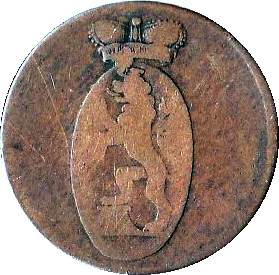
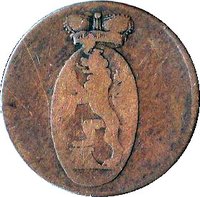
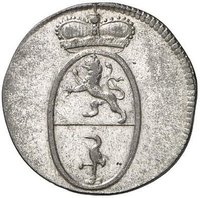
obverse
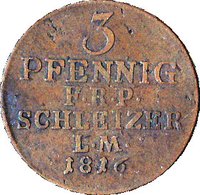
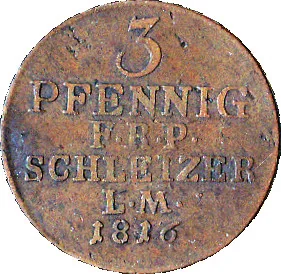
reverse

3 Pfennigs – Principality of Reuss-Schleiz and Gera

Germany
Context
Years: 1815–1816
Country: Germany Country flag
Ruler: Henry XLII
Currency:
(1806—1868)
Demonetized: Yes
Total mintage: 76,000
Material
Diameter: 23.5 mm
Weight: 4.6 g
Shape: Round
Composition: Copper
Magnetic: No
Technique: Milled
Alignment: Medal alignment
Obverse
OBVERSE ↑
flip
Reverse
REVERSE ↑
References
KM: #Click to copy to clipboard50
Numista: #80361

Obverse

Description:
Crowned oval shield.

Reverse

Description:
Dated six-line inscription with denomination.
Inscription:
3

PFENNIG

F.R.P.

SCHLEIZER

L.M.

1815
Script: Latin

Edge
Mints

NameMark
Saalfeld

Mintings

YearMint MarkMintageQualityCollection
181576,000
1816

Historical background

Following the Congress of Vienna in 1815, the Principality of Reuss-Schleiz and Gera (a junior line of the Reuss family) found itself within the newly formed German Confederation, but its monetary landscape remained fragmented and complex. The principality did not possess a dominant, unified coinage of its own. Instead, its economy operated on a practical mixture of currencies, primarily influenced by its geographic and political ties within Thuringia and the wider Confederation. The most significant circulating coins were those of the neighboring Kingdom of Saxony, whose Thaler and Groschen were widely accepted and formed a de facto standard for larger transactions.

This monetary plurality was further complicated by the lingering influence of earlier regimes and trade routes. Older coins from the Holy Roman Empire, particularly the Konventionsthaler standard that had been prevalent before the Napoleonic Wars, still held value and circulated alongside the Saxon issues. Furthermore, due to the intricate web of small states in the region, coins from other Thuringian principalities and even Prussian currency could be found in circulation, leading to a constant need for exchange and valuation based on precious metal content.

Consequently, the post-1815 period in Reuss-Schleiz-Gera was characterized by a lack of sovereign monetary authority and the challenges of a multi-currency system. This situation was typical of the smaller German states before the drive for standardization that would later lead to the Zollverein customs union and, ultimately, the Imperial German mark. For local merchants and citizens, daily commerce required familiarity with various coin types, their weights, and their fluctuating exchange rates, making the currency situation a practical reflection of the principality's embedded position within a politically fragmented Germany.
💎 Extremely Rare